


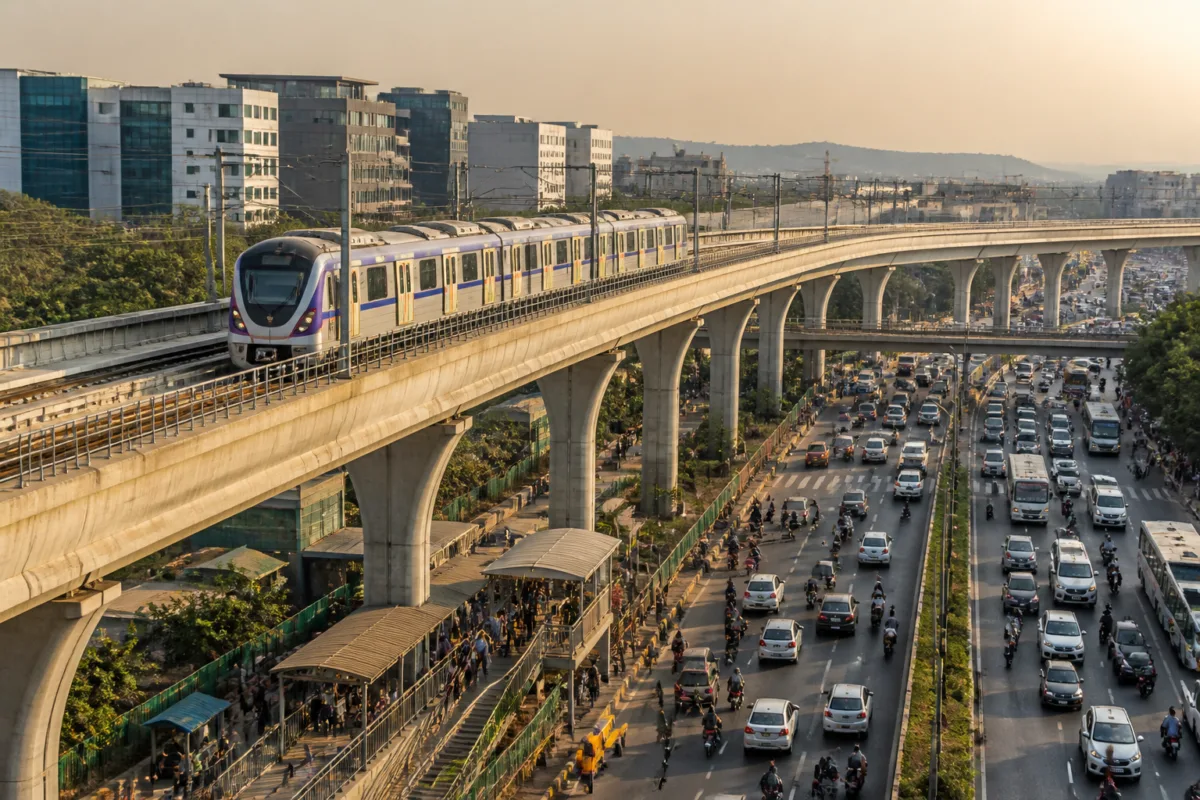
Pune Metro Line 3 connecting Hinjewadi with Shivajinagar has been inaugurated, with Maharashtra Chief Minister Devendra Fadnavis saying the 23-km corridor will reduce commuting delays for thousands of IT professionals and other road users travelling through western Pune.
The corridor connects Maan with the District Court station and has 23 stations. Fadnavis said the new service addresses a long-standing need for better public transport connectivity to Hinjewadi, one of Pune’s largest employment centres. The area has faced persistent traffic congestion, with daily road journeys frequently affected by delays.
Speaking to reporters after the inauguration, Fadnavis said the metro would reduce the commuting burden and make daily travel more convenient. The report did not provide details of fares, service frequency or the exact number of daily passengers expected to use the line.
The corridor, also known as the Pink Line, is among the first metro projects approved under the Centre’s 2017 public-private partnership policy through the Design, Build, Finance, Operate and Transfer model. The project was awarded to a joint venture between Tata Realty and Siemens.
Fadnavis said the project faced several implementation challenges but that these had been addressed before the line became operational. The route’s importance is linked to the concentration of technology companies and employment in Hinjewadi, where road-based commuting has placed sustained pressure on the existing transport network.
A major feature highlighted by the Chief Minister was the participation of women in the corridor’s construction and operations. He said nearly 100 women had been trained as train operators and that women made up around half of the overall workforce. Women engineers, he added, had also held important responsibilities during construction.
Fadnavis described the workforce model as an effort to expand women’s participation in technical and operational positions rather than limiting their roles to administrative work. The report did not specify the total workforce strength, the number of women engineers involved or the operating agencies responsible for different functions on the corridor.
The inauguration also formed part of a wider infrastructure discussion for the Pune Metropolitan Region. Fadnavis referred to the proposed outer and inner ring roads, the High Capacity Mass Transit Route and tunnels planned as part of a broader development programme covering Pune, Pimpri-Chinchwad and surrounding areas.
He said the government was working towards coordinated development across the metropolitan region and that ₹5,000 crore would be made available through the Centre for the PMR Growth Centre. According to the Chief Minister, the funding would support the next phase of development work across the region. Further details on the allocation schedule and specific projects to be financed were not provided in the report.

