


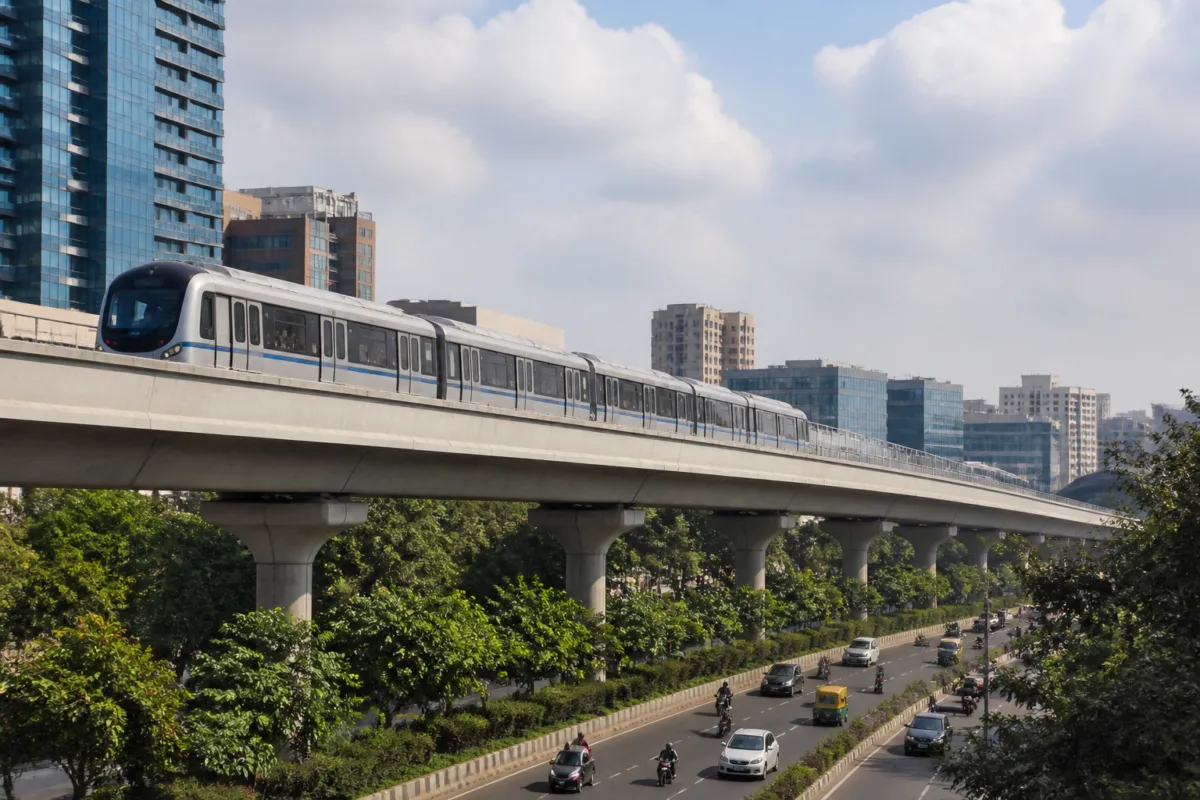
Pune Metro Line 3, connecting Maan-Hinjawadi with Shivajinagar, was virtually inaugurated by Prime Minister Narendra Modi on Tuesday, while foundation stones were laid for four additional corridors under Pune Metro Phase II. The expansion is set to extend public transport access across Pune, Pimpri-Chinchwad and the Pune Metropolitan Region, with the Hinjawadi corridor aimed at easing daily travel to the city’s major information technology hub.
The 23.203-km elevated corridor has 23 stations and was developed at a cost of Rs 8,313 crore under the public-private partnership model. Tata Projects and Siemens executed the project under the Design-Build-Operate-Transfer framework. The corridor directly links Maan-Hinjawadi to Shivajinagar and is expected to provide faster and more convenient travel for IT professionals and other commuters who currently face long road journeys.
Addressing the inauguration ceremony, Modi said the corridor would improve connectivity between Pune’s established areas and newer employment centres. He said the expansion of metro services would give fresh momentum to the city’s development. The Prime Minister also highlighted the growth of India’s metro network, which he said had increased from 248 km in 2014 to approximately 1,200 km, with metro services now available in 26 cities. More than one crore passengers travel by metro every day, he said.
In Maharashtra, the operational metro network has grown from approximately 10-11 km in 2014 to around 200 km, while work on more than 680 km of additional routes is underway. Modi said investments exceeding Rs 2.5 lakh crore had been made in metro infrastructure across the state. He also underlined the role of public-private partnerships in building urban transport systems and said modern public transport could reduce commuting time, improve productivity and support economic growth.
Chief Minister Devendra Fadnavis said Pune, Pimpri-Chinchwad and the PMR would develop into a major mobility hub by 2030. He listed metro corridors, electric buses, inner and outer ring roads, tunnels and a new airport among the infrastructure projects being developed to improve regional connectivity.
Fadnavis said thousands of employees travelling to Hinjawadi spend one to two hours in traffic congestion every day. He described Metro Line 3 as a response to the daily mobility problems faced by the information technology workforce and recalled that Modi had laid the foundation stone for the project in 2018.
Deputy Chief Minister Eknath Shinde said the corridor would help make daily commuting faster, safer and more comfortable. He also said more than 90 lakh passengers had travelled by Pune Metro so far. Union Minister of State Murlidhar Mohol said the 23-km corridor would expand Pune Metro’s network to approximately 55 km and benefit IT professionals and other commuters. He said Pune Metro recorded 9,58,603 passenger journeys in September.
The project has also been presented as a significant women-led urban transport initiative. Deputy Chief Minister Sunetra Pawar said Metro Line 3 would become India’s first 100 per cent women-operated metro corridor. Around 100 women train pilots are expected to be involved in operations, while women will account for 50 per cent of the workforce at metro stations. The project has been described as a “Pink Powered” metro because of the participation of women in its construction and operations.
The ceremony also marked the foundation-stone laying for four new corridors under Phase II. The corridors named at the event were Khadakwasla-Kharadi, Vanaz-Chandani Chowk, Ramwadi-Wagholi and Manikbaug-Nal Stop. Together, they are expected to cover approximately 46 km and improve links across the eastern, western and southern parts of Pune.
Separately, Sunetra Pawar said four Phase II corridors spanning 31 km with 28 stations had received Union Cabinet approval at an estimated cost of Rs 9,858 crore. The planned connections include Chandani Chowk, Kothrud, Bavdhan, Viman Nagar, Kharadi and Wagholi. Once the proposed projects are completed, Pune Metro’s network is expected to extend beyond 100 km.
The state has also approved road development works worth Rs 426 crore to improve access to metro stations in Hinjawadi, Maan and Marunji. These road links are intended to support access to the new corridor and connect surrounding neighbourhoods and employment areas to the metro system.
The four corridors and Line 3 form part of a wider effort to create a more integrated mobility network for Pune and its expanding metropolitan region. The inauguration programme was attended by Governor Jishnu Dev Varma, Union Minister Manohar Lal, Deputy Chief Ministers Eknath Shinde and Sunetra Pawar, Union Minister of State Murlidhar Mohol, state ministers, the mayors of Pune and Pimpri-Chinchwad, and other public representatives.
PMRDA Commissioner Dr Abhijeet Chaudhary delivered the introductory address and briefed the gathering about the project. The next phase of the expansion will involve implementation of the approved corridors, station access works and associated transport infrastructure across the Pune metropolitan region.

