


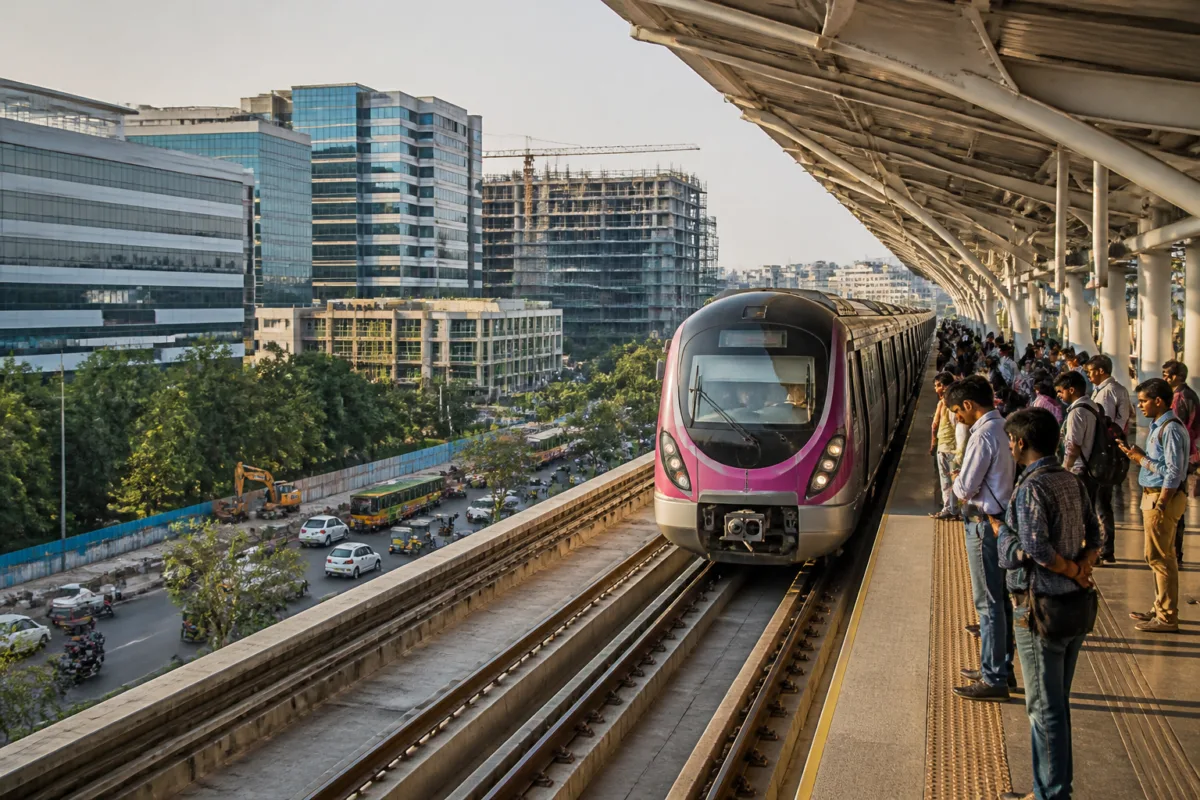
The inauguration of Pune Metro’s Line 3, or Pink Line, to Hinjewadi places one of the city’s most important employment corridors inside India’s larger metro expansion story. Prime Minister Narendra Modi used the event to highlight the growth of the national metro network from 248 km in 2014 to around 1,200 km now, but the significance of the Pune project lies in the urban problem it is intended to address: connecting an expanding technology and employment district with the rest of the city.
The Pink Line runs from Maan to District Court via Hinjewadi, one of Pune’s largest information technology hubs. Its inauguration adds a new mobility link between newer development areas and the established urban core. Modi said the line would provide better connectivity to Hinjewadi and that further expansion would strengthen links between Pune’s older and newer areas.
That description captures the central challenge facing Pune. The city’s economic geography has expanded beyond its traditional centres, with employment, housing and services increasingly distributed across a wider metropolitan area. The report identifies Pune as a major centre for information technology, automobiles, pharmaceuticals, startups, innovation and manufacturing. These activities generate daily travel demand across the city, making the quality and reach of mass transit a question of economic access as well as commuting convenience.
The project also reflects the institutional complexity of delivering urban transport infrastructure. The inauguration brought together the state government, Pune Metropolitan Region Development Authority, Maha Metro and Pune IT City Metro Rail Ltd. PMRDA commissioner Abhijit Chaudhari made the introductory presentation, while Maha Metro managing director Shravan Hardikar, PMRDA additional metropolitan commissioner K Manjulakshmi and Pune IT City Metro Rail Ltd CEO Anil Kumar Saini were among the senior officials present.
Modi described the Pink Line as an example of a public-private partnership, presenting collaboration between government and private enterprise as a way to accelerate infrastructure development. The report does not provide the project’s capital structure, concession terms, ridership projections or revenue arrangements. That absence is important because the label PPP alone does not explain how financial risk, construction responsibility, operations and accountability are distributed. Those details will determine how the model performs after the inauguration phase.
The broader figures presented at the event show the scale of India’s shift towards metro-based urban transport. According to Modi, the country had 248 km of operational Metro lines in 2014. The network has since expanded to around 1,200 km, while the number of cities with Metro services has increased from five to 26. More than one crore people are said to travel by Metro every day, and India’s network is among the world’s three largest.
These numbers indicate a substantial increase in physical infrastructure and geographic coverage. They also show how Metro has moved from being concentrated in a few large cities to becoming a widely adopted urban transport investment. The expansion, however, should not be measured only by route kilometres. The practical value of a Metro line depends on whether it connects major residential and employment areas, whether stations are accessible, and whether passengers can complete the first and last legs of their journeys.
For Pune, the route towards Hinjewadi gives the network a particularly employment-oriented function. A line linking an IT hub to District Court and Maan is not simply a movement corridor between stations. It creates the possibility of a more structured connection between a large job cluster and the wider metropolitan transport system. The report does not provide expected daily ridership, station-level access plans or integration details with buses and other modes, so the extent of that effect cannot yet be established from the available information.
The Maharashtra figures presented by the Prime Minister further underline the state’s accelerated investment. Only around 10-11 km of Metro lines were operational in Maharashtra in 2014, compared with around 200 km now. Work on more than 680 km was described as being underway, while investments exceeding Rs2.5 lakh crore were cited for Metro infrastructure in the state.
This expansion has created a large implementation responsibility for state and metropolitan institutions. Every additional corridor requires decisions on land, construction, operations, safety, financing and integration with existing urban systems. The presence of several agencies at the Pune event reflects that distributed structure. It also means that the performance of a corridor cannot be attributed to one institution alone. Planning authority, rail operators, private project entities and state and Union governments each occupy different parts of the delivery chain.
The political and administrative messaging around the project has focused on ease of living, ease of transportation and productivity. Modi argued that when a city saves time, its productivity increases, creating momentum for the wider economy. He also linked Metro investment to employment for engineers and activity in shops and factories. These are stated policy objectives rather than independently measured outcomes in the supplied report, but they reveal how Metro projects are being justified: not only as transport infrastructure, but as instruments of urban economic policy.
That framing matters for Pune because the city’s growth has produced a mismatch between where people live and where they work. The Pink Line’s route through Hinjewadi responds to that mismatch by prioritising a major employment node. Yet a Metro corridor can address only the part of the travel problem covered by its route and stations. Its full urban effect will depend on access from surrounding neighbourhoods, interchange arrangements, pedestrian conditions and the availability of connecting services. The source report does not establish how those elements will operate.
The event also places the Pink Line within a longer Pune Metro timeline. Modi said he had laid the foundation stone for the first phase around 10 years ago. The project therefore represents not just a new operational asset but the continuation of a decade-long effort to build a citywide rail network. That long gestation highlights the difference between announcing a corridor and bringing it into service. Urban transport systems require sustained institutional coordination well beyond the foundation-stone and inauguration stages.
For residents, the immediate question is whether the new connection changes the reliability and duration of everyday journeys. For employers in Hinjewadi, the relevant issue is whether workers from more parts of Pune can reach the district through a dependable mass-transit option. For public agencies, the test is whether the corridor can be integrated into a network rather than function as an isolated line. The available report confirms the project’s route, institutional participants and stated objectives, but it does not yet provide performance data against which these outcomes can be assessed.
The national expansion figures similarly establish momentum but not uniform success. A network growing from 248 km to around 1,200 km and reaching 26 cities is a major infrastructure transition. However, route length and daily passenger numbers do not by themselves reveal differences in utilisation, service quality, financial sustainability or access across cities. Those questions will become more important as construction continues on the more than 680 km of Metro lines cited for Maharashtra and as public authorities manage the operating costs of a much larger network.
Pune’s Pink Line therefore represents two developments at once. It is a new link to Hinjewadi and a practical intervention in the city’s expanding travel patterns. It is also part of a national infrastructure strategy that treats Metro expansion as central to urban competitiveness, productivity and the ease of living. The evidence supplied confirms the scale of the build-out and the project’s intended connectivity role. The next stage will be to track how the line performs in daily use, how its public-private structure functions, and whether it successfully connects Pune’s older urban areas with its newer economic geography.

