


Pune’s dengue cases reached their highest monthly level of the year in October, but the citywide surge was not evenly distributed. Four of the Pune Municipal Corporation’s 16 wards accounted for roughly half of the 843 laboratory-confirmed cases recorded during the month, turning a citywide health alert into a neighbourhood-level governance problem.
The pattern matters because the increase was concentrated in specific urban environments rather than spread uniformly across Pune. Aundh-Baner, Yerawada-Wadgaonsheri, Dhankawadi-Sahakarnagar and Keshavnagar together reported 428 cases in October. That is just over half of the monthly total. At the same time, six wards recorded fewer cases than in September, while ten saw increases.
The figures, reported from Pune Municipal Corporation data and cited by the Times of India, show that the city recorded 2,486 dengue cases between January 1 and October 30. October contributed 843 cases, or nearly 34% of the cumulative tally. The scale of the late-monsoon increase is particularly significant: August, September and October together accounted for 2,017 cases, or 81% of the total reported during the first ten months.
This concentration challenges the usefulness of treating dengue only as a citywide seasonal outbreak. The aggregate number establishes the seriousness of the problem, but the ward-level figures point towards a more specific question: what is allowing mosquito-breeding conditions to persist or multiply in particular parts of Pune?
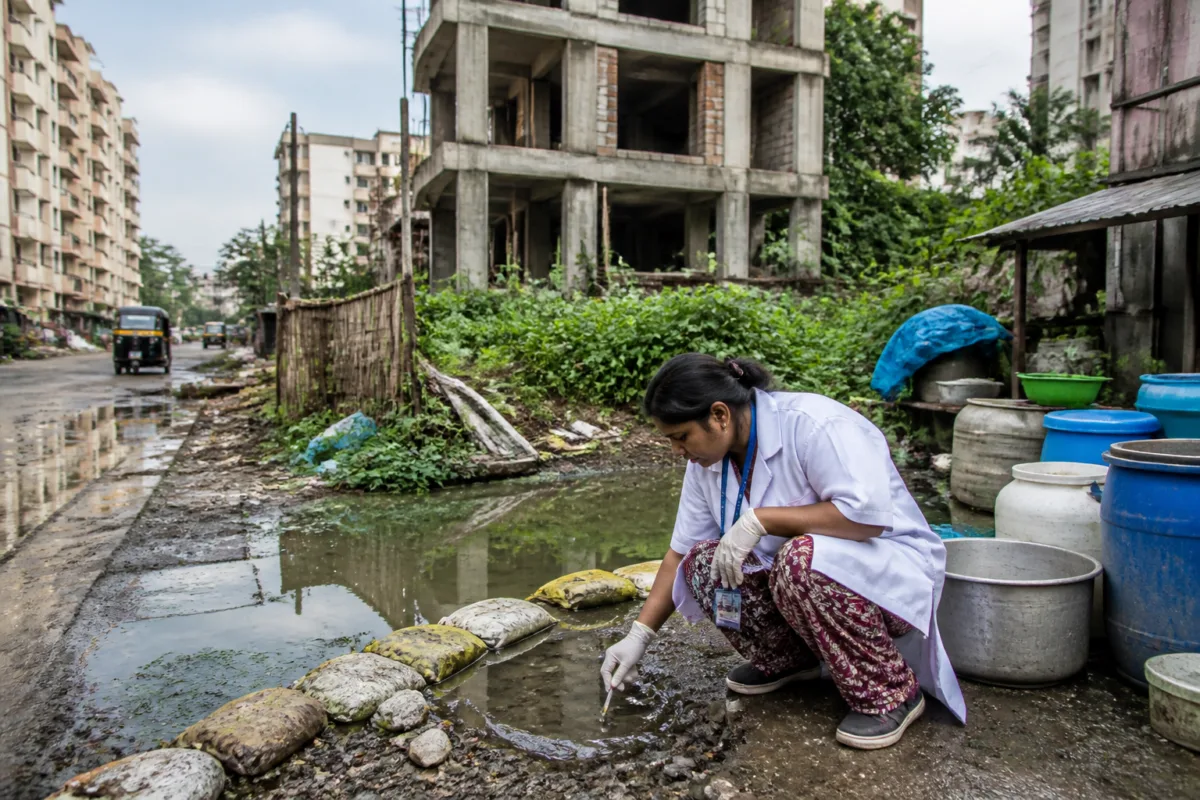
The answer suggested by the available evidence is not a single source. Experts cited stagnant water after the monsoon, construction sites, household water storage during supply interruptions and warm, humid conditions as factors that can support mosquito breeding. These conditions are linked to the way neighbourhoods are built, serviced and monitored. They also place responsibilities across several levels, including municipal health teams, construction-site operators, property owners and households.
The October data shows how quickly the pattern changed in the most affected wards. Aundh-Baner recorded 152 cases, compared with 107 in September and 66 in August. Its cumulative tally of 364 cases was the highest among all wards. Yerawada-Wadgaonsheri reported 110 cases in October, up from 60 in September and 42 in August. Dhankawadi-Sahakarnagar rose from 54 cases in September to 92 in October, after recording 36 in August.
The increase in these three wards alone helps explain the city’s monthly jump. Their combined tally rose from 144 cases in August to 221 in September and 354 in October. The combined increase between September and October was 133 cases, nearly three-quarters of Pune’s net monthly rise of 181 cases.
Keshavnagar added another 74 cases in October, compared with 49 in September and just 11 in August. Other areas also showed sharp increases. Kondhwa-Undri recorded 65 cases in October after 48 in September and 30 in August. Tilak Road-Sinhagad Road nearly doubled its count from 28 in September to 55 in October.
However, the data does not describe a uniform deterioration across the municipal corporation. Kothrud recorded 73 cases in October, down from 80 in September, although its tally remained higher than the 67 cases reported in August. Nagar Road-Wagholi fell from 83 cases in September to 71 in October, matching its August count. Six wards recorded declines compared with September.
That divergence is the most important feature of the data. If all wards had moved in the same direction, a citywide seasonal explanation would have been sufficient to describe the trend. Instead, the figures show different trajectories within the same municipal system. Some wards experienced sustained month-on-month increases, while others stabilised or declined. This makes ward-level surveillance and local investigation central to understanding the outbreak.
The municipal response has also expanded alongside the increase in cases. Dr Rajesh Dighe, assistant health officer of the PMC and in-charge of vector-borne infections, said the corporation surveyed 2.94 lakh homes and establishments in October and issued 448 notices. Across the year, the PMC investigated 16 lakh establishments and issued more than 3,099 notices. It collected penalties totalling Rs6.47 lakh, including Rs90,400 in October.
These figures reveal the administrative scale of dengue control, but they also show the difference between activity and outcome. Surveys, notices and penalties indicate that the civic machinery is inspecting premises and identifying possible violations. The continued rise in cases, particularly in the four leading wards, indicates that enforcement activity alone has not prevented transmission during the period covered by the data.
The available material does not establish how many notices were issued in each ward, what violations were found, how quickly corrective action followed, or whether repeat violations were concentrated at particular types of premises. It also does not provide a ward-wise comparison of inspections, penalties and confirmed cases. Without those links, it is difficult to determine whether the highest case counts reflect greater breeding risk, more intensive testing, stronger reporting, or some combination of these factors.
That limitation is important for interpreting the numbers. A laboratory-confirmed case count is a clear indicator of reported disease burden, but it does not by itself identify the precise source of transmission. The PMC’s month-wise and ward-wise Integrated Health Information Platform report records dengue IgM and NS1 ELISA-positive cases, according to Dr Dighe. The data therefore provides a reliable picture of reported confirmed cases in the supplied period, while leaving the underlying contribution of individual environmental factors unresolved.
The urban systems behind the outbreak are nevertheless visible in the explanation provided by experts. Post-monsoon stagnant water can emerge in open plots, roadside depressions, drains, containers and other low-lying spaces. Construction sites can create additional locations where water collects. Household storage can become more common when supply interruptions require residents to retain water. Each setting involves a different enforcement or service responsibility, even though the health consequence may appear in the same ward-level case count.
This makes dengue control partly a question of municipal coordination. Health teams may identify breeding sites, but the corrective action can involve solid-waste removal, drainage maintenance, construction-site compliance, water-supply reliability, property management or household practices. The source material does not specify how these departments coordinate in the four wards with the highest October counts. That missing institutional detail is significant because a health department’s inspection programme cannot by itself resolve every physical condition that permits breeding.
The figures also place pressure on the way seasonal disease is discussed in a growing city. The count rose from 103 cases in June to 366 in July, 512 in August, 662 in September and 843 in October. The increase between September and October was 181 cases, the largest absolute monthly rise in the sequence provided. October’s tally was nearly 64% higher than August’s, showing that the increase was sustained across three consecutive months rather than confined to a single short-lived spike.
At the same time, the concentration in four wards means that the city’s response cannot be assessed only through its total number of inspections or notices. Pune surveyed 2.94 lakh homes and establishments in October, but the public-interest question is how that effort translated into action in the locations where cases were rising fastest. The supplied data does not answer that question, but it establishes why it needs to be asked.
The October trend therefore confirms three points. Pune’s dengue burden accelerated sharply during the late monsoon and post-monsoon period; the increase was heavily concentrated in a small group of wards; and the PMC intensified inspections and enforcement while cases continued to climb. What remains uncertain is the relative contribution of stagnant water, construction activity, household storage, climate conditions and differences in surveillance across wards.
The next stage of scrutiny should remain neighbourhood-specific. Monitoring whether Aundh-Baner, Yerawada-Wadgaonsheri, Dhankawadi-Sahakarnagar and Keshavnagar continue to account for a disproportionate share of cases, and whether the wards that recorded October declines sustain that improvement, will show whether the October spike was contained or became a broader municipal pattern.

