


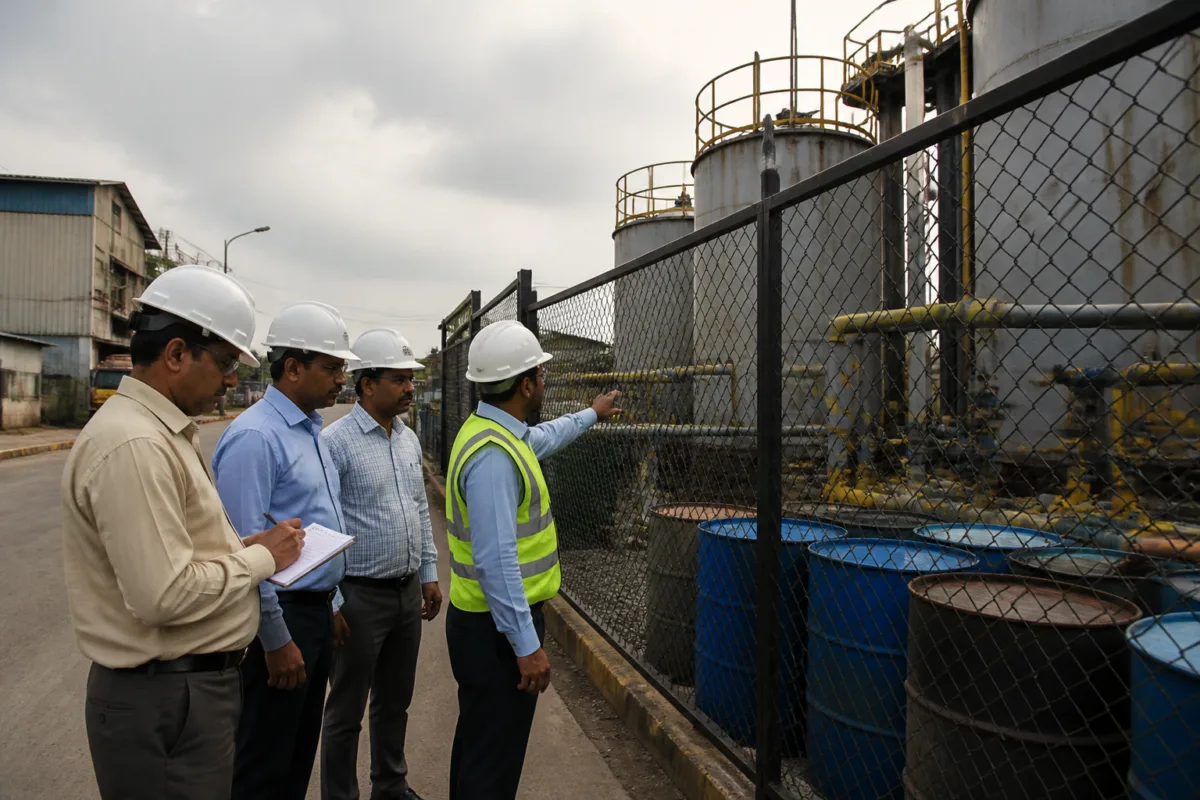
The methanol supply chain at the centre of Pune’s toxic-liquor deaths has raised a larger question than whether one company’s licence should remain cancelled: how effectively can India’s regulatory system track an industrial chemical when it moves from legitimate manufacturing into an alleged criminal network? The question has gained urgency after Maharashtra Food and Drug Administration (FDA) Minister Narhari Zirwal temporarily stayed the cancellation of the licence of a methanol-producing company in Ranjangaon MIDC, while a CID investigation into the deaths of 22 people has entered the chargesheet stage.
According to documents reviewed and reported by Civic Mirror, the FDA’s licensing authority cancelled the licence of ASK Chemicals India Private Limited on 17 June 2026. The company, located in Group F-1 of Ranjangaon MIDC, appealed against the decision. On 9 September, the minister admitted the appeal and temporarily stayed the licence-cancellation order after considering the company’s submissions and preliminary documents.
The minister’s order did not amount to an unconditional clearance. It required the company to ensure that its registered competent person remained present at the premises, and directed it to maintain complete records of the receipt, storage and sale of raw materials. The order also required there to be no discrepancies between purchase, inventory and sales records. Other deficiencies identified in the FDA’s 17 June order were to be rectified within 15 days, followed by a compliance report to the licensing authority.
The order further directed the licensing officer for Zone Six to conduct regular inspections of the company’s premises. Inspection reports were to be submitted to the competent authority every three months. If the company failed to submit the required compliance report within the prescribed period, the appeal could be decided on its merits under the relevant rules, the report said.
These conditions are important because they show that the dispute is not only about whether a licence was cancelled or restored temporarily. It is also about how the state verifies chemical inventories, assigns responsibility for compliance and responds when a regulated company challenges enforcement action. In a case involving a substance alleged to have entered an illegal liquor network, those administrative processes become directly connected to public safety.
The immediate background is the toxic-liquor incident reported in Pune between 26 and 28 May 2026. Twenty-two people died in incidents involving Hadapsar in Pune and the Fugewadi-Dapodi area of Pimpri-Chinchwad. The investigation alleged that methanol, a toxic industrial chemical, had been mixed into country liquor. Several people were also hospitalised.
The incident exposed a chain that extended beyond the sale of illicit alcohol. The reported investigation examined the alleged procurement, transport, storage and distribution of methanol, as well as the people accused of mixing the chemical into liquor. According to the report, the CID alleged that liquor was supplied by Radheshyam Prajapati of Uruli Kanchan, while Yogesh Ramchandra Vhanke, also known as Sikandar Rathod, allegedly mixed methanol into the liquor and distributed it in Pune and Pimpri-Chinchwad. The investigation also reportedly traced the chemical supply through a warehouse in Bhiwandi and an intermediary.
The allegations remain matters for the criminal proceedings. The report said that the owners of the Ranjangaon company, Arun Chaubey and his son Abhishek Chaubey, were arrested in connection with the alleged chemical supply chain. On 28 October, the CID filed a chargesheet against nine arrested accused before a special Maharashtra Control of Organised Crime Act court. One suspect was reported to be absconding.
The chargesheet and the ministerial order belong to different parts of the state’s response. The CID case concerns alleged criminal conduct and the operation of a distribution network. The FDA action concerns licensing, compliance and the conditions under which a methanol-producing company can operate. Yet the two processes overlap because the chemical’s legal supply chain is central to understanding how it may have reached illegal alcohol producers.
That overlap makes the regulatory record significant. Industrial chemicals such as methanol can have legitimate uses, but their handling requires accurate documentation and controls over movement. The conditions in the minister’s order—presence of a competent person, records of inward supplies, storage and sales, and periodic inspections—indicate the points at which the administration expects the company’s activities to remain traceable. The supplied report does not establish whether these controls failed at the company, elsewhere in the distribution chain, or at multiple points. It does, however, show why those controls are now under scrutiny.
The case also illustrates the divided institutional structure involved in chemical-related public safety. The FDA is responsible for the licensing action described in the report. The police initially registered cases at the Hadapsar and Dapodi police stations, after which the investigation was transferred to the CID. The special MCOCA court is examining the criminal case against the accused. Each institution has a different mandate, but the effectiveness of the overall response depends on whether information can move across those boundaries.
A licensing order can identify regulatory deficiencies, but it cannot by itself establish criminal liability. A criminal investigation can trace an alleged supply chain, but it does not automatically resolve whether a company’s licence should be cancelled under administrative rules. The ministerial appeal process therefore becomes a crucial point of accountability: the reasoning behind the stay, the deficiencies identified in the original order, the company’s corrective action and the inspection reports will determine whether the regulatory response is substantive or merely procedural.
The political dimension has emerged because the company has been alleged to have links with a Nationalist Congress Party leader, and because the minister stayed the FDA’s action. Civic Mirror explicitly reported that the alleged political links and political interference in the decision have not been independently established. They must therefore remain allegations, not conclusions. The central public-interest issue is whether the appeal was decided through a transparent application of the rules and whether the reasons for the stay can withstand scrutiny in light of the 22 deaths.
The report also places the dispute in the context of FDA Commissioner Tukaram Mundhe’s tenure. It said complaints received by the FDA had increased by 557 per cent after he assumed charge, attributing the rise in reporting to public awareness and increased administrative action. That figure is presented in the source report, but the supplied material does not provide the underlying complaint counts, time periods or methodology. It therefore cannot by itself establish whether enforcement performance improved or whether the administration became more visible to citizens.
That limitation matters. Administrative activity can be measured through complaints, inspections, licence actions, prosecutions and compliance reports, but each indicator captures a different part of regulatory performance. A rise in complaints may indicate greater public awareness, worsening violations, improved reporting access or more than one of these factors. In this case, the most relevant evidence will be whether inspections were conducted, whether inventory records were consistent, whether deficiencies were corrected within the prescribed period and whether violations were escalated when necessary.
The Ranjangaon order places a 15-day correction period and quarterly inspection reporting at the centre of the next stage. Those milestones create an administrative trail that can be examined independently of the political allegations. The company’s compliance report, the licensing authority’s assessment and the inspection reports should show whether the safeguards imposed by the minister were met. They may also clarify which deficiencies led to the original licence cancellation and whether those deficiencies were technical, operational or directly related to chemical-control risks.
For Pune and Pimpri-Chinchwad, the issue is not abstract industrial regulation. The alleged movement of methanol into illicit liquor connected an industrial supply chain with neighbourhood-level harm. The deaths occurred in urban areas where informal markets, transport networks, warehouses, small-scale distribution and vulnerable consumers intersect. Preventing a repeat incident requires more than action at the point where poisoned liquor is sold. It requires visibility across the chain through which hazardous substances are manufactured, stored, transported and purchased.
The evidence currently establishes three separate facts: 22 people died in the reported toxic-liquor incident; the FDA cancelled the Ranjangaon company’s licence before the minister temporarily stayed that order with conditions; and the CID filed a chargesheet against nine accused while one suspect was reported to be absconding. It does not establish that the company supplied methanol for illegal liquor, nor does it establish political interference in the minister’s decision. Those questions remain tied to the criminal investigation, the administrative record and the compliance process.
The next developments to watch are the company’s compliance submission, the FDA’s inspection reports, the ministerial appeal proceedings and the court’s handling of the CID chargesheet. Together, these records will show whether Maharashtra’s response can connect criminal accountability with effective regulation of the methanol supply chain.

