


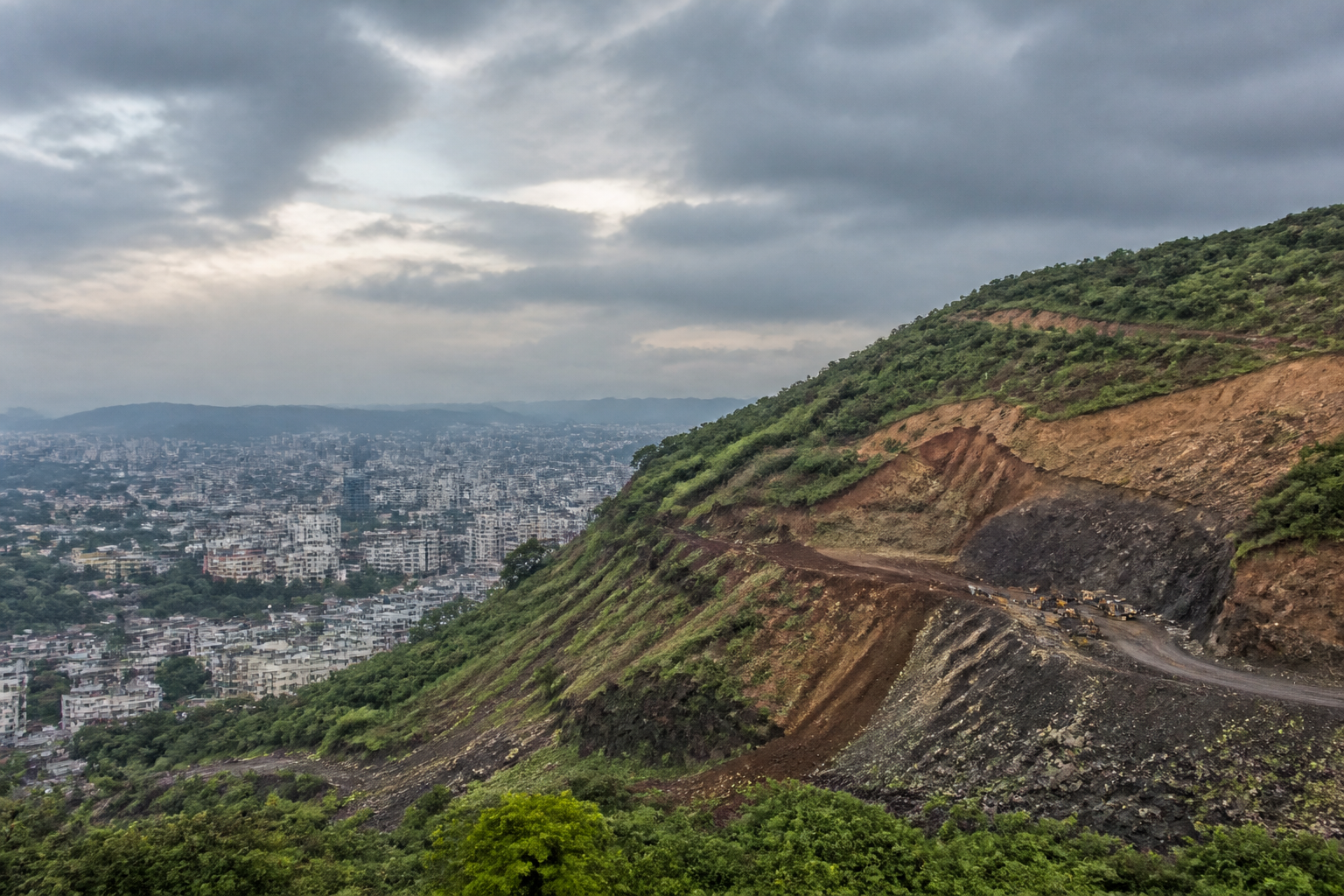
The Pune hills report has reached the Maharashtra Urban Development Department after about 18 months of study, bringing the city to an important point in its long-running conflict between environmental protection, land rights and urban expansion. The report prepared by a committee headed by former civil servant Ramanath Jha is expected to shape how the state approaches construction, roads, excavation and land use in hilltop-hillslope areas and biodiversity park zones.
The report itself has not yet been made public, and its recommendations are therefore not known. What is established is that the committee was appointed by the Maharashtra government in April 2025 to examine the current condition of Pune’s hills and the development control regulations governing them. The committee was asked to study hilltop and hillslope areas, as well as biodiversity park areas, and recommend changes to the rules that regulate development in these locations.
That mandate places the committee at the centre of a structural urban question. Pune’s hills are not only undeveloped land waiting for a permitted use. They are also part of the city’s ecological and physical system. Once roads, buildings or excavation alter a hill, the change affects how land is accessed, cleared and developed. The supplied report identifies illegal construction, roads, excavation and the increasing use of land as issues that have brought the environmental protection of the hills into sharper focus. It does not, however, provide the committee’s findings on the scale of these activities.
The delay in submitting the report is significant for understanding the administrative process. The committee was initially expected to submit its findings within a shorter period, but its term was extended because of the breadth of the study and the technical issues involved. A drone survey was also planned to establish the ground situation on the hills, including construction, roads, excavation and other development activity. A supplementary committee was formed to examine related proposals and technical matters.
This process shows why hill protection cannot be reduced to a single prohibition or permission. The state must first establish what exists on the ground, distinguish authorised development from violations, understand the physical character of different sites and then decide whether the existing development control framework is adequate. The report’s importance will depend not only on the recommendations it contains but also on whether those recommendations are specific enough to guide municipal decisions and enforcement.
The next formal step is for the report to be presented to Eknath Shinde, Maharashtra’s Deputy Chief Minister and Urban Development Minister, according to the supplied report. The state government may then take decisions on construction on the hills and the use of land based on the committee’s recommendations. This means that the committee’s submission is an administrative milestone, not yet a change in the rules. Until the government considers and acts on the report, the regulatory position remains unresolved.
That distinction matters for residents, landowners, builders and environmental groups. A submitted report does not automatically legalise existing construction, stop all activity or create a new development framework. The consequences will depend on whether the state accepts the recommendations, modifies them, publishes them and translates them into enforceable decisions. The supplied report does not state whether the committee has proposed a blanket restriction, differentiated controls for various hill areas, regularisation measures or a new enforcement system.
The issue is especially complex because three claims must be handled together: environmental protection, the rights of landowners and the requirements of future urban development. The report describes this as a need to balance the ecological protection of the hills with landowners’ rights and future development. That balance is not merely a political formulation. It determines how planning authorities classify land, what permissions can be issued, what existing structures are treated as violations and which agency is responsible for action.
The drone survey is potentially important because it indicates an attempt to supplement paper records and regulatory maps with a current view of actual land use. The supplied report says the survey was intended to identify illegal buildings and development activity, but it does not disclose how many structures or projects were found. It also does not provide the survey methodology, coverage area, date of collection or criteria used to classify activity as illegal. Those details will be necessary for the public to assess the report’s conclusions once they are released.
The absence of public recommendations is currently the central information gap. Residents and environmental groups want to know what restrictions the committee has proposed for development on the hills, what action it has recommended against illegal construction and whether it has suggested relief for existing owners or occupants. The report also does not say how the committee has addressed roads and excavation, even though both can alter access and accelerate the conversion of hill land.
For Pune’s urban governance system, the report may test the difference between planning rules on paper and enforcement on the ground. A regulation can identify protected or restricted areas, but its effectiveness depends on accurate mapping, permission systems, inspections and action against violations. The supplied material does not identify the specific municipal or state agencies responsible for each stage, nor does it provide figures on enforcement action already taken. Those omissions should be addressed when the report and the government’s response become available.
The timeline also illustrates how technically difficult land-use decisions can become when a city has already experienced development pressure. The committee required an extension beyond its original schedule, and the government supported a technical process involving drone surveys and supplementary review. That does not establish whether the eventual recommendations will be stronger or weaker. It does establish that the government treated the issue as requiring more than a short administrative review.
The wider urban significance lies in the fact that Pune’s hills are being considered through development control regulations rather than only as isolated environmental sites. That brings ecological concerns directly into the planning system. The decisions that follow could affect how the city defines permissible development, how it handles disputed construction and how it manages the relationship between private land, protected landscapes and public environmental interests. At present, however, the available evidence is insufficient to determine the final policy direction.
The most important upcoming milestone is the public release of the committee’s report and the state government’s decision after it is presented to the urban development minister. Those documents will reveal whether the committee has recommended new restrictions, enforcement measures, land-use changes or a framework for balancing conservation with ownership and development. Until then, the submission of the report confirms that Pune’s hill governance framework is under review, but not what the city’s hills will ultimately be allowed to become.

