


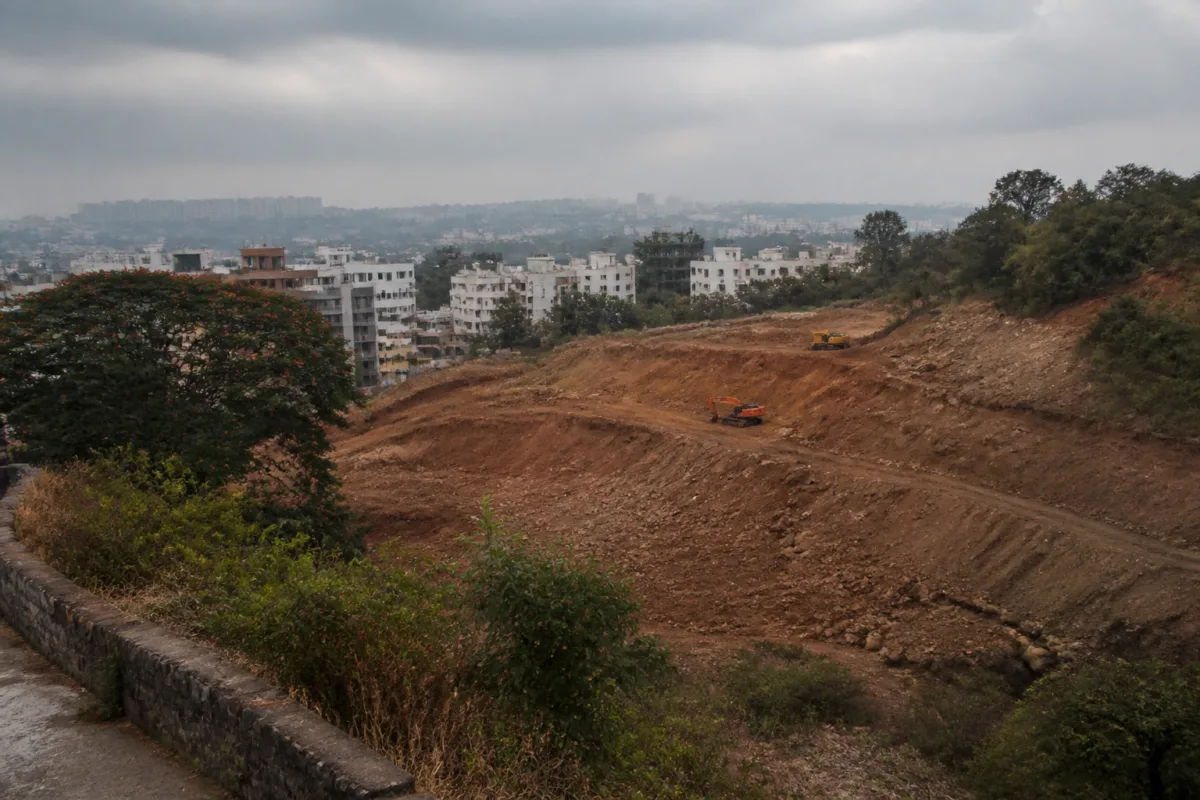
Allegations of large-scale excavation and levelling on a hill parcel reserved for a biodiversity park in Pune’s Sutardara area have brought renewed attention to how the city protects its remaining natural slopes while permitting urban development. The claims involve about 38 acres in Survey Number 113, where the Aam Aadmi Party says heavy machinery was used to remove soil and murum and prepare land for a residential and commercial project. The allegations have not been independently verified in the supplied report, and the developer denies that any illegal activity took place.
The dispute places three institutions at the centre of the issue: the Pune Municipal Corporation, which is responsible for building permissions and enforcement within the city; the revenue administration, which regulates the extraction of minor minerals such as soil and murum; and the developer identified in the report as HillEdge Realty and Developers LLP. The matter also raises a broader question about whether notices issued after alleged environmental damage are being followed by timely measurement, recovery and prosecution.
According to the report by Civic Mirror – Pune, the Aam Aadmi Party submitted a representation to the Pune municipal commissioner alleging that the developer had levelled part of the hill using heavy machinery. The party claimed that between 1,000 and 1,500 brass of soil and murum had been excavated and that several trees had been cut. It also alleged that the developer had not obtained permission from the municipal building department or the revenue department for the work.
The figures and the extent of tree loss remain unconfirmed. The report states that the Pune Municipal Corporation does not have official data on the number of trees allegedly cut and that the allegations have not been independently verified. Establishing the physical scale of excavation would therefore require an authoritative survey, including a comparison of the site’s earlier and current contours, the quantity of material removed and the legal status of the land and work undertaken there.
The political complaint has been made by Raviraj Kale, Maharashtra state president of the AAP’s youth wing. The party has demanded immediate criminal action against HillEdge Realty and Developers LLP, an electronic total station survey to measure the alleged excavation, recovery of royalty on any minerals removed and action against officials who may have allowed the work to continue. It has also sought an assessment of tree loss and compensatory plantation linked to the age of the trees allegedly removed.
The developer has rejected the allegations. Darshan Sharad Chordia, identified in the report as a director of HillEdge Realty and Developers LLP, said the accusations were false and baseless. He said no such activity had taken place and that municipal officials had inspected the relevant area without finding illegal work. The report also identifies Sameer Imambaksh Mulani and Chordia as registered directors of the developer. These statements represent the company’s position and do not establish the condition or legal status of the site independently.
The municipal response described in the report is incomplete. A stop-work notice had reportedly been issued to the developer earlier, along with directions to halt excavation. City engineer Aniruddha Pawaskar was also reported to have taken note of the matter and assured that a criminal case would be filed within seven days. The report states that no criminal case had been registered at the time of publication. Pune Municipal Commissioner Navalkishor Ram, meanwhile, said he was not aware of the complaint but would personally investigate it.
This sequence points to a familiar enforcement problem in urban land governance: the distinction between stopping activity and establishing accountability. A stop-work notice can halt ongoing work, but it does not by itself determine how much material was removed, whether permissions were required, whether trees were damaged or whether public revenue is recoverable. Those questions depend on documented inspections, site measurements, land records, permission registers and action by the competent authorities.
The demand for an electronic total station survey reflects the importance of measurement in such disputes. The report says the AAP wants the technology used to determine the volume of minor minerals allegedly excavated. That evidence would be relevant not only to the environmental assessment but also to any calculation of royalty, penalties or restoration obligations. Until an official survey is completed and disclosed, the reported estimate of 1,000 to 1,500 brass remains an allegation rather than an established quantity.
The same evidence gap applies to the biodiversity park designation and the project’s permissions. The report describes Survey Number 113 as including a biodiversity park and hill land, and links the alleged work to a proposed residential and commercial project. However, the supplied material does not include the relevant development plan extract, ownership documents, sanctioned building plans, environmental permissions, revenue records, survey report or the municipal stop-work notice. Without those documents, it is not possible to determine the precise legal protections applying to every part of the 38-acre parcel or whether any authorised activity occurred on the site.
The issue is significant for Pune because hills and open natural land perform functions beyond their apparent value as developable plots. They form part of the city’s landscape, support vegetation and influence how urban expansion meets remaining undeveloped terrain. In this case, the concern is not only whether a particular developer breached a rule. It is also whether multiple agencies can identify protected land early, prevent unauthorised alteration and publish a clear record when a complaint is made.
The report links the Sutardara allegations to an earlier controversy involving tree cutting and excavation near Gangadham in Bibwewadi. That comparison was made by the AAP, not independently established in the supplied material. Even so, the recurrence of similar allegations is relevant to the administrative question of whether hill-related complaints are being handled through a consistent process. Such a process would need to clarify the responsible authority, the time limit for inspection, the method used to measure damage and the action required after a violation is confirmed.
The immediate next step is the municipal investigation announced by Commissioner Ram. The outstanding factual questions include whether excavation occurred, the volume of any material removed, the number and status of trees affected, the permissions held by the developer, the legal designation of the land and whether the earlier stop-work notice was complied with. The supplied report does not establish those facts, making an official survey and disclosure of the relevant records essential before the allegations can be treated as proven.

