


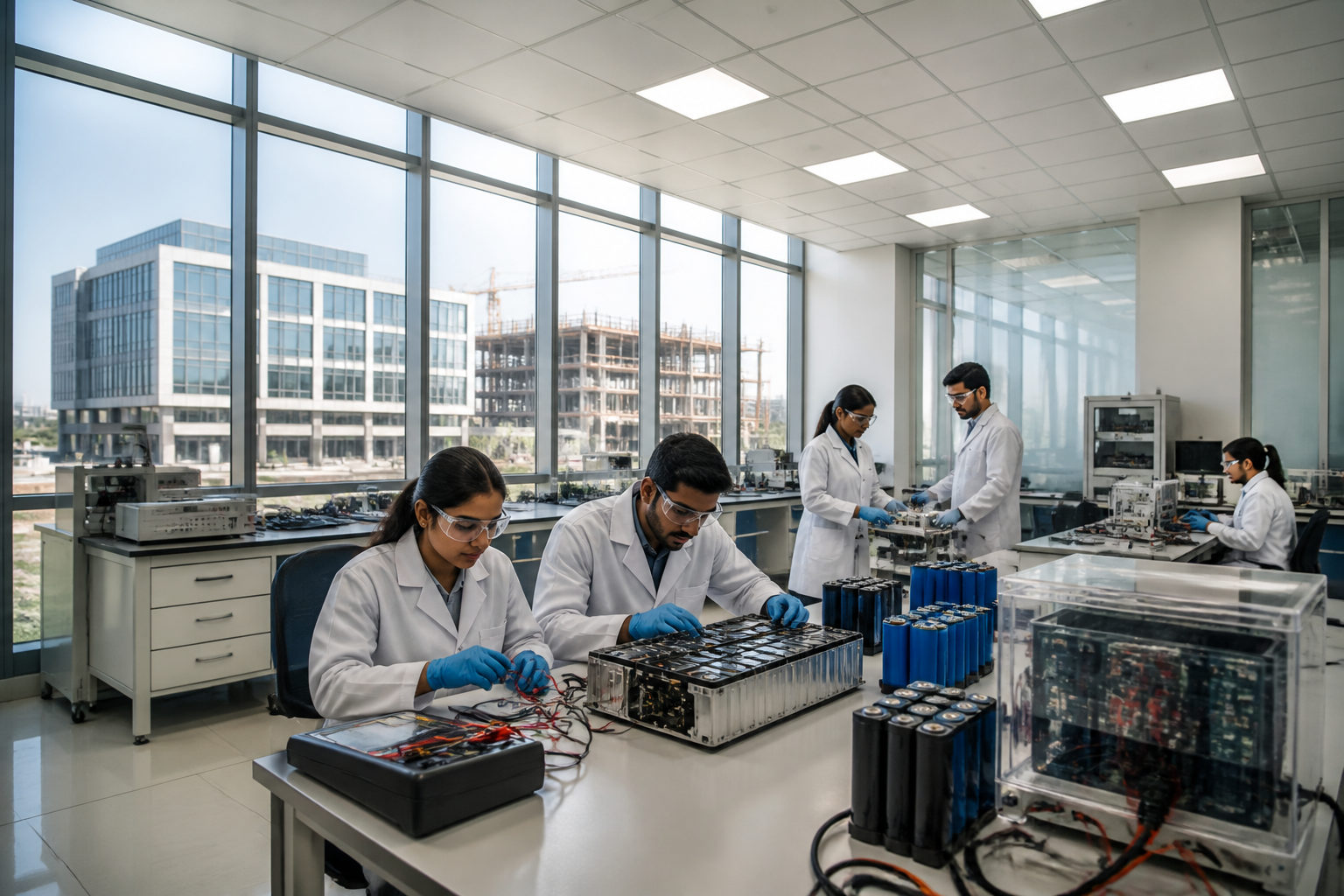
COEP Technological University and JSW Projects have signed an agreement to establish an indigenous lithium-ion battery technology centre at the university’s research facility in Chikhali, Pune district, in a project estimated to cost ₹800 crore.
The centre will be developed in two phases and is planned to include battery prototyping, pilot-scale research and development facilities. According to the report by Loksatta, the project will support the development of lithium-ion battery cell technology within Pune’s academic and engineering ecosystem.
The agreement was signed by COEP registrar Dr D. N. Sonawane and JSW Group executive vice-president Naresh Lalwani. COEP vice-chancellor Prof Sunil Bhirud, Dr S. P. Mahajan, dean Prof P. A. Sadgir, Dr Ranjit Date, professor of practice Dr Sarika Kelkar and other university officials attended the signing. JSW senior vice-president Amitabh Singh, associate vice-president Chandrakant Mahalingam and deputy general managers Vijay Chaudhary and Sudeep Sarkar were also present.
Bhirud said the centre could help develop an indigenous alternative to imported batteries and contribute to India’s effort to build domestic capability. He said students would receive opportunities to learn advanced battery technology and work on practical applications, while the facility would provide a wider platform for research, innovation and technology development.
The project places an engineering university at the centre of a technology area that has implications for electric mobility, energy storage and industrial manufacturing. However, the supplied report does not specify the proposed capacity of the facility, the exact timeline for either phase, the technologies to be developed, or whether the centre will manufacture commercial battery cells.
JSW Group chairman Sajjan Jindal said India had spent substantial foreign exchange on crude oil imports over several decades and needed to develop advanced skills and capabilities to manufacture batteries domestically. He described the partnership with COEP, which has a 172-year engineering history, as a collaboration that could create new opportunities across industry, research and education.
The agreement marks a new industry-academia initiative for Pune’s research landscape. Its eventual impact will depend on the execution of the two phases, the research infrastructure established at Chikhali, and the translation of laboratory and pilot-scale work into deployable battery technologies. The next milestones will be the detailed implementation of the project and the development of the proposed centre.
