


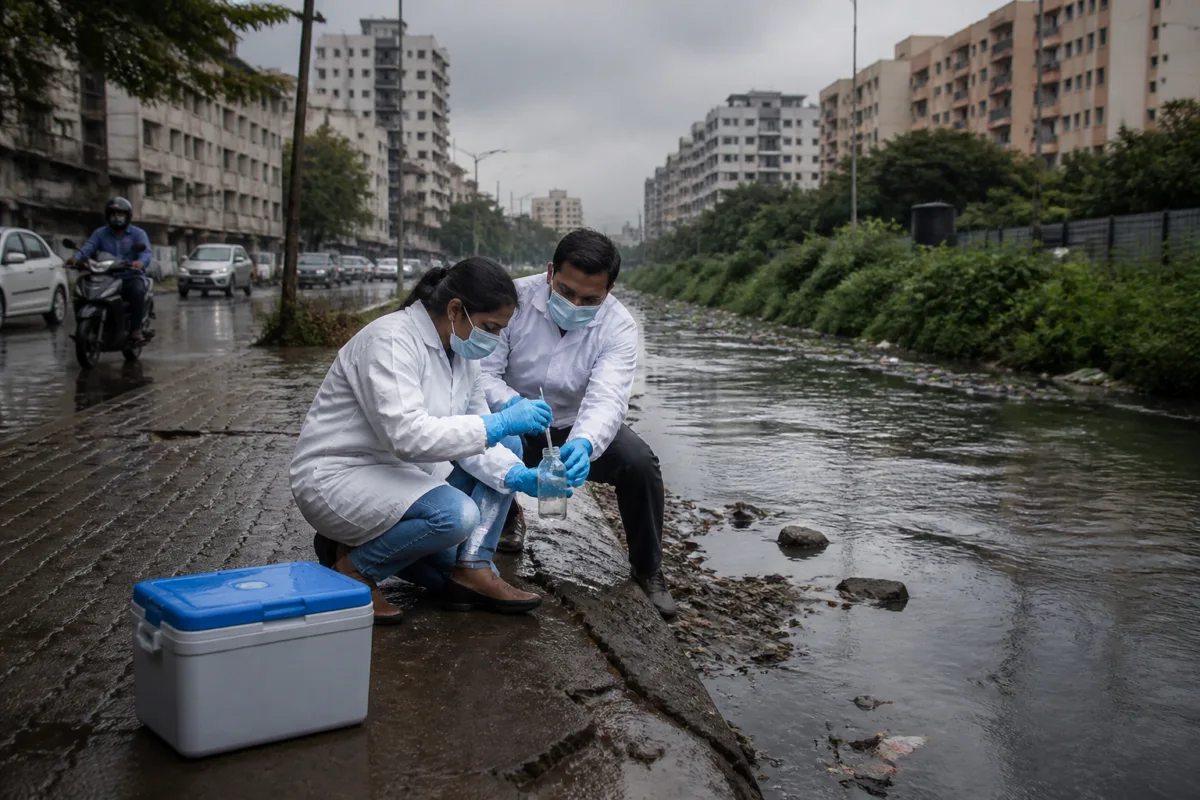
The Pune GBS outbreak was not linked to one confirmed source, but to evidence of multiple infectious agents moving through a city’s human, water and animal environments. A study by the National Institute of Virology (NIV), as reported by Punekar News, identified Campylobacter jejuni and norovirus in patient samples and also detected them in water sources and chicken droppings examined during the investigation. The findings offer a clearer account of what may have contributed to the outbreak while leaving the most consequential question unanswered: where, exactly, did the infections begin?
The outbreak affected 230 people and claimed 12 lives between January and March 2025. Its concentration in Pune, particularly around Sinhagad Road, made it an urban public-health event rather than only a clinical episode. GBS is a neurological condition that can follow an infection, and the NIV investigation examined whether preceding infections could help explain the sudden increase in cases. The study’s findings, as described in the report, point towards a combination of infectious pathways rather than a single, established chain of transmission.
That distinction matters. The detection of Campylobacter in water and chicken-dropping samples may identify possible environmental reservoirs, but it does not prove that contaminated water or poultry caused the outbreak. The study itself, according to the report, calls for further research to establish how the pathogens contributed to the cases. In a city, the difference between detecting an organism and proving a source is the difference between a warning signal and a completed public-health investigation.
The evidence is strongest on the relationship between prior infection and the patients who were studied. Of the 230 patients investigated, 147, or 63.9%, had experienced another infection before developing symptoms of GBS. Diarrhoea was the most commonly reported preceding symptom, affecting about 37% of patients. This pattern supports the possibility that gastrointestinal infections formed part of the pathway preceding the neurological illness, but it does not establish that every gastrointestinal infection led to GBS or that one pathogen was responsible for all cases.
The patient data also show that the outbreak was distributed across age groups, while male patients outnumbered female patients by 2.2 to one. These figures describe the population affected but do not, by themselves, explain why some groups experienced greater exposure or risk. The concentration of cases in the Sinhagad Road area may be relevant to further investigation, yet a geographical cluster must be connected to exposure data, movement patterns, water systems, food practices and health-seeking behaviour before it can identify a cause.
The laboratory results provide a more detailed picture of the investigation. Among 193 patients tested, 108, or 56%, showed evidence of an infectious agent. Campylobacter jejuni was detected in 72 of 148 patient samples, representing 48.7% of those tested. Norovirus was found in 40 of 180 patient samples. Of those 40 patients, 21 had only norovirus infection, while 19 had norovirus alongside another infection. The overlap is significant because it reinforces the study’s suggestion that multiple infectious agents may have been involved.
At the same time, the figures cannot be read as a simple count of confirmed causes. The samples were not identical in number across tests, and the presence of a pathogen in a patient sample does not alone demonstrate the route through which that patient was infected. It also does not settle whether the organism directly contributed to GBS, acted through an intermediate infection, or appeared alongside another relevant factor. The NIV findings narrow the field of investigation, but they do not close it.
The environmental sampling produces a similar combination of clues and limitations. Researchers examined 208 water samples, finding Campylobacter in one and norovirus in eight. They also tested 66 chicken-dropping samples: 24 were positive for Campylobacter and five contained norovirus. No toxic substances were found in nine selected water samples tested during the investigation. Together, these results show that the study looked beyond patients to possible environmental pathways, including water and poultry-related exposure.
However, the environmental results do not establish a city-wide contamination event. One positive water sample for Campylobacter and eight positive samples for norovirus demonstrate detection within the tested material, not the scale, duration or distribution of contamination across Pune. Similarly, positive chicken-dropping samples indicate that the pathogens were present in the tested material; they do not prove that poultry products, farms, markets or household food preparation transmitted infection to patients.
This is where the Pune GBS outbreak raises a broader urban question. Cities are not only collections of hospitals and laboratories. They are networks through which water, food, animals, waste, people and pathogens move. Public-health risks can cross the administrative boundaries between municipal water supply, private borewells, food vendors, poultry operations, drainage systems, neighbourhood sanitation and clinical surveillance. When an outbreak is investigated only after patients arrive at hospitals, the city may have evidence of illness without a sufficiently detailed picture of the exposure system that produced it.
The NIV investigation appears to have combined clinical samples with water and chicken-dropping samples, which is important because it connects patient surveillance with environmental investigation. Yet the reported findings also show why such work is difficult. The study tested different types and numbers of samples, found more than one pathogen, and identified a geographical concentration without establishing a definitive source. An effective urban disease-tracking system therefore needs more than case counts. It needs timely links between hospitals, laboratories, water authorities, municipal health departments, sanitation teams and agencies responsible for food and animal health.
The institutional challenge is one of coordination as much as laboratory capacity. A patient’s preceding diarrhoea may be recorded in a hospital, while a possible water exposure is managed by a civic agency and poultry-related risks sit within another regulatory chain. Unless these pieces are brought together quickly, evidence can remain fragmented. The Pune investigation’s use of patient, water and chicken-dropping samples demonstrates the value of a cross-sector approach, while the unresolved source shows the cost of trying to reconstruct transmission after the event.
The data also complicate the public-health response. Campylobacter and norovirus have different characteristics, and the presence of both in the investigation means that a single intervention cannot automatically be assumed to address the entire risk. Improving water safety may be important where water exposure is established, but the reported findings do not prove that water was the definitive source. Food and poultry controls may also warrant attention, but the study does not establish poultry as the source. The evidence supports investigation across multiple pathways rather than a premature focus on one.
For Pune residents, this distinction has a practical consequence. Public communication during an outbreak must be clear about what is known, what is suspected and what has not been proved. Stating that pathogens were detected in environmental samples is materially different from stating that a particular water supply or food chain caused the outbreak. Overstating the evidence can create unnecessary fear or direct attention away from other exposure routes; understating it can prevent residents and institutions from responding to a legitimate risk.
The outbreak’s toll also demonstrates why early warning systems matter. Twelve deaths and 230 affected people represent a significant health burden, but the numbers alone do not reveal how quickly the increase in cases was recognised, how long laboratory confirmation took, or how rapidly environmental testing followed. Those operational details are not established in the supplied report. They are nevertheless central to understanding whether Pune’s urban health institutions can detect and contain similar clusters in the future.
What the NIV study confirms is that the 2025 Pune GBS outbreak had a substantial infectious component among the patients investigated, with Campylobacter jejuni and norovirus identified in clinical samples and also detected in selected environmental material. It also shows that many patients reported a preceding infection, particularly diarrhoea. What it does not confirm is a single source, a complete transmission route or the precise contribution of each pathogen to GBS.
The next stage of understanding Pune’s outbreak therefore depends on the further research identified in the report. The evidence points towards a connected urban health problem involving clinical surveillance, environmental sampling and institutional coordination. Until those links are examined more fully, the outbreak should be understood neither as an unexplained medical anomaly nor as a proven water or poultry contamination event, but as a warning about how difficult it remains to trace disease through a complex city.

