


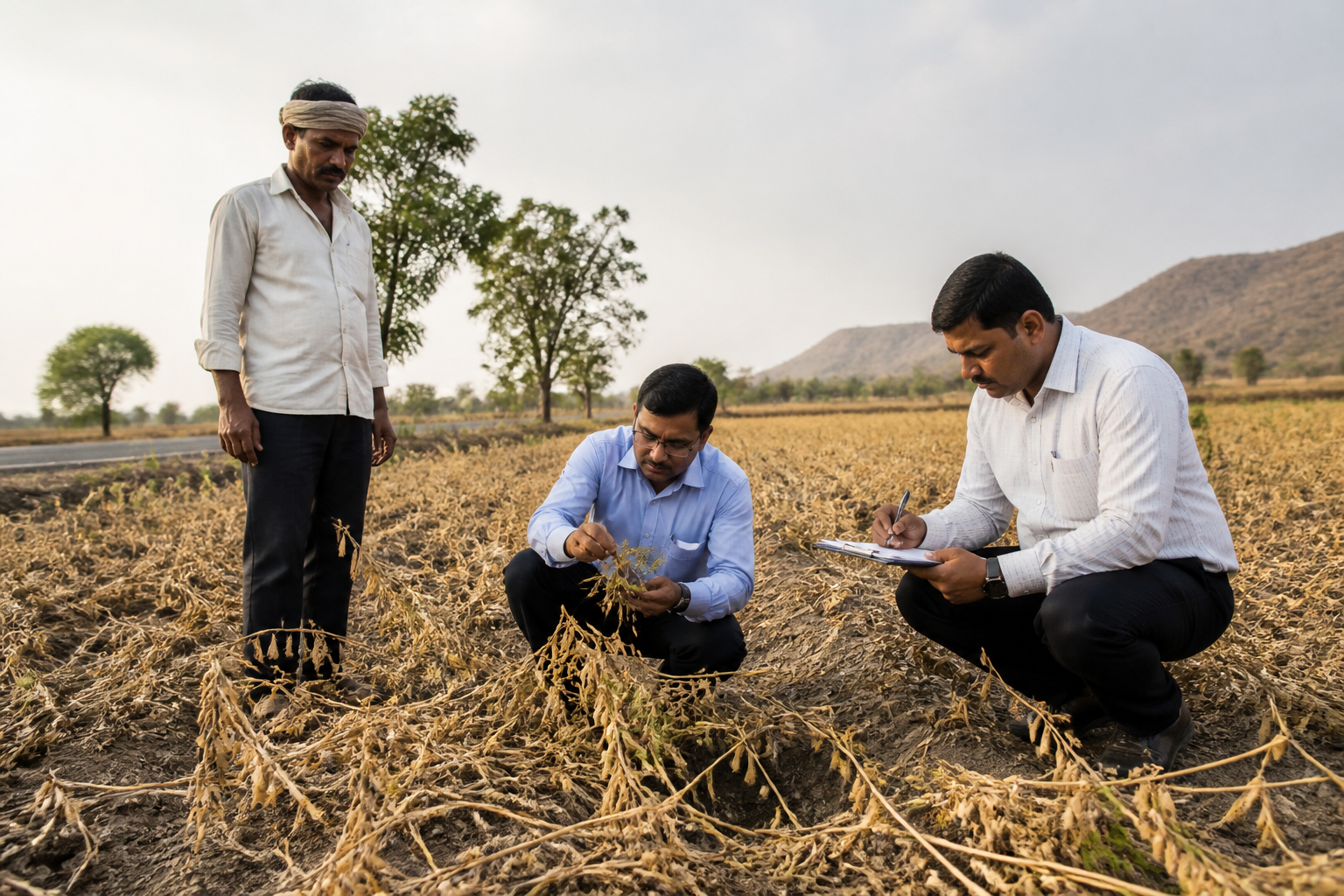
Pune’s drought crop loss assessment has covered only around 7,000 hectares in a week, against an estimated 1.25 lakh hectares of affected kharif farmland, raising concerns over delays in documenting losses and processing relief for farmers.
The panchanama exercise is being conducted across eight drought-declared tehsils: Bhor, Velhe, Khed, Shirur, Daund, Purandar, Baramati and Indapur. Agriculture department officials have been instructed to visit affected farms, record the extent of crop damage, upload photographs and other details to the government system, and submit the completed assessments to higher authorities.
District agriculture officer Vaibhav Tambe said tehsil-level teams had been directed to accelerate the process. “I have instructed all tehsil-level teams to expedite the exercise this week. It is a challenging task for them to visit each affected zone and farm to complete the procedure. But our endeavour is to complete the entire exercise within a few days,” he said.
The slow pace has become a concern because farmers may remove damaged crops or begin preparing their fields for the next season before officials reach their farms. Agriculture activist Shripad Lonari of Bhose village in Khed said farmers often uproot crops or flatten plantations when they know the harvest will be poor. If the panchanama is delayed, he said, officials may not be able to determine the actual extent of an individual farmer’s loss.
Farmers also face a practical conflict between preserving evidence and preparing land for the next crop. Asha Pandhare, a farmer from Shirur, said she needed to prepare her soybean field for onion cultivation and could not wait indefinitely for officials to conduct the inspection. “If I don’t prepare my plot, how will I replant the onion? So I did not think of leaving evidence in the farm,” she said.
Agriculture officials said the process involved more than a field visit. Teams must document the damage, upload photographic evidence and ensure that farmers submit the required documents. An agriculture assistant involved in the exercise said the farmer’s presence and paperwork were essential because an incomplete application could not be forwarded as a final panchanama report.
Coordination with the revenue department has added another logistical challenge. Officials said revenue personnel were required to be present in some cases but could be responsible for three to five villages at a time. One agriculture official said teams could not proceed in those cases without the revenue department’s participation, arguing that the staffing constraints also needed to be considered when assessing the pace of the exercise.
The assessment has therefore become a test of how quickly multiple layers of district administration can document damage across a large rural area. The estimated affected area is nearly 1.25 lakh hectares, requiring thousands of field-level visits within a limited period while farmers face pressure to clear damaged crops and begin the next agricultural cycle.
The agriculture department has said it will accelerate the exercise and aims to complete it within a few days. The final assessments will determine how accurately the drought-related crop losses are recorded and how quickly affected farmers can be considered for government relief.

