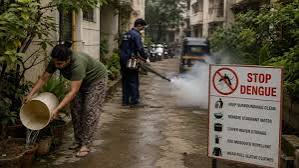
Dengue transmission is continuing across Maharashtra’s Mumbai-Pune-Thane urban belt, with diagnostic data indicating elevated positivity over 16 consecutive weeks. The pattern matters because sustained transmission across a connected metropolitan corridor can place prolonged pressure on civic health systems, particularly when monsoon conditions support mosquito breeding and residents move frequently between adjoining cities.
Data from a private diagnostic network tracking more than 200 cities shows dengue positivity of nearly 8% in Mumbai and above 7% in Pune. The figures are based on tests conducted through the network and therefore do not represent the total disease burden across Maharashtra. However, the duration of the trend provides an important surveillance signal. The persistence also needs to be viewed against government data. Maharashtra’s official dengue surveillance recorded 19,034 cases in 2024 and 19,385 in 2025, according to national vector-borne disease data. The latest surveillance figures indicate that dengue remains a recurring public-health challenge rather than an isolated seasonal event. Pune, in particular, has seen a marked increase in suspected dengue cases. Municipal data showed 484 suspected cases in August, compared with 323 in July and 175 in June. The civic administration has identified areas including Kothrud and Nagar Road-Wagholi for closer monitoring and has directed departments to remove stagnant-water breeding sites.
That urban geography is significant. Mumbai, Thane and Pune are linked by dense residential development, workplaces, transport networks and commercial activity. Disease-control measures therefore cannot depend only on isolated ward-level action. Water storage, construction sites, discarded containers and poorly managed drainage can create mosquito-breeding locations across both formal and informal neighbourhoods. The monsoon adds another layer of risk. Intermittent rainfall and water accumulation can provide breeding opportunities for Aedes mosquitoes, the primary vectors responsible for dengue transmission. Urban planners and public-health experts increasingly view drainage, waste management and water infrastructure as part of disease prevention rather than separate municipal functions. The fever burden is also becoming harder to interpret through symptoms alone. Dengue can present with fever, headache, fatigue and body aches, symptoms that overlap with other infections. Maharashtra is simultaneously monitoring illnesses such as typhoid and leptospirosis, with the latter particularly relevant where flooding or contact with contaminated water occurs.
For city administrations, the immediate requirement is sustained surveillance rather than short-term response. That means regular mapping of cases, rapid removal of breeding sites and better coordination between health, sanitation, drainage and building authorities. The Maharashtra dengue trend ultimately underlines a broader urban-health lesson: climate-sensitive diseases are closely connected to how cities manage water, waste and public space. As the monsoon moves towards its later stages, maintaining those basic systems will be central to limiting continued transmission.