


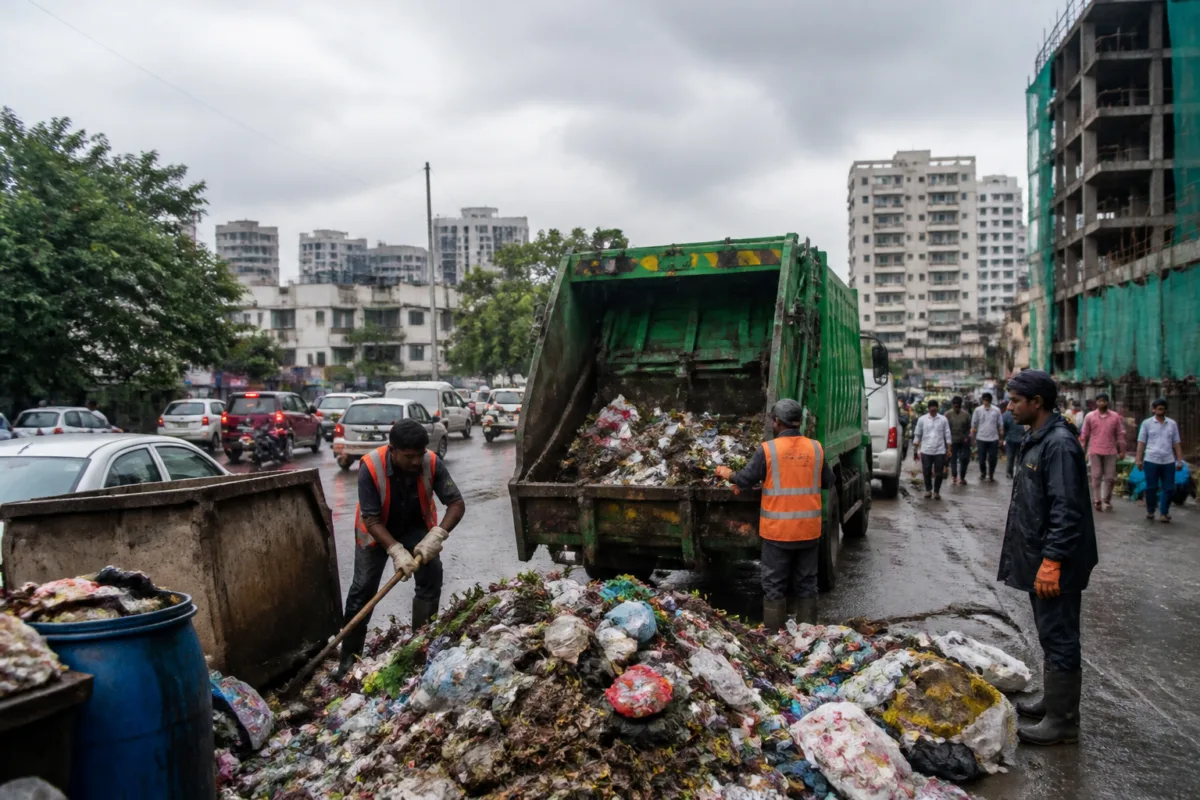
Pune’s fall out of the top 10 in the national cleanliness rankings is more than a reputational setback for the municipal corporation. It exposes a widening gap between the money spent on waste collection, processing and public awareness and the everyday condition of the city’s streets, dumping points and air.
According to a report by Sakal – Pune, Pune ranked 27th among cities with populations above 100,000 and 12th among cities with populations above one million in the latest cleanliness assessment. In the previous assessment for cities with more than one million residents, Pune had ranked eighth, after placing sixth before that. The decline has continued despite repeated assurances that the city’s performance would improve in the next cycle.
The ranking therefore captures a service-delivery problem that is visible beyond the final position. The report says garbage accumulated at several locations during June and July, while complaints about waste collection, transportation, processing and general cleanliness were raised by councillors across political parties. The reported result suggests that the systems responsible for moving waste from households and commercial areas to processing or disposal facilities are not delivering consistently at street level.
That distinction matters because cleanliness rankings assess more than whether a city announces sanitation campaigns. They are also influenced by the condition of public spaces, toilets, waste handling and municipal initiatives. The report says a central government team inspected public sanitation, toilets and various civic programmes during the same period when Pune was facing criticism over garbage accumulation. The city’s eventual decline indicates that visible campaigns and formal programmes did not compensate for weaknesses in routine operations.
Pune’s waste-management model involves several layers: collection from neighbourhoods, transportation, processing and final disposal. The municipal corporation spends hundreds of crores of rupees each year on these activities, while contractors receive large-value work orders for waste disposal and related services. Regional offices also spend substantial amounts on public-awareness campaigns, wall painting and cleanliness messaging.
The central institutional question is not whether money is being allocated. It is whether expenditure is translating into reliable service outcomes. A city can increase spending on collection vehicles, contracts, processing facilities and publicity while still failing residents if responsibilities are fragmented, performance is weakly monitored or waste remains unprocessed at key points in the chain.
The Sakal report records allegations made by councillors that waste was being deliberately stored to create opportunities for specific contractors to obtain new waste-processing projects. Those allegations were made in civic meetings and are not independently established in the supplied material. They nonetheless point to a structural concern: when waste-management contracts are treated mainly as procurement exercises, the public may see more spending without receiving cleaner streets or more dependable disposal.
The reported presence of garbage piles during the survey period also raises the question of timing. If field conditions deteriorate shortly before an inspection, the city’s ranking can reflect a short-term operational breakdown. But Pune’s earlier movement from sixth to eighth and then to 12th among large cities indicates that the problem cannot be understood only as a single bad week. The longer decline suggests that the municipal system has not corrected recurring weaknesses in collection, transportation, processing or public-space maintenance.
Air quality adds another layer to the assessment. Pune was placed 18th among 50 cities in the clean-air survey, according to the report. The city has received a fund of Rs 281 crore for measures intended to control air pollution, yet its ranking declined. The report links the deterioration to waste burning, unauthorised ready-mix concrete plants and violations during construction activity, which have contributed to dust in several parts of the city.
These sources of pollution fall across different administrative responsibilities. Waste burning is linked to collection, segregation and enforcement. Dust from construction is connected to building-site compliance, road management and monitoring. Ready-mix concrete plants involve land-use permissions, industrial regulation and local enforcement. The result is a coordination problem in which a city’s air-quality performance depends on several agencies and sectors, while accountability can remain divided.
The reported mismatch between the Rs 281 crore allocation and the lower clean-air ranking does not by itself establish that the money was misused or ineffective. It does show that funding alone cannot be treated as evidence of improved air quality. For public spending to produce measurable results, the city must be able to connect each intervention with clear targets, implementation records and outcomes that can be checked on the ground.
Pune’s sanitation and air-quality experience also shows why rankings should be read as signals rather than complete diagnoses. A ranking can identify deterioration, but it does not automatically explain whether the cause is inadequate infrastructure, weak contract management, poor enforcement, uneven service coverage or operational disruption. Those explanations require municipal records, contract-performance data, inspection reports and ward-level evidence, none of which are provided in the supplied report.
Still, the available facts establish a consistent pattern. The city has fallen in the large-city cleanliness ranking, garbage accumulation has generated repeated public criticism, major sums are being spent on waste services, and air-quality performance has weakened despite dedicated funding. The problem is therefore not limited to public perception. It involves the relationship between municipal inputs and urban outcomes.
The political response recorded in the report reflects this accountability gap. Congress councillor Prashant Jagtap criticised the municipal administration and the ruling BJP, arguing that the city remained unclean despite central funding and spending on waste collection and processing. His comments are political claims and should be distinguished from the reported ranking and service conditions. Standing Committee chairperson Shrinath Bhimale said the issue would be examined and that information would be obtained before discussion and corrective measures.
The municipal corporation’s next step, as described in the report, is to gather information and discuss measures in the Standing Committee. That process will be important because the ranking decline cannot be addressed through awareness campaigns alone. The city will need to establish where waste is accumulating, how quickly complaints are resolved, whether contractors meet their obligations, how processing capacity is being used and how air-pollution funds have been deployed.
The larger urban question is whether Pune’s civic system measures success through expenditure and visible initiatives or through the reliability of basic services experienced by residents. Clean streets, functioning public toilets, controlled dust and timely waste removal are not separate campaign goals. They are connected outputs of municipal planning, contracting, enforcement and daily field supervision.
The evidence supplied in the report confirms Pune’s decline in cleanliness rankings and records continued concern over garbage management and air pollution. It does not establish the precise reasons for the fall or verify the allegations concerning contractors. Those questions will require detailed municipal data and formal responses. The immediate milestone is the promised discussion in the Standing Committee, where the administration is expected to explain the city’s ranking, the use of sanitation and air-quality funds, and the measures planned to reverse the decline.

