


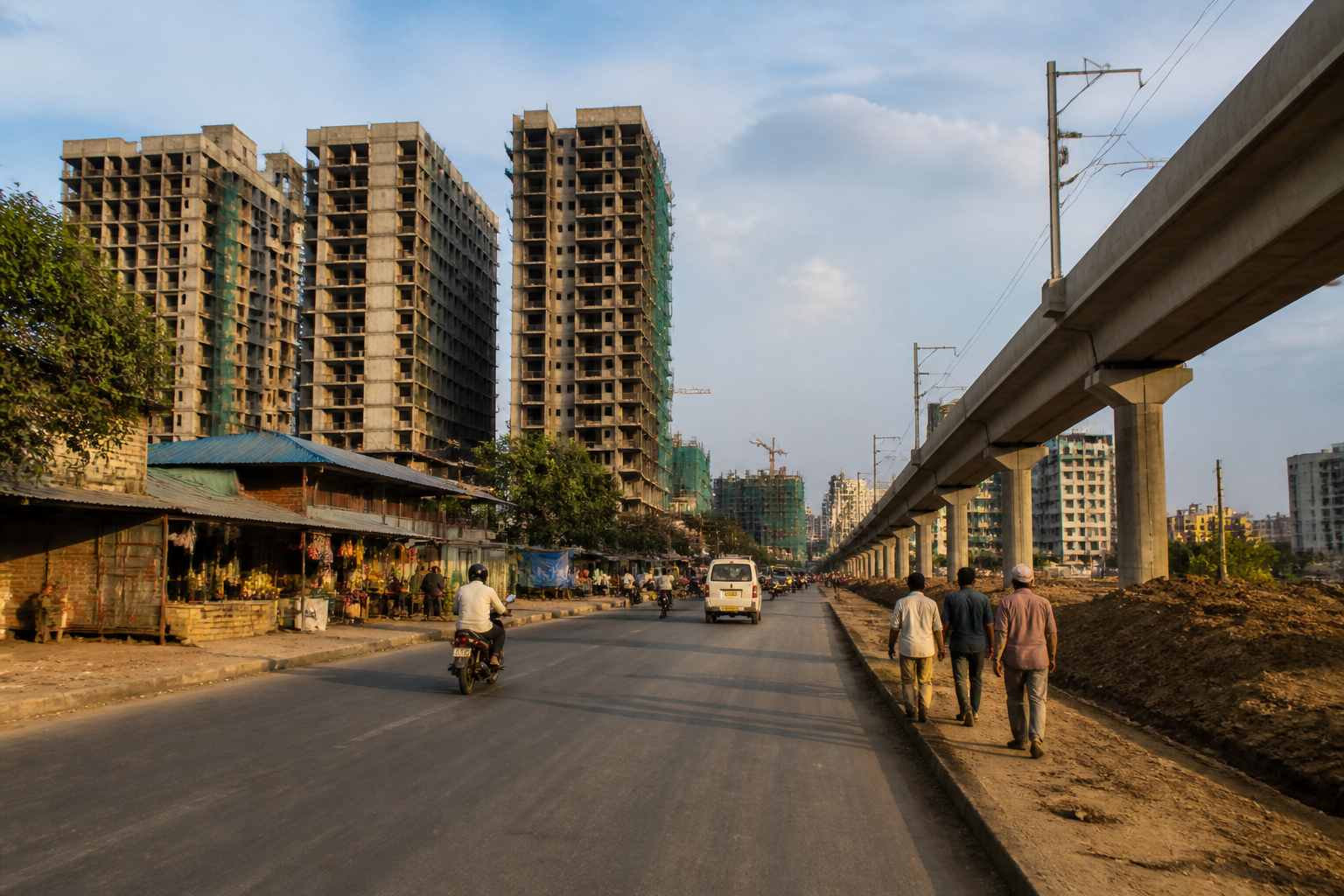
Property under Rs 50 lakh is becoming harder to find in established Indian urban markets, pushing buyers towards locations where infrastructure, employment and housing supply are still developing. A recent report by NDTV Business identifies Pune’s western corridor, Dholera Special Investment Region in Gujarat, and parts of the Delhi-NCR region as three different types of opportunity—but the evidence also shows that affordability in these markets is inseparable from execution risk.
The central issue is not simply whether a buyer can purchase a home or plot within a Rs 50 lakh budget. It is whether the surrounding urban system will become functional enough to support that asset. Roads and metro lines can reduce travel time, industrial projects can create employment, and new expressways can shift the geography of demand. But these benefits do not arrive at the same pace, and an announced project is not the same as an operating one.
That distinction separates the three markets highlighted in the report. Pune’s western corridor represents an established technology and residential market awaiting further transport capacity. Dholera is a development-led proposition whose investment case depends heavily on planned infrastructure and industrial activity. Greater Noida, Ghaziabad and Faridabad offer lower-cost access to the wider Delhi-NCR market, but their performance depends on project quality, location and the ability of new development to connect with existing urban demand.
Pune’s western corridor has the strongest existing demand base among the three. Balewadi, Baner and Hinjewadi have already experienced substantial price appreciation, with Vijay Raundal, director at Teerth Realties, citing increases of 64 per cent, 58 per cent and 51 per cent respectively between 2021 and 2025. These figures are supplied by an industry representative and should therefore be read as a market assessment rather than an independently verified citywide index.
The corridor’s next proposed growth trigger is Metro Line 3. Raundal said the project could reduce travel time from around 90 minutes to 25 minutes. The significance of that claim is less about the precise travel-time reduction than about the relationship between housing and daily mobility. A home becomes more valuable to households when it provides practical access to workplaces, education and services. If a transport project reduces the time and uncertainty of commuting, it can expand the area in which workers are willing to live.
However, the corridor’s existing popularity creates a budget problem. Baner, Balewadi and other established locations may already command prices beyond the reach of a buyer with Rs 50 lakh. The budget may therefore push buyers towards adjoining micro-markets, where the infrastructure benefit may be more distant and the quality of civic services may vary. In other words, the same transport project that supports appreciation in one locality may not produce an identical outcome in every nearby project.
Rental demand is another part of Pune’s investment case. Raundal put current rental yields in the western corridor at between 4.2 per cent and 5.1 per cent and projected 80-120 per cent capital appreciation along the corridor by 2030. These are projections from a developer representative, not assured outcomes. They also illustrate why buyers need to distinguish between rental income and capital appreciation: an asset can attract tenants without delivering the projected resale value, particularly if supply expands faster than demand or if connectivity improvements are delayed.
Dholera presents a more speculative urban growth model. Dholera SIR is being developed as an industrial and investment hub in Gujarat, with the Ahmedabad-Dholera Expressway and a proposed international airport forming part of its broader growth narrative. Here, the property proposition is tied less to an already mature residential ecosystem and more to whether planned infrastructure and industrial activity generate sustained demand.
Hardik Shah, director at Shyam Group Dholera SIR, said plots in approved areas are available at around Rs 7,000-10,000 per square yard, while some high-growth areas have plots being offered at around Rs 999 per square yard. The report also cites developer projections of four- to five-fold returns over five to seven years for some plots, along with projected appreciation of 80-100 per cent over five years for residential units in the Dholera activation zone.
These figures carry a higher risk of being interpreted as a promise when they are, in fact, projections linked to future development. A low land price can reflect early-stage urbanisation, limited current demand or uncertainty about when infrastructure and employment will arrive. It does not by itself establish that the location is undervalued. The practical test is whether the buyer can verify the title, approval status, applicable RERA registration, exact project location and the infrastructure that is already operational rather than merely proposed.
The distinction between approved land and a general growth story is particularly important in a development region. A large planning area can contain locations with very different access to roads, utilities and future activity. Buyers evaluating Dholera therefore need to identify the specific activation zone, the status of the relevant project and the legal basis for the transaction. The report itself warns that infrastructure, industrial activity and actual demand will determine whether the investment case materialises.
The third option is the Delhi-NCR budget belt comprising Greater Noida, Ghaziabad and Faridabad. These markets are closer to an established metropolitan economy and have benefited from expressways and improving connectivity. The Dwarka Expressway and Yamuna Expressway have altered the development map across the region, although the existence of a major road does not mean every project along it will have equal access or equal demand.
Keshav Mangla, general manager for business development at Forteasia Realty, said these cities are seeing demand for residential apartments priced at around Rs 3,000-4,500 per square foot. The lower entry price compared with several established Delhi-NCR markets is the main attraction for buyers who want metropolitan access without paying the prices commanded in the region’s more mature locations.
But the NCR markets also demonstrate the limits of an infrastructure-only approach. Mangla advised buyers to focus on the right developers and ready-to-move projects. That advice points to a wider housing problem: affordability is not determined only by the advertised price of a flat. A buyer must also consider possession, construction quality, approvals, maintenance, water and power access, social infrastructure and the time required to reach employment centres.
A project can be located near an expressway and still impose high daily costs if residents depend on private vehicles, face poor last-mile connections or lack nearby schools and services. Similarly, a lower per-square-foot price may not translate into a lower total cost if the unit is smaller, peripheral or burdened by delayed delivery. The report’s focus on ready-to-move projects is therefore relevant because it reduces one category of uncertainty, although it does not eliminate legal, financial or operational risks.
Across the three markets, the same urban mechanism appears in different forms. In Pune, infrastructure is expected to reinforce an existing technology and rental market. In Dholera, infrastructure is expected to help create a market by connecting an industrial region to wider economic activity. In the NCR, expressways are helping extend the metropolitan housing market into lower-cost locations. The common factor is not infrastructure in isolation but the relationship between transport, jobs and liveable housing.
This is also why projected returns should not be treated as a substitute for housing-market evidence. The supplied report gives appreciation, rental-yield and price figures, but it does not provide independent transaction data, absorption rates, vacancy levels, construction completion records or a comparison of project-level performance. Without those measures, the projections cannot establish how representative the cited numbers are across each market.
For buyers with a Rs 50 lakh budget, the three markets consequently represent different risk profiles. Pune offers a more established demand story but may require compromise on location or unit size. Dholera offers lower entry points in some cited areas but depends more heavily on future industrial and infrastructure delivery. Greater Noida, Ghaziabad and Faridabad offer access to a broader metropolitan economy, while requiring close scrutiny of developers, project completion and actual connectivity.
The institutional question is whether planning and investment decisions are keeping pace with housing expansion. Transport authorities may build corridors, industrial agencies may develop investment regions, and private developers may launch projects, but households experience the result as a single system. If housing is delivered without mobility, jobs without affordable homes, or roads without reliable civic services, the apparent value of the investment may not translate into a functional urban life.
The evidence supplied here supports a more limited conclusion than the promise of doubling money. Infrastructure can create conditions for property demand, but it cannot guarantee returns. The relevant facts for a buyer are the status of the specific project, the legal and regulatory documentation, the developer’s delivery record, current access to services and the strength of existing demand. The three markets are not interchangeable bets: each depends on a different stage of urban development, and each carries uncertainty that the projected appreciation figures do not remove.
