


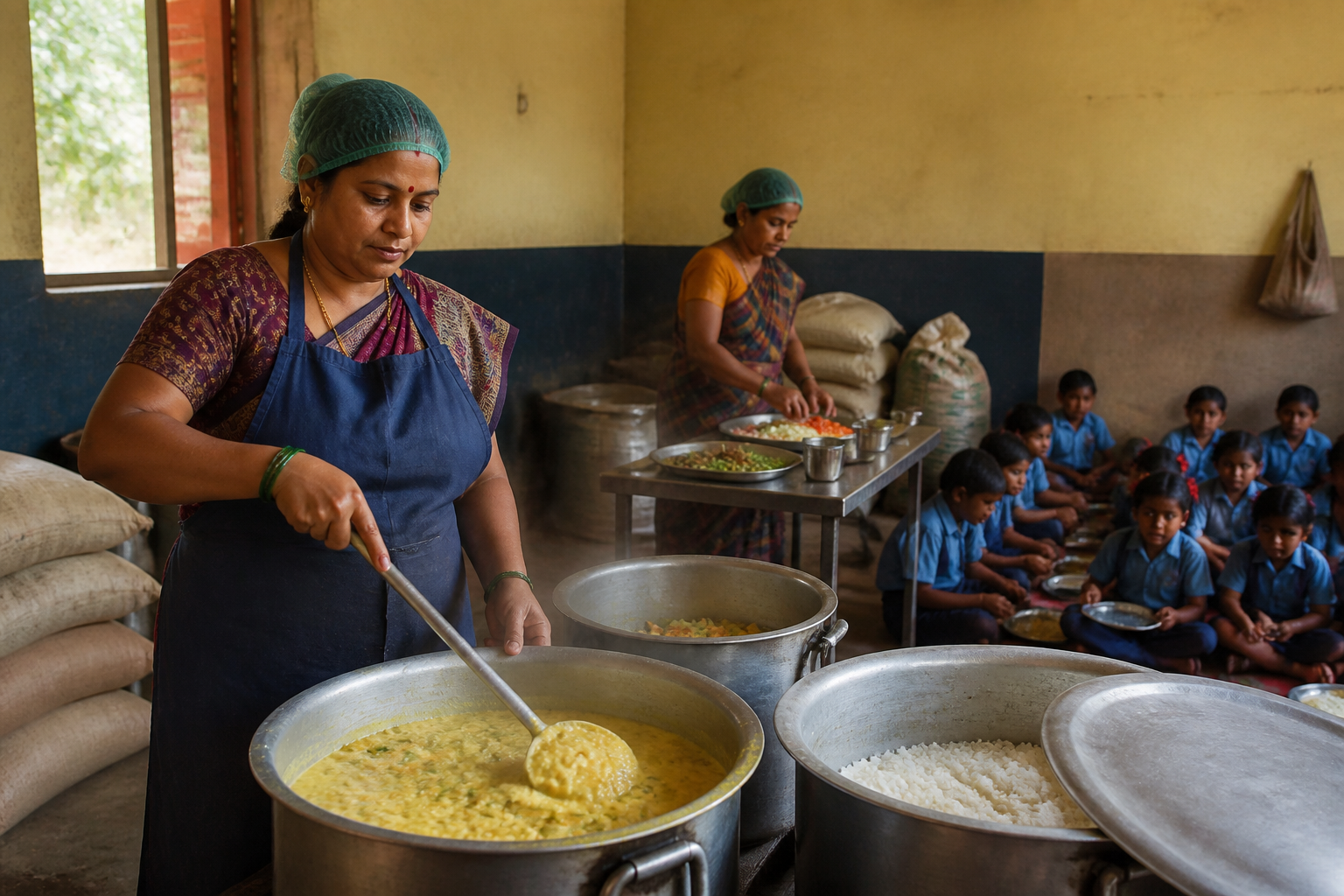
Schools implementing the PM Poshan scheme in Palghar are facing difficulties in serving meals that meet expected quality standards as food grain quality, supplementary food costs and fuel prices put pressure on their limited per-child grants, according to a report by Loksatta.
The report said schools are receiving grain of inconsistent quality under the Pradhan Mantri Poshan Shakti Nirman scheme. At the same time, schools must purchase supplementary ingredients locally and absorb increases in the cost of fuel used to prepare meals. These pressures are making it difficult for schools to maintain the quality of mid-day meals, it said.
School principals are also concerned about possible action by the Food and Drug Administration. The report said a penalty of up to Rs 10 lakh can be imposed if irregularities are detected. Principals named as food-safety certificate holders could therefore face financial and administrative exposure while overseeing the scheme.
The meal programme is being managed alongside schools’ regular academic responsibilities and work assigned through the Election Commission, adding to the administrative burden, according to the report. It did not identify specific schools or detail any inspection action already taken in Palghar.
The per-child rates fixed in June 2025 are Rs 2.59 for students in Classes 1 to 5 and Rs 3.88 for students in Classes 6 to 8. Schools must provide meals within these amounts while procuring ingredients and fuel needed for preparation.
The menu prescribed by the education department includes dal and rice with moong and drumstick, as well as vegetable pulao, onion and potato pulao, masala rice, moong dal khichdi, cowpea khichdi, soybean pulao, chana pulao, lentil pulao and egg pulao. The government has also specified the quantity of food to be served to the two student groups.
The report did not provide a revised grant proposal, a statement from the district education department or details of any immediate administrative measure to address the gap between meal costs and the prescribed rates. It also did not state whether any school in the district had been fined. The existing meal rates, menu requirements and food-safety responsibilities remain the operational framework described in the report.
