


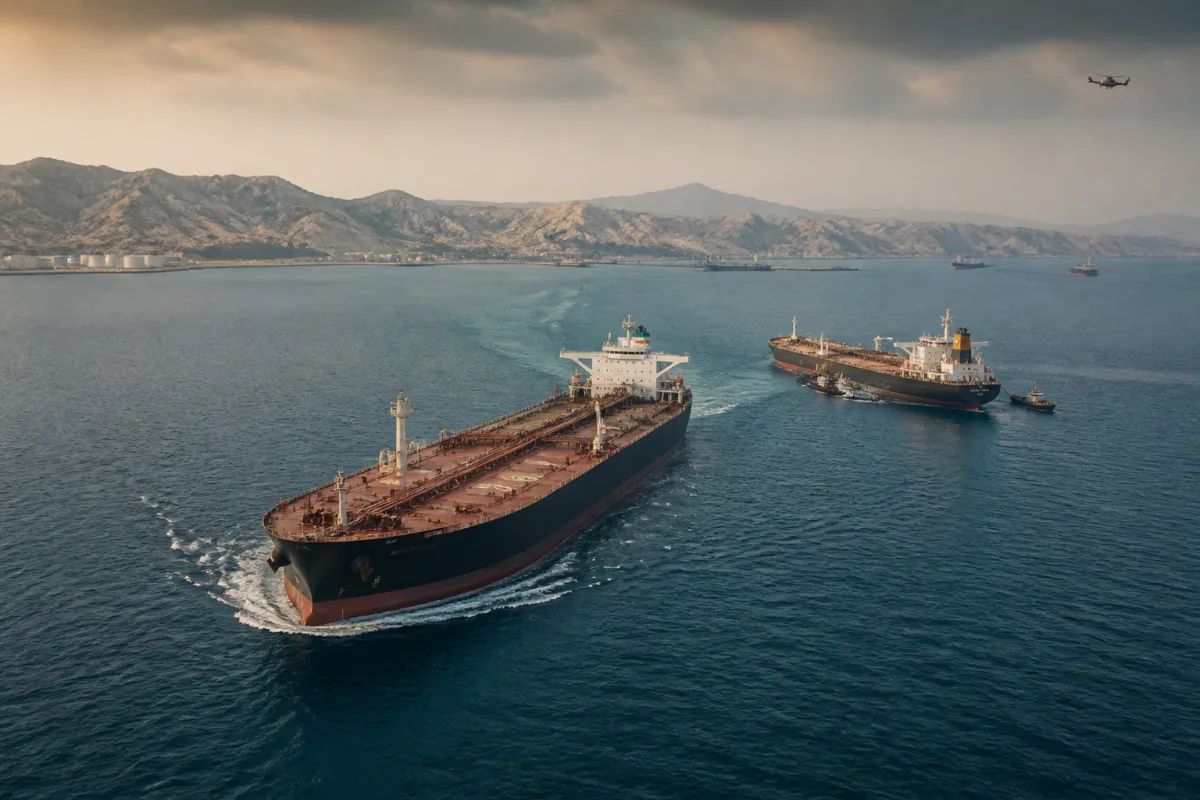
Persian Gulf oil exports have recovered beyond their prewar average even as attacks on vessels in and around the Strait of Hormuz have made the movement of crude more expensive, dangerous and dependent on improvised logistics. The development shows that supply disruption is no longer measured only by how many barrels leave the region. It also depends on how much risk, insurance and additional transport capacity are required to move them.
Oil flows from the Middle East, including shipments through the Strait of Hormuz and alternative routes, averaged more than 24 million barrels a day in the week ending October 18, according to ship-tracking firm Kpler. That was above the prewar average of 23.3 million barrels a day. The headline recovery, however, conceals a significant change in the route taken by those barrels.
Preliminary estimates put average flows through the Strait of Hormuz, including offshore transfers in the Gulf of Oman, at around 14 million barrels a day during the same week. That was about 82% of prewar volumes, according to figures reported by The Wall Street Journal. The difference between total regional exports and flows through the strait indicates that exporters and shipowners are relying more heavily on alternative routes and complex transfer arrangements.
This is not a return to normal shipping. It is the emergence of a risk-adjusted system in which oil continues to move because the commercial incentives are high enough to compensate some participants for the danger. Around 30 attacks on vessels were reported in October, accounting for about 20% of all ship attacks recorded during the war, according to Michelle Wiese Bockmann, a senior analyst at maritime intelligence firm Windward.
The system now supporting Gulf exports combines military protection, route changes, ship-to-ship transfers and pipelines. Some tankers make short trips into the Gulf to load crude, travel through Hormuz and then transfer their cargo to other vessels near Oman for onward delivery. Tankers sometimes switch off their tracking signals during parts of these journeys, making the movement of cargo harder to monitor.
American air cover provides some protection along a corridor near the Omani coast, although it does not remove the threat of attack. Pipelines crossing Saudi Arabia and the United Arab Emirates are also allowing exporters to bypass the strait. Kpler estimated that around 40% of non-Iranian crude shipped out of the Gulf in September travelled through routes avoiding Hormuz, compared with 17% before the war.
The shift matters because the Strait of Hormuz is not merely a geographic passage. It is a critical piece of energy infrastructure whose value depends on predictable access, vessel availability, insurance and the willingness of crews and operators to accept exposure to danger. When one part of that system becomes unreliable, exporters can preserve volumes only by adding alternative capacity and accepting higher operating costs.
Hamad Hussain, a senior commodities economist at Capital Economics, said the shipping system through the dangerous waterway had become well established and that the risk appetite of those involved in exporting oil had increased. His assessment points to an important distinction: resilience in the volume of exports does not mean resilience in the underlying network.
The commercial returns help explain why vessels continue to enter the high-risk area. Traders can earn around $20 more per barrel by reselling Iraqi oil than before the war, according to Homayoun Falakshahi, Kpler’s head of crude oil analysis. For a supertanker carrying a typical cargo of two million barrels, that represents an additional $40 million in potential returns.
Shipowners are also paying more to attract crews willing to make the crossings. One China-based ship-staffing company offered seafarers as much as $25,000 for a round trip that typically lasts one or two weeks, The Wall Street Journal reported. These payments show how a security crisis is being translated into labour costs as well as freight and insurance costs.
The risks remain tangible. The Tanzania-flagged supertanker Loyalty entered the Persian Gulf twice in September and October to load Iraqi crude. After transferring two million barrels of oil to another tanker in the Gulf of Oman in early October, it returned to the Gulf for another cargo. On October 16, the vessel was struck by a rocket-propelled grenade fired from a small boat, according to maritime security company Vanguard. A crew member said the projectile damaged a freshwater tank while the tanker was carrying two million barrels of Iraqi crude.
Such incidents demonstrate why increased export volumes should not be interpreted as evidence that the route has become secure. The logistics system is functioning under active threat. Iran’s Islamic Revolutionary Guard Corps has used drones and missiles against vessels attempting the crossing, while small boats have also been used to target shipping, according to the report.
The cost of transportation provides another measure of the disruption. Freight for a supertanker carrying Gulf crude to China approached a record $37.37 per barrel during the week covered by the report, Kpler said. War-risk insurance premiums rose to as much as 10% of a vessel’s value, compared with less than 3% before the conflict, according to Windward.
These costs change the nature of the supply problem. In April, the main concern was a shortage of crude, according to Natasha Kaneva, head of the global commodities strategy team at JPMorgan. By October, she said, the problem was the cost of moving it. The distinction is important for cities and economies that depend on stable energy supply: oil can remain physically available while becoming more expensive to transport, insure and deliver.
Brent crude rose to around $108 a barrel on Tuesday as markets assessed the possibility that the improvement in oil flows might not last if fighting intensified. The report also said global inventories were thinning, leaving markets with limited room to absorb another supply shock. This creates a fragile form of continuity: present volumes are being maintained, but the buffer available to manage a renewed disruption is narrowing.
The changes are also affecting Iran’s leverage over regional oil flows. Iran’s own oil trade has been constrained by a US maritime blockade, while Tehran has sought to reassert control over Hormuz and warned that neighbouring countries should not be able to export oil if Iran cannot ship its own. Yet continued crude movement through the strait and via alternative routes has weakened its ability to deter regional shipments.
Hussain said Iran would have to become more aggressive to achieve the same degree of control over regional oil flows that it previously possessed. That assessment reflects the way infrastructure redundancy can alter strategic power. Pipelines, offshore transfers, protected corridors and the willingness of operators to pay higher costs have prevented a complete halt in exports, even though none of these measures has made the system safe.
The evidence therefore points to two simultaneous realities. Persian Gulf oil exports have moved above their prewar average, but the route is operating with lower strait volumes, more bypass infrastructure, higher freight rates, sharply increased insurance premiums and greater risks for crews and vessels. Supply resilience is being purchased through cost and exposure.
Whether this arrangement can continue depends on the security of the shipping routes and the direction of the conflict, according to the report. The developments that require monitoring are not only daily export volumes, but also flows through Hormuz, the use of alternative routes, war-risk insurance, tanker freight rates and the availability of crews willing to undertake the crossings. Together, these indicators will show whether the region’s oil system is genuinely stabilising or merely continuing under increasingly expensive pressure.

