


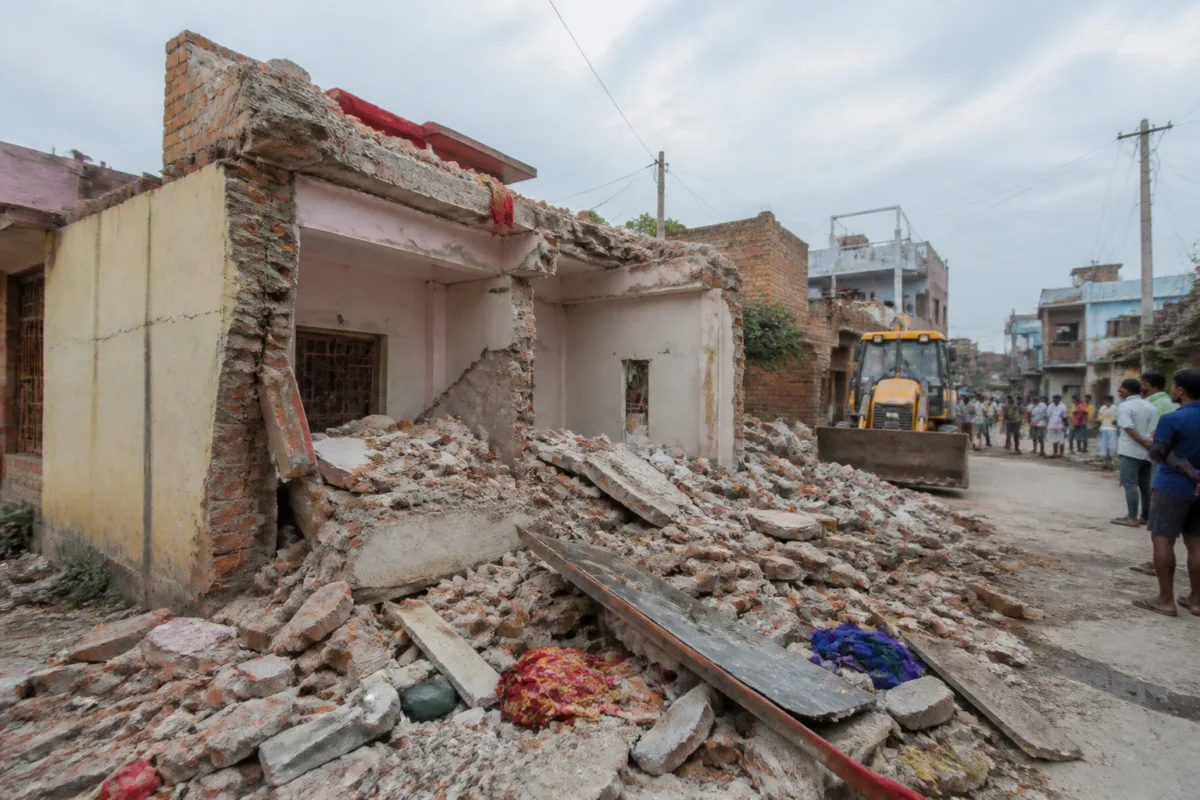
The Patna High Court has directed the Bihar government to pay Rs 2 lakh as interim compensation to a Nawada resident whose house was demolished in 2016 during a land dispute, ruling that an order to deliver possession cannot be treated as legal authorisation to destroy a house or other structure.
A single bench of Justice Raj Kumar passed the order while allowing a decade-old writ petition filed by Birendra Kumar, a resident of Nawada town. The court also directed the chief secretary to appoint a senior officer, excluding the Magadh divisional commissioner and the Nawada district magistrate, to assess the total compensation payable to Kumar.
The Rs 2 lakh payment will be adjusted against the final compensation determined after the assessment, according to the order. The court’s direction places responsibility on the state administration to quantify the damage arising from the demolition and complete the compensation process.
The case originated in a land dispute decided by the Nawada deputy collector land reforms on December 12, 2015. The authority held that Kumar’s possession of his three-decimal plot in Nawada town was illegal. Kumar challenged that decision before the Magadh divisional commissioner in Gaya, but the appeal had not been decided when officials proceeded with the eviction.
According to the account before the court, the deputy collector land reforms directed Kumar to vacate the land before the appeal was resolved. On January 13, 2016, the Nawada circle officer arrived at the property with around 80 police personnel. The house was subsequently demolished using bulldozers by Nagar Parishad Nawada personnel.
The High Court said that a direction for “delivery of possession” did not authorise the demolition of any house or structure standing on the land. It also criticised the conduct of the administrative and police officers, stating that they remained “mute spectators” during the unauthorised bulldozer action.
In its 34-page verdict, the court relied on a recent judgment in the case of Asharfi Yadav, which equated the illegal demolition of a house with “Brahma Hatya”, described in the judgment as a grave sin. The reference forms part of the court’s reasoning on the seriousness of demolishing a residential structure without lawful authority.
The order highlights the distinction between recovering possession of disputed land and removing a built structure from it. In Kumar’s case, the action took place while his challenge to the land decision was pending before the divisional commissioner, according to the court record described in the report.
The next step is the appointment of the senior officer by the chief secretary, followed by an assessment of the total compensation payable to Kumar after accounting for the interim Rs 2 lakh ordered by the High Court.

