


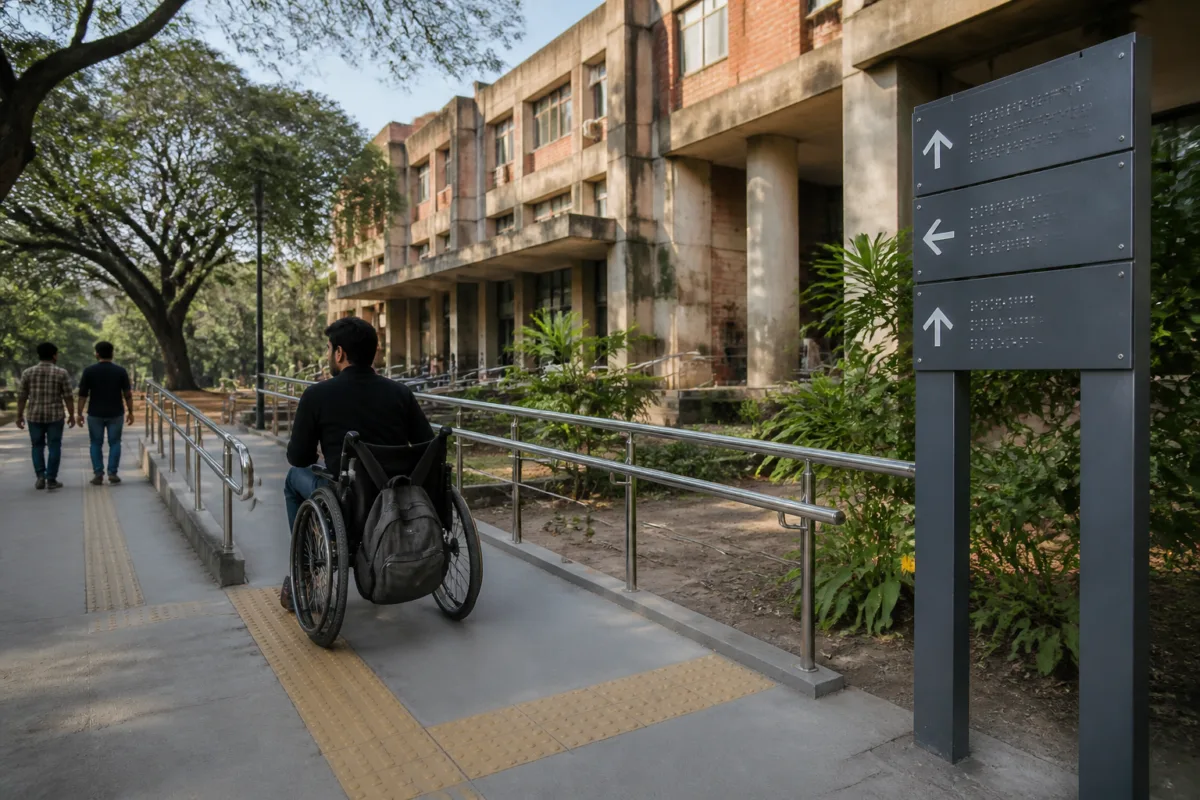
Panjab University has begun a phased accessibility upgrade of its 550-acre campus after a 2023 audit identified infrastructure gaps affecting access for persons with disabilities, according to a report by The Tribune.
The university’s in-house Construction Department has estimated that about Rs 54-55 crore will be needed to improve 16 buildings, including hostels and the administrative block. These facilities are among those frequently visited by persons with disabilities.
The first phase received a grant of Rs 10.43 crore through the Public Financial Management System. Of this, 50 per cent, or nearly Rs 5.21 crore, was earmarked for eight buildings. The university was able to utilise around Rs 2.12 crore before the financial year ended, while the remaining Rs 3.09 crore had to be returned. The unspent amount is expected to be reallocated along with funds released in subsequent phases.
The accessibility audit was conducted in 2023 by Delhi-based organisation Samarthya. The findings prompted the university to initiate a phased improvement programme rather than attempt to upgrade all identified buildings at once.
The first phase included tactile tiles for visually impaired users, accessible washrooms, ramps, handrails, Braille directions and signage. The work covered the Centre for Distance and Online Education, the Institute of Educational Technology and Vocational Education, the Construction Office, the Administrative Block, and the departments of Chemistry, Physics, Geology and the University Institute of Legal Studies.
The accessibility-related work in these buildings has been completed up to the first floor. Narender Luthra, Superintendent of the Equal Opportunity Cell for Persons with Disabilities, said the implementation period ran from July 2025 to October 31 and involved the approval of drawings, tendering and construction execution. Most of the physical construction, he said, took place during February and March this year.
The extent of the work completed so far also highlights a continuing access gap within the campus. While improvements have been made in eight buildings, the university’s own estimate covers 16 structures. Upper floors remain a particular concern where lifts or other accessible movement systems are not yet available.
Installing lifts in older heritage buildings has emerged as one of the project’s main technical challenges. At the Arts Block, conventional modifications were considered difficult, leading to a proposal for an external lift. The report said some components had to be imported and that supply-chain disruptions linked to the conflict in West Asia delayed the process.
For the next phase, the university plans to prioritise lift-related tenders and accessible washrooms on upper floors. These measures are intended to improve movement and access between floors, where ramps alone may not provide a practical solution in multi-storey buildings.
The project therefore combines two different infrastructure tasks: introducing basic accessibility features in existing buildings and adapting older structures where standard interventions may be difficult. The proposed external lift at the Arts Block illustrates the constraints that can arise when accessibility upgrades must be fitted into heritage buildings without major conventional alterations.
The funding position remains central to the pace of implementation. The first phase did not use the full amount allocated for the eight buildings, and the university expects the unspent funds to be reallocated with grants from later phases. The total estimated requirement of Rs 54-55 crore indicates that the campus-wide upgrade will depend on continued funding and phased construction.
Registrar YP Verma said the inclusion of students with disabilities was an important issue for the university and that efforts were under way to secure grants for more buildings. Until the remaining phases are completed, access across the campus will continue to depend on which buildings and floors have received upgrades.

