


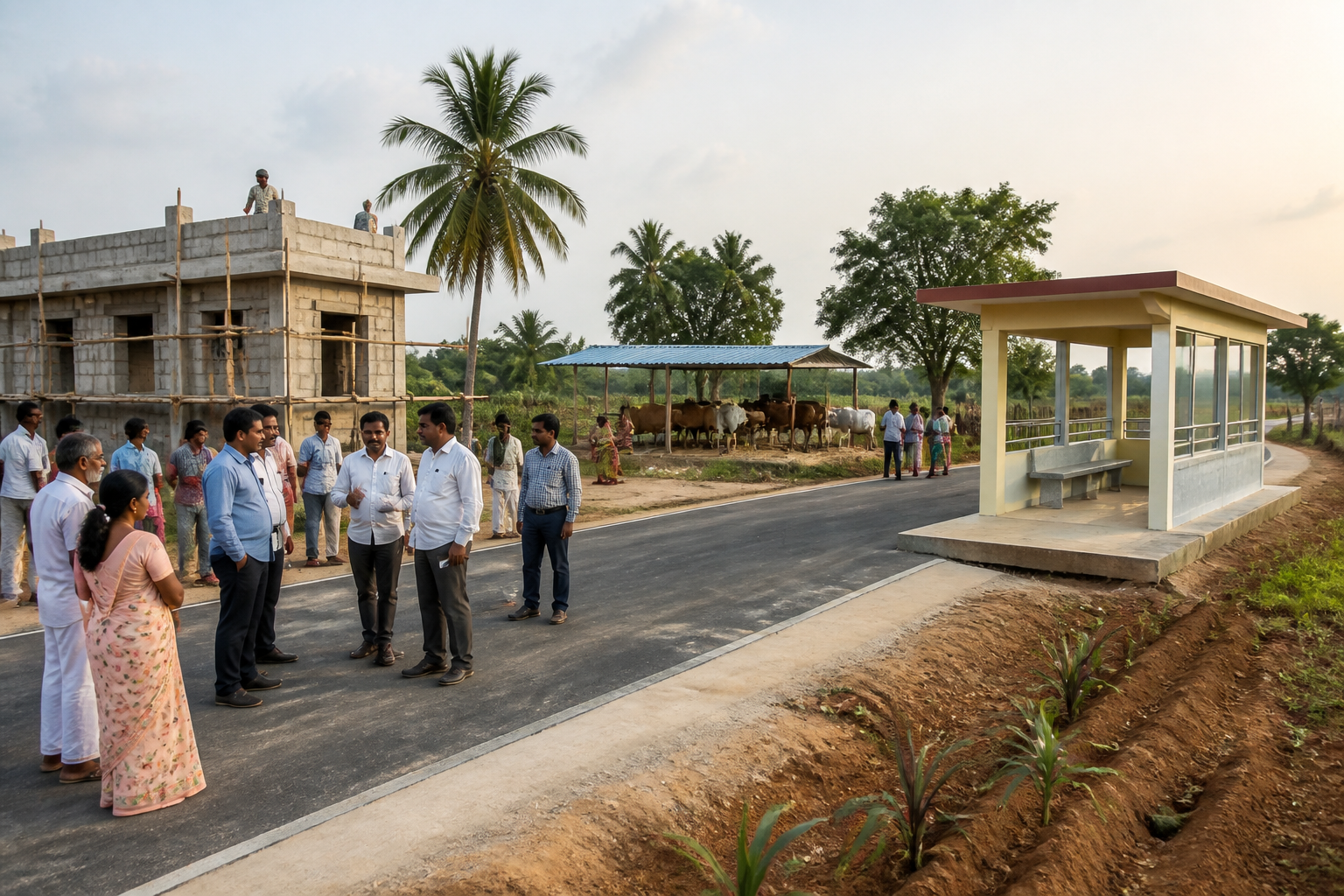
Andhra Pradesh Chief Minister N Chandrababu Naidu on Tuesday launched development works worth Rs 11,085 crore under Palle Panduga 3.0 in Nellore district, covering village roads, bus shelters, gram panchayat buildings, cattle sheds and plantation activities.
The launch took place at Kakolluvaripalli, where the chief minister and the deputy chief minister laid the foundation for the works, according to a press release issued by the state government and reported by PTI. The programme is being implemented as a village infrastructure initiative covering basic amenities and facilities linked to rural livelihoods.
Under Palle Panduga 3.0, the state plans to construct roads and mini gokulams, or cattle sheds, while also taking up plantation works. The programme will additionally cover bus shelters and gram panchayat buildings, among other rural infrastructure projects. The government has said the initiative is intended to strengthen village infrastructure, support farmers and dairy producers, and improve basic amenities.
The scale of the latest package follows two earlier phases of the programme, for which the Panchayat Raj and Rural Development Department reported a range of completed works. Under Palle Panduga 1.0, the department laid 4,000 km of cement concrete roads, constructed 22,514 cattle sheds and 21,000 farm ponds, and undertook horticulture plantations across 64,000 acres.
The second phase included 2,500 km of cement concrete roads and 8,300 km of bitumen roads, according to the government release. It also covered 15,750 cattle sheds, 15,500 cattle water troughs, 86,000 farm ponds, 82,000 individual soak pits and 32 km of magic drains.
The list of works places village connectivity alongside water management, sanitation-related infrastructure, livestock support and local government facilities. Cement and bitumen roads address different layers of rural access, while farm ponds, soak pits and drains relate to water retention, wastewater management and local drainage. Cattle sheds and water troughs are intended to support livestock-based livelihoods and dairy producers.
The programme also assigns a visible role to gram panchayat buildings and bus shelters, which are part of the everyday civic infrastructure used for local administration and public mobility. Plantation works and horticulture activities add an environmental and livelihood component to the construction programme, although the release did not provide district-wise allocations, project-wise timelines or completion targets for the third phase.
The government press release did not specify how the Rs 11,085 crore package would be distributed across roads, buildings, cattle infrastructure, water works and plantation activities. It also did not state the number of villages covered under Palle Panduga 3.0. Further implementation details, including project schedules and departmental responsibilities, will determine how the package translates into facilities on the ground.
