


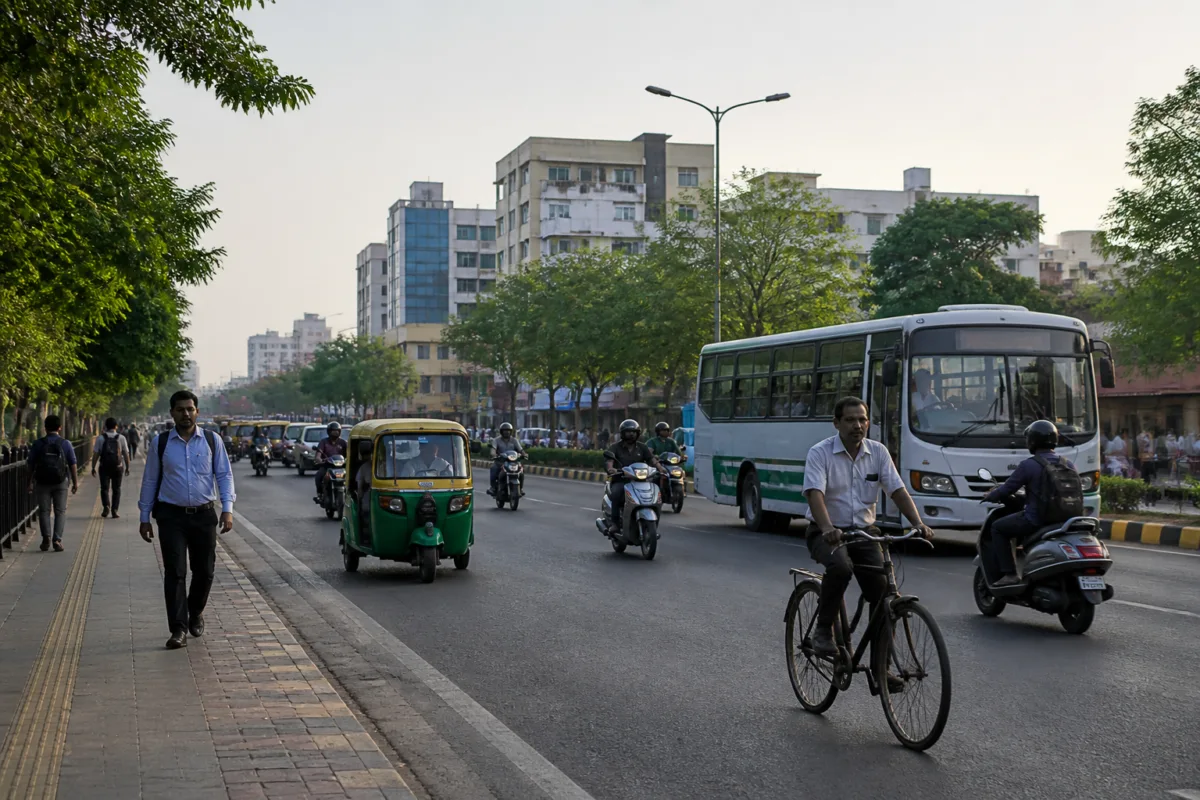
Odisha’s commuting costs are well below the national average, but the National Household Travel Survey 2025–26 suggests that the bigger story is not simply cheaper travel. It is how the state’s settlement pattern, distribution of employment, shorter urban distances and transport choices may be reducing the need for long daily journeys.
Workers in Odisha spend an average of Rs 589 a month on commuting if they are men and Rs 409 if they are women, according to the first National Household Travel Survey released by the National Statistics Office. The national average is Rs 785 a month. The survey was conducted between July 2025 and June 2026 and covered 4.92 lakh households and more than 20.34 lakh people across 14,274 villages and 10,377 urban blocks.
The figures are significant because commuting is often treated as a transport problem alone. In practice, the cost and duration of a journey are shaped by where homes are located, where jobs are available, how far educational institutions are from households, which modes are usable and whether cities have expanded faster than their public transport systems. Odisha’s results bring those relationships into view, although the survey findings do not by themselves establish a single cause for the state’s lower spending.
Travel times in Odisha were relatively short across both rural and urban areas. Workers took an average of 23 minutes to reach fixed workplaces in rural areas and 22 minutes in urban areas. Students took an average of 22 minutes to reach educational institutions. The one-minute difference between rural and urban workers is notable because it indicates that the daily geography of work may not be sharply divided between villages and cities in the state.
The survey counted journeys involving travel of more than 1 km. That qualification matters when reading the results. The data captures journeys beyond the immediate walking distance threshold used in the survey, but the supplied findings do not establish how much of the remaining commuting is done on foot, by bicycle, shared autorickshaw, two-wheeler, bus or other modes in Odisha specifically. Nor do they establish whether lower expenditure results mainly from shorter distances, cheaper modes, lower incomes, different work patterns or some combination of these factors.
The gender gap in commuting expenditure is substantial. Women in Odisha spend an average of Rs 409 a month, around 31% less than men, who spend Rs 589. The survey figures do not explain whether this reflects shorter journeys, different transport modes, lower participation in fixed-workplace employment, different working hours or other factors. Treating the gap only as evidence of affordability would therefore risk overlooking the ways in which access to work and mobility can differ between men and women.
The distribution of employment offers one possible explanation for Odisha’s relatively low travel costs. The Times of India report cited the Sixth State Finance Commission, which found that around 80% of Odisha’s manufacturing jobs were located in rural areas in 2023–24, compared with 53% nationally. This does not prove that rural employment caused lower commuting expenditure, but it points to a different economic geography from states where jobs are concentrated in large metropolitan centres.
When employment is available closer to where people live, workers may not need to travel to a distant urban core. That can reduce both journey length and dependence on costly modes. It can also help explain why the gap between rural and urban travel times in Odisha is marginal. The survey’s 23-minute rural average is only one minute longer than the urban average of 22 minutes, suggesting that the state’s work-related travel system may be less dominated by long-distance rural-to-city commuting than in more metropolitan economies.
Urban planner Piyush Rout attributed the state’s lower commuting expenditure partly to shorter travel distances and the use of bicycles, shared autorickshaws and public transport. He also said many workers in Bhubaneswar live close to their workplaces. His explanation links household expenditure to the physical structure of the city: a compact urban form can shorten journeys before transport policy even begins to influence the cost.
Rout described Bhubaneswar’s grid-based layout as a factor that makes movement between places easier. He also said smaller urban settlements elsewhere in Odisha have often developed along one or two main roads, extending from villages. Their relatively compact spread, he argued, helps keep daily journeys shorter and travel costs lower. These observations are expert commentary rather than direct conclusions established by the survey, but they provide a way to interpret the state-level results through the design and growth pattern of its settlements.
The contrast with larger metropolitan regions is important. Rout said workers in metro cities can spend up to three hours commuting every day, while distances in Odisha’s cities are relatively short. The survey data supplied in the report does not provide a state-by-state comparison of travel times or confirm the three-hour figure as a national benchmark. It does, however, show that 83.4% of workers nationally reached their fixed workplaces in less than 30 minutes. Odisha’s reported averages of 22 minutes in urban areas and 23 minutes in rural areas fall within that broad national pattern.
National transport choices also reveal why commuting cost cannot be separated from mode choice. Two-wheelers were the most widely used mode for workplace journeys across India, accounting for 42.6% of workers. Walking accounted for 28.3%, buses for 6.7% and cars for 3%. For students travelling more than 1 km to educational institutions, walking was the most common mode nationally, followed by buses and bicycles.
These national figures do not show precisely how Odisha compares by mode, but they establish the wider transport context in which the state’s spending figures sit. A worker travelling a short distance by bicycle, walking for part of the journey or using a shared autorickshaw may face a very different monthly cost from a worker dependent on a private vehicle or multiple paid transfers. The survey’s expenditure data captures the outcome, while the supplied material leaves the exact contribution of each mode unresolved.
The findings also raise a planning question about what happens when compact settlements begin to expand. Short commuting distances can be an advantage, but that advantage depends on continued proximity between homes, workplaces, schools and services. If employment becomes concentrated in a few larger centres, or if housing growth moves farther from job locations, travel times and costs could rise even without a major change in transport fares. The supplied survey does not project such a change, so the question remains one for future monitoring rather than a conclusion about Odisha’s trajectory.
The institutional significance of the survey lies in its scale. With nearly five lakh households and more than 20 lakh people across rural villages and urban blocks, it provides a common framework for examining how Indians travel to fixed workplaces and educational institutions. Its value for urban policy is not limited to ranking states by expenditure. It can help connect transport demand with settlement form, employment distribution and access to everyday destinations.
For Odisha, the central evidence is clear: workers report lower monthly commuting expenditure than the national average, and average travel times are short in both rural and urban areas. The evidence is less conclusive on why this is so. Rural employment, compact settlements, proximity between homes and workplaces, and lower-cost transport modes are all identified in the supplied material as possible explanations, but none is established as the sole cause.
The next analytical task is therefore to disaggregate the state-level averages by city, settlement type, gender, occupation, income and mode of transport. Until those details are available, Odisha’s commuting figures should be read as a strong signal about the relationship between urban form and mobility, not as proof that lower travel spending automatically means equal or better access to jobs and services.

