


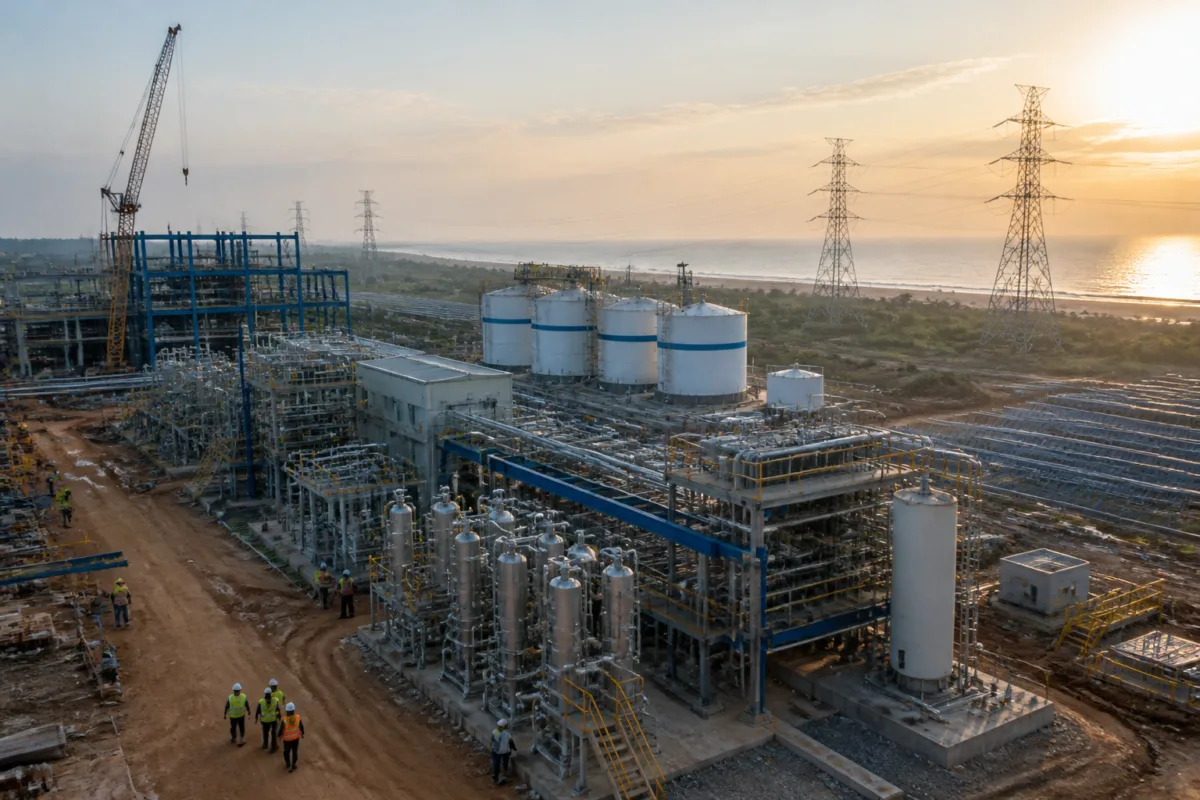
ACME Group has taken the final investment decision to develop a $3.6-billion green ammonia facility at Gopalpur in Odisha, moving the 760,000-tonne-a-year project from development into execution, Business Standard reported on Wednesday.
The plant is expected to be commissioned by 2029 and will use renewable electricity to produce green hydrogen through electrolysers before converting it into ammonia through the Haber-Bosch process. ACME said the facility is designed to operate entirely on renewable energy and could avoid more than 1.5 million tonnes of greenhouse gas emissions each year compared with conventional production pathways.
The project is being developed through ACME’s joint venture with Japan’s IHI Corporation. Its ammonia synthesis loop, with a capacity of 2,200 tonnes a day, is being designed by Germany-based Thyssenkrupp Uhde. ACME said the facility is also being designed to meet the European Union’s Renewable Fuels of Non-Biological Origin standards, which could allow its output to serve markets with strict certification and renewable-energy traceability requirements.
ACME has secured commitments for 370,000 tonnes of green ammonia a year from Indian fertiliser companies through the Solar Energy Corporation of India under the Centre’s Strategic Interventions for Green Hydrogen Transition scheme. A further 83,000 tonnes a year is committed to Japan’s IHI Corporation under the country’s Long-Term Decarbonisation of Power Auction programme.
Together, those commitments cover 453,000 tonnes a year, or nearly 60 per cent of the proposed plant’s output. ACME said the remaining production is intended for other customers and markets, including the European Union.
Green ammonia is produced using renewable hydrogen rather than hydrogen derived from fossil fuels. It is being considered for lower-carbon fertiliser manufacturing, shipping, power generation and other applications that are difficult to electrify directly. Ammonia is also a key input for nitrogenous fertilisers, including urea, making the project relevant to both industrial decarbonisation and agricultural supply chains.
However, green ammonia remains more expensive than conventional ammonia. The project’s commercial structure therefore relies on long-term procurement arrangements, policy support and scale. The secured offtake commitments provide a substantial demand base, while the planned international certification is intended to support access to overseas markets.
ACME said CertifHy, a globally accredited certification scheme for renewable fuels, had examined the proposed renewable electricity framework for the project. This included the geographical relationship between renewable electricity generation, transmission and consumption. The company said the planned ammonia output would comply with applicable green standards in India, Japan and the European Union.
The Odisha investment is aligned with India’s National Green Hydrogen Mission, which has an outlay of ₹19,744 crore and aims to establish at least five million tonnes of annual green hydrogen production capacity by 2030. The project adds to India’s emerging green-molecules pipeline, while also creating a large industrial facility that will require renewable power, electrolysis equipment, ammonia-processing systems and export-linked logistics.
Manoj Kumar Upadhyay, chairman of ACME Group, said the investment decision marked a milestone in moving from ambition to execution at scale. He said the project was backed by long-term offtake commitments from customers in India, Japan and the European Union.
The decision follows Brookfield’s commitment of $600 million to ACME’s green-molecules business. ACME said the investment, together with its own capital, is expected to support more than 1.5 million tonnes a year of green-molecule projects over the near to medium term, backed by long-term agreements with global counterparties.
ACME’s portfolio also includes a first-phase green ammonia facility at Duqm in Oman, with annual capacity of 100,000 tonnes and commissioning expected shortly. In Odisha, the company’s project with IHI was selected earlier this year as the only green ammonia project to receive a contract-for-difference certificate under a programme of Japan’s Ministry of Economy, Trade and Industry. ACME has separately signed a long-term binding agreement with Mitsubishi Gas Chemical for RFNBO-compliant green methanol from Odisha.

