


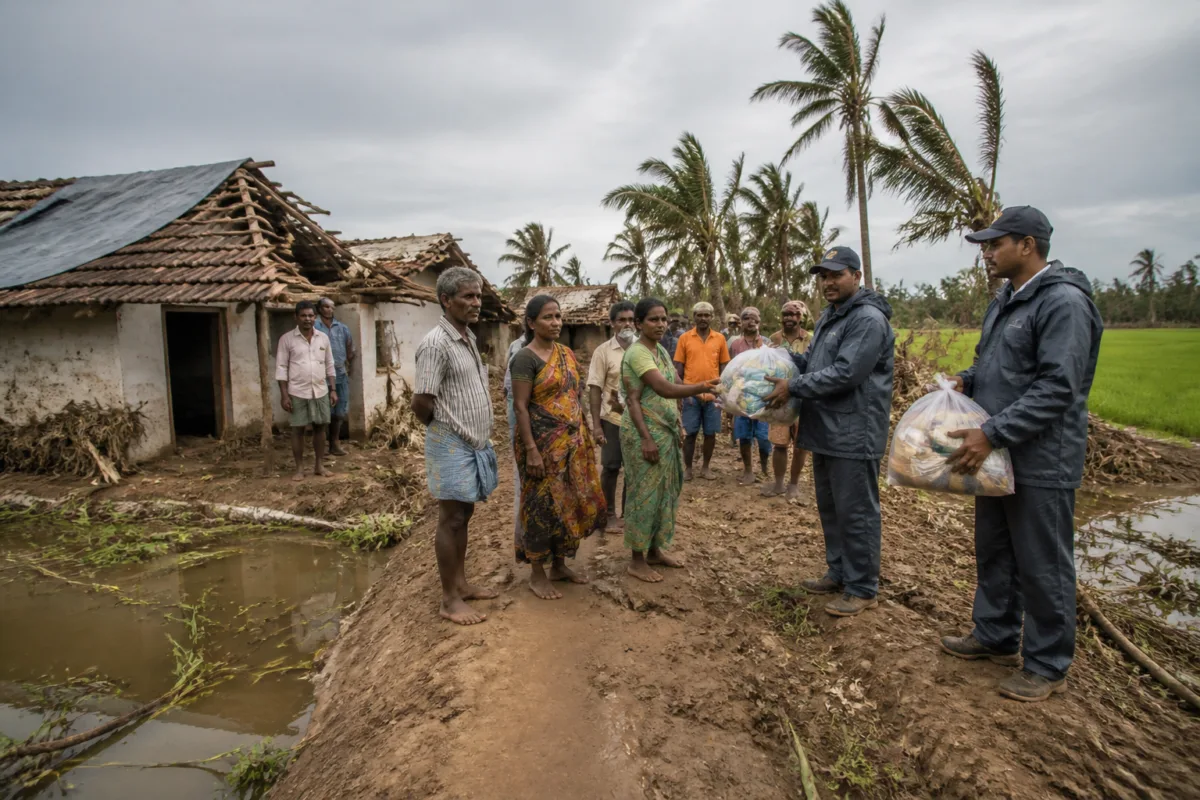
The Odisha government has announced compensation and recovery assistance for families, farmers, fishers, livestock owners, small businesses and other groups affected by Cyclone Arnab, with Chief Minister Mohan Charan Majhi approving the package after a high-level review meeting at the Special Relief Commissioner’s office on Sunday evening.
Each affected family will receive 50 kilograms of rice and ₹2,500 as ex-gratia assistance, according to the announcement. Families whose houses have been washed away, completely destroyed or remained submerged for more than two days will receive an additional ₹2,500 for clothing and ₹2,500 for household utensils.
For houses that are completely or severely damaged, assistance will be ₹1.2 lakh in plain areas and ₹1.3 lakh in hilly areas. Partially damaged pucca houses will qualify for ₹6,500, while partially damaged kutcha houses will receive ₹4,000. The package also provides ₹8,000 for damaged thatched houses and ₹3,000 for damaged cattle sheds.
Farmers reporting crop losses of 33% or more will be eligible for input subsidies for up to two hectares. The assistance will be ₹8,500 per hectare in non-irrigated areas, ₹17,000 in irrigated areas and ₹22,500 for perennial crops, subject to the stated minimum assistance levels. Farmers will also receive ₹18,000 per hectare for removing sand or silt from agricultural land, with a minimum assistance amount of ₹2,200 per farmer.
The government will distribute 1.2 lakh pulse mini-kits, 5,000 oilseed kits and 50,000 vegetable seed kits, taking the total number of special mini-kits to 1.75 lakh. In affected sugarcane-growing areas covering 2,000 hectares, assistance will be provided for demonstrations of space transplanting at ₹27,500 per hectare or ratoon crop management at ₹12,500 per hectare, depending on farmers’ requirements. A 75% subsidy on pesticides and bio-pesticides has also been announced for the 2026-27 rabi season.
The package includes measures for farmers without land or formal tenancy arrangements. Joint liability groups will be formed to help sharecroppers, landless farmers and those cultivating under oral agreements access loans during the current rabi season. Short-term kharif loans may also be converted into medium-term loans for willing farmers in areas where crop losses have reached at least 33%.
Compensation has also been specified for livestock, fisheries and small enterprises. The death of a milch cow or buffalo will attract ₹37,500, while assistance for sheep, goats and pigs will be ₹4,000. Compensation for large draught animals will be ₹32,000 and for smaller draught animals ₹20,000. Poultry owners will receive ₹100 per bird, subject to a maximum of ₹10,000. Support will be extended to 200 poultry farms with losses above 70% for restoration under the Chief Minister’s Agriculture Enterprise Scheme.
Affected fish farmers will receive assistance of up to 75% at a rate of ₹1,12,500 per hectare, with support also available for damaged pond embankments and soil erosion. Assistance has been announced for damaged boats and nets, including higher limits for marine and Chilika fishers. Community ponds leased by women’s self-help groups will also be covered, with support of up to ₹1.75 lakh per hectare.
Small industries, traders and shopkeepers will be eligible for loan assistance of up to ₹12 lakh, including a 25% subsidy on loans up to ₹3 lakh. Street vendors, temporary stalls and kiosks will receive ₹10,000, while shops and commercial establishments will receive ₹25,000. Eligible women’s self-help groups will receive an additional ₹5,000 as seed money. Weavers and artisans will receive ₹5,000 per person for replacing tools and ₹5,000 for damaged materials.
The government has also directed the Odisha Lift Irrigation Corporation to repair lift irrigation points in affected villages on a priority basis. The Chief Minister directed that all such points be made operational before the rabi season. Teams deployed for Cyclone Murasu will remain at their current locations, according to the announcement.

