


The proposed Karnataka electricity rules 2026 have turned a technical regulatory exercise into a wider test of how an essential urban service is connected, priced and enforced. At a public hearing on the draft Karnataka Electricity Regulatory Commission Electricity Supply Regulations, 2026, consumer rights groups, trade bodies and industry representatives objected to provisions they said could shift the financial and procedural risks of the electricity system on to applicants, households, developers and businesses.
The objections covered four linked areas: the proposed deduction of part of a security deposit when an applicant withdraws a connection request; the possible use of occupancy or completion certificates as preconditions for a connection; additional infrastructure charges; and retrospective billing when a meter is found to be non-recording. The participants also questioned proposals on additional security deposits and disconnection while billing disputes remain unresolved.
Taken together, the concerns show that the draft is not only about tariff administration. It is also about the sequence in which urban development, building approvals, electricity access and consumer protection are made to fit together. Electricity supply companies need procedures that protect the network and recover legitimate costs. Applicants and consumers, however, face a system in which delays, documentation problems and technical failures may arise from decisions or processes outside their control. The central regulatory question is where that risk should sit.
The draft’s proposed 10% deduction from the security deposit is one of the clearest points of contention. Tushar M Baddi, general secretary of Vidyuth Grahakara Hitharakshana Vedike, Karnataka, questioned the legality of an automatic forfeiture, saying the Electricity Act, 2003, did not provide for such a deduction. The supplied report does not indicate how KERC has responded to that objection or whether the provision will be modified before the regulations are finalised.
A security deposit is intended to protect a supply company against specified financial exposure. The dispute over the proposed deduction is therefore not simply about the amount involved. It concerns the trigger for retaining money, the consumer’s ability to challenge the decision and whether an applicant who does not proceed with a connection should bear a fixed financial penalty. Those details matter because connection applications can be affected by changes in construction schedules, documentation, project viability or other circumstances not explained in the draft’s public discussion as reported.
The issue becomes more consequential when electricity access is tied to building documentation. The Karnataka Small Scale Industries Association objected to a proposed requirement for occupancy certificates or completion certificates before a power connection is granted. Its vice-president, HN Ramakrishnaiah, argued that obtaining these documents can involve lengthy bureaucratic procedures and that the process is not entirely within the applicant’s control.
The association’s position reflects a recurring administrative tension in the built environment. A power connection can be treated as part of a compliance system, but it is also a basic operating requirement for homes, workshops, offices and industrial premises. If electricity companies are required to enforce building-related documentation before supply, applicants may face a dependency between two separate administrative processes: building approval and utility connection. The draft hearing, as reported, does not establish how the proposed rules would resolve delays between those processes.
Ramakrishnaiah proposed that electricity companies should be able to seek the certificates at a later stage during verification rather than making them an absolute precondition to connection. That is a position put forward by KASSIA, not an adopted change in the regulations. Its significance lies in the implementation question it raises: whether regulatory compliance is best secured by blocking initial access or by allowing supply while retaining a later verification mechanism.
### The cost of infrastructure and the risk of duplication
The draft’s infrastructure provisions have raised a separate concern over possible double recovery. An advocate representing a group of resident welfare associations said consumers and developers could both be made to pay for the same electricity infrastructure. The concern relates to a proposed additional 5% charge on distribution transformers, even where developers are already required to deposit 80% of the estimated cost, according to the report.
The available material does not establish whether the two payments would legally cover identical components, whether they would apply in every project or how the final regulations would define the charges. That uncertainty is precisely why the financial architecture of the rule matters. Infrastructure contributions can be legitimate when they correspond to identifiable network costs. They become difficult for consumers and developers to assess when the relationship between an existing deposit and an additional levy is not transparent.
For urban projects, these charges also affect the point at which electricity infrastructure is financed. Developers may incorporate deposits and connection costs into project budgets, while resident welfare associations and eventual consumers may bear those costs indirectly through prices, maintenance obligations or later charges. The hearing therefore connects a regulatory clause to the broader question of how rapidly expanding built-up areas pay for network capacity.
The objection is not a finding that the draft would definitely impose an unlawful double charge. It is a warning from an RWA representative that the structure could produce that result. Whether the final regulations prevent duplication will depend on the definitions, charging formulae and accounting treatment that KERC adopts.
### Meter failure, retrospective billing and the burden of proof
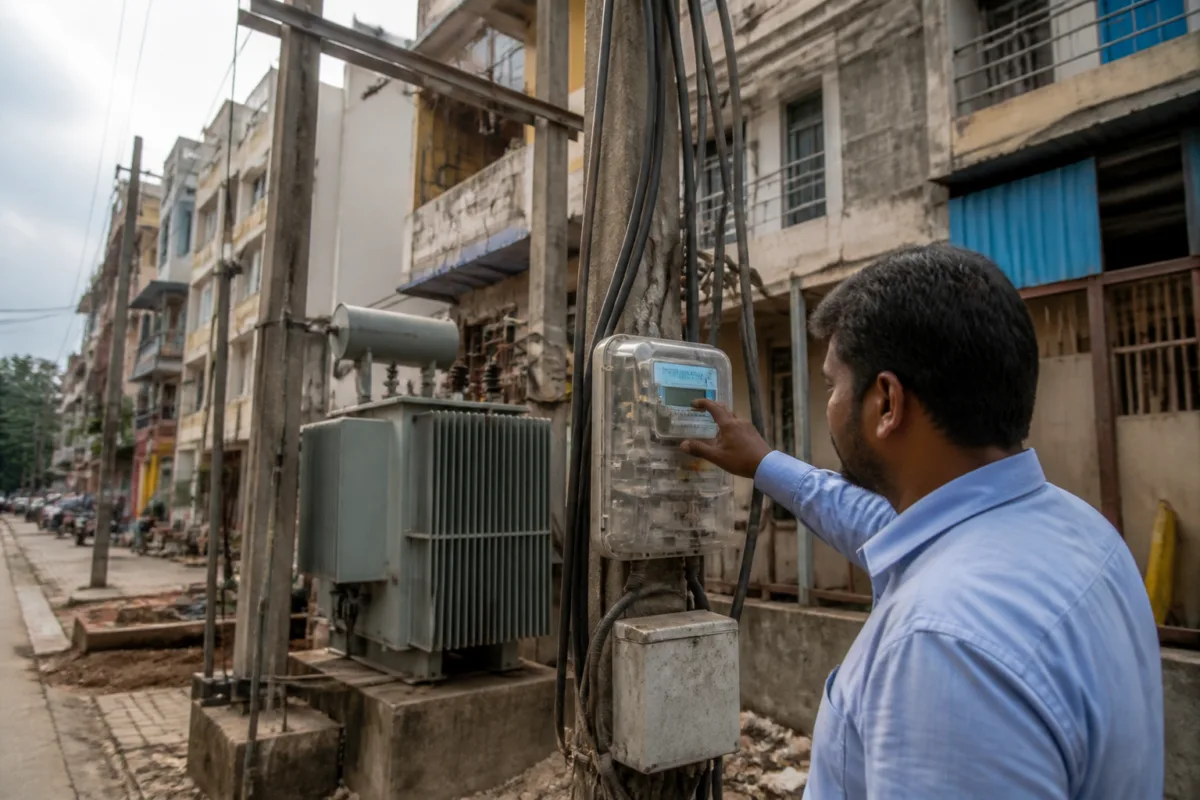
The most direct consumer-protection concern involves meters that are found to be non-recording. MG Prabhakar, an independent energy consultant from Bengaluru, said consumers could face retrospective demands covering as many as six billing months if an inspection found that a meter was not recording. He called for laboratory testing to establish the cause and duration of the malfunction before an additional bill is raised.
This issue exposes the difference between identifying a technical fault and proving the amount of electricity consumed. A non-recording meter may establish that the normal measurement process has failed. It does not, by itself, establish when the failure began or how much power was used during the affected period. The demand for laboratory testing is therefore a demand for a clearer evidentiary process before a retrospective liability is imposed.
The reported proposal places particular importance on timing. A retrospective demand of up to six billing months can convert a technical problem discovered during inspection into a substantial financial liability. The source material does not provide the proposed calculation method, the safeguards available to consumers or the evidence that would be required to determine consumption during the disputed period. Those details will be central to assessing whether the mechanism is predictable and contestable.
Prabhakar also opposed allowing an additional security deposit demand after a single payment default. He sought protection from disconnection while a genuine billing dispute is pending before the electricity supply company. Again, the reported hearing does not establish the final position of KERC or whether the draft contains a formal stay on disconnection during disputes.
That gap points to the importance of sequencing. A consumer may first receive a bill, then challenge it, face a demand for more security and still risk disconnection while the dispute is being considered. The draft’s practical effect will depend on whether these procedures operate independently or whether the regulations create a defined path for complaints, technical examination, revised bills and continued supply.
### A regulatory framework still under examination
KERC’s draft regulations sit at the intersection of the regulator’s rule-making role and the operational responsibilities of electricity supply companies. The public hearing is the mechanism through which affected consumers, trade bodies, developers and other stakeholders can place objections on record before the rules are finalised. The hearing does not itself change the regulations, and the supplied report does not state when KERC will issue its final decision.
The participation of several types of stakeholders is significant because each encounters a different part of the electricity system. Consumer groups focus on deposits, billing and disconnection. Small industries focus on whether documentation requirements can delay operations. RWAs and their representatives focus on infrastructure costs that may ultimately affect occupants. An energy consultant focuses on how technical failure should be established before a bill is revised. These are not identical interests, but they converge on the question of procedural fairness.
The draft also illustrates how utility regulation can shape urban development without appearing in a building plan or land-use policy. A connection rule can affect when a premises becomes operational. A certificate requirement can link electricity access to municipal or building approvals. An infrastructure charge can alter project costs. A retrospective billing clause can transfer the consequences of equipment failure to the user. Each provision operates within the electricity framework, but its effects extend into construction, housing, commerce and local livelihoods.
The evidence currently available confirms that substantial objections were raised at the hearing. It does not confirm that the disputed provisions will be adopted unchanged, that the proposed charges will apply universally, or that retrospective demands will routinely be issued. It also does not provide KERC’s response to each objection, the draft’s full text or the timetable for final notification.
The next important stage is therefore the regulator’s treatment of the objections. The final regulations will need to clarify the basis for security-deposit deductions, the relationship between building certificates and connections, the calculation of infrastructure charges, the proof required for retrospective billing and the status of supply during genuine disputes. Until those details are settled, the draft remains a proposal—but one that reveals how much financial and administrative power is exercised through the everyday act of connecting a city to electricity.

