


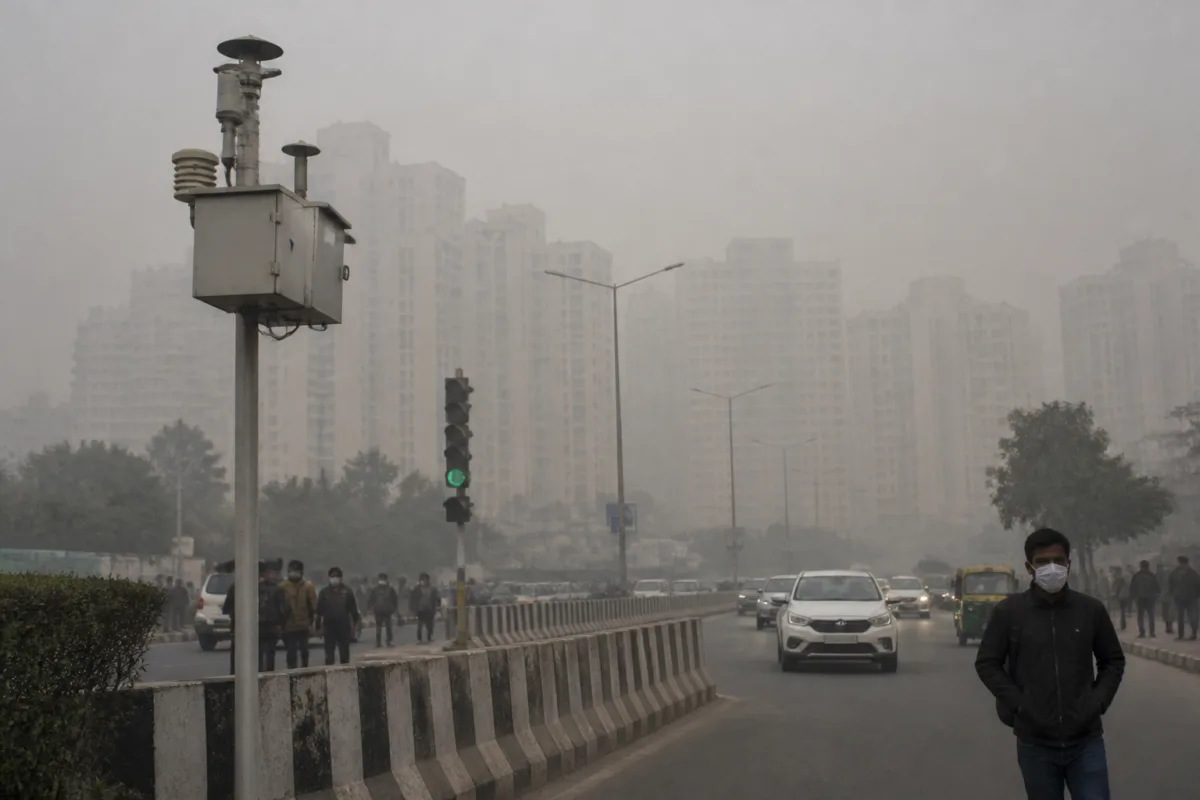
Noida’s air quality deteriorated sharply after Diwali fireworks, with the AQI at Sector 62 reaching 420 on Monday morning as residents across the National Capital Region reported haze, eye irritation, throat discomfort and breathing difficulty. The city’s average AQI was reported at 341 at 10am, placing it in the very poor range.
The deterioration followed heavy fireworks across Delhi-NCR on Sunday. By Monday morning, a layer of haze was visible over Delhi, Noida, Greater Noida and Ghaziabad, according to a report by Navbharat Times – Noida. Delhi’s AQI was reported to have reached 441, while several areas in Ghaziabad also remained under severe pollution pressure.
Within Noida, Sector 62 recorded the highest reported reading at 420. Other locations also showed very poor air quality: the AQI was recorded at 327 in Sector 1, 373 in Sector 110, 278 in Sector 116, 308 in Sector 125, 341 in Sector 150 and 340 in Sector 39.
The readings underline the uneven exposure residents can face within the same city. While the citywide average stood at 341, several monitoring locations recorded substantially higher levels, particularly Sector 62 and Sector 110. The spread of readings across Noida also shows why a single city average may not fully represent the conditions experienced by people in individual neighbourhoods.
The report said the deterioration was visible despite the implementation of Stage II of the Graded Response Action Plan, or GRAP-2, across Delhi-NCR. It did not cite any immediate improvement in air quality after the restrictions came into force. The latest readings therefore place attention on the gap between regional pollution-control measures and conditions recorded at local monitoring stations.
Residents reported symptoms including burning or irritation in the eyes, sore throats and difficulty breathing after stepping outdoors. The report advised children, older people and those with respiratory or heart-related conditions to exercise particular caution while air quality remains in the very poor to severe range.
The pollution episode also illustrates the regional nature of the NCR’s air-quality problem. The affected locations were not limited to one city or one municipal boundary: Delhi, Noida, Greater Noida and Ghaziabad all experienced haze and elevated pollution levels after the festival. This makes the response dependent on coordinated action across the wider urban region rather than on measures in Noida alone.
The immediate air-quality readings and health precautions remain the next indicators to watch as authorities continue implementing GRAP-2 across Delhi-NCR.

