


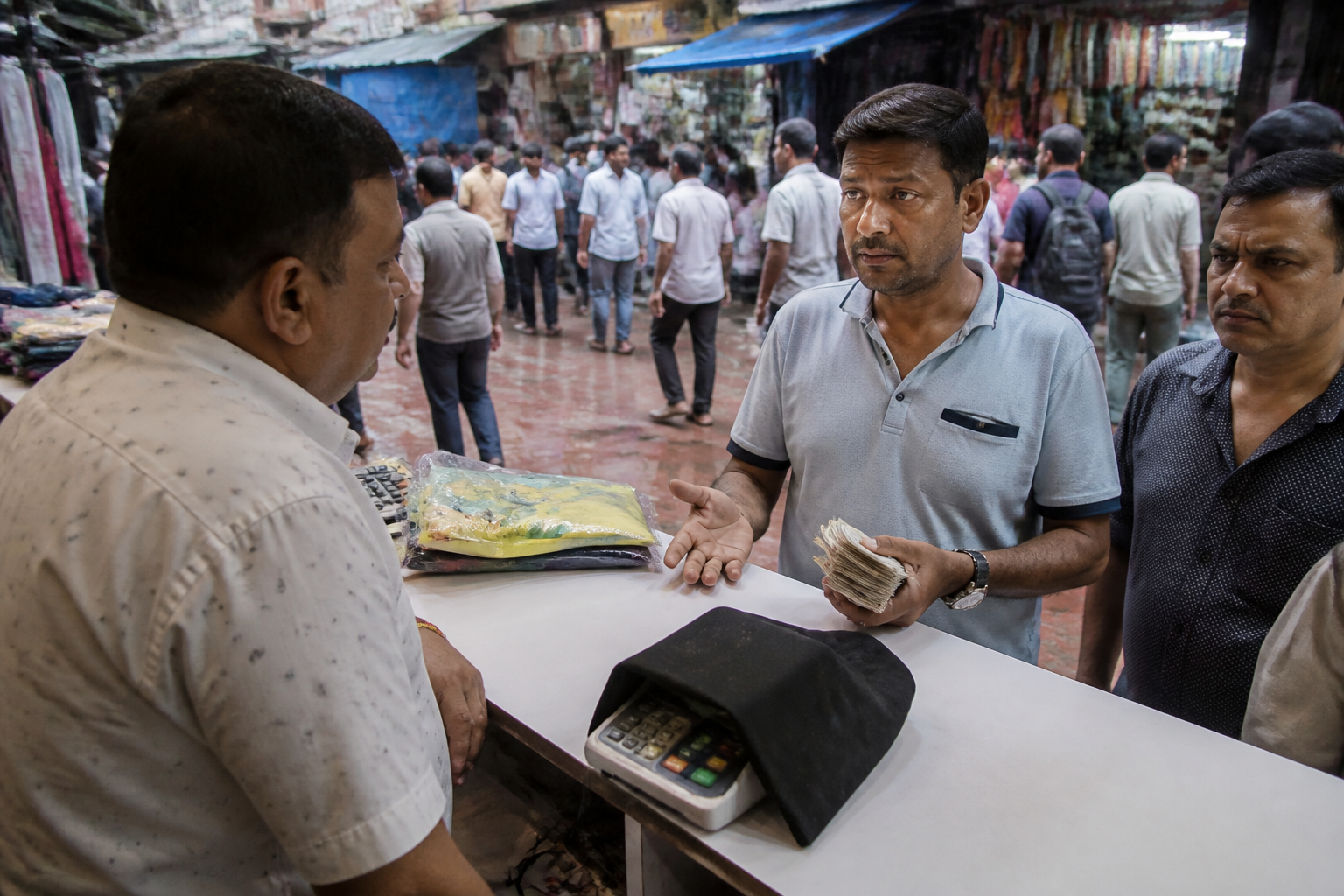
Some traders in Delhi are asking shops to stop accepting UPI payments on October 2 in protest against a proposed 0.4% merchant discount rate on selected UPI transactions above ₹2,000, while other major trade bodies have withdrawn from or denied supporting the call.
The Confederation of Traders of India (CTI) has appealed to traders to observe a “No UPI Day” and accept only cash payments. It has also asked merchants to cover UPI machines with black cloth. CTI claims that more than 100 large trader organisations support the campaign and that the protest could be visible at over 2,000 locations.
The appeal does not mean that UPI will be unavailable at every shop in Delhi. The Confederation of All India Traders (CAIT) has said that it did not decide to observe No UPI Day on October 2, and that no resolution or official announcement to that effect was made. Reports have also emerged that some organisations announced the withdrawal of the protest after a delegation met Union Finance Minister Nirmala Sitharaman.
CAIT, the All India Mobile Retailers Association and the All India Consumer Products Distributors Federation said their representatives met the finance minister and submitted a joint memorandum. The groups sought a postponement of the proposed MDR, a phased implementation and a change in the threshold at which the charge would apply. They also asked that merchant-to-merchant transactions be excluded from the framework and proposed an expert committee to examine concerns from the retail and distribution sectors.
Under the reported framework, a 0.4% MDR is proposed from October 15, 2026, on specified person-to-merchant UPI transactions above ₹2,000. Person-to-person transfers and payments below ₹2,000 would remain outside the proposed charge. The charge would be linked to the merchant payment rather than collected directly from the customer, according to the report.
The proposed framework would cap the MDR at ₹300 for UPI payments of ₹75,000 or more. Separate arrangements have been reported for railway tickets, telephone bills, insurance, fuel and some agriculture-related essential sectors, where a flat MDR of ₹5 per transaction would apply to payments above ₹2,000.
The dispute has also reached the Supreme Court. A petition has challenged the Centre’s September 14 notification and the MDR framework announced on September 15. During the hearing, the court asked the Centre, the Reserve Bank of India and the National Payments Corporation of India about the legal basis for charging fees on certain merchant UPI transactions and how the resulting funds would be distributed.
The court has not stayed the proposed arrangement at this stage and has sought affidavits from the parties. A final decision is still pending. CTI has warned that the proposed charge could increase the financial burden on around six crore shopkeepers and traders, but the extent to which the framework could affect UPI usage or cash payments has not been established in the supplied report.

