


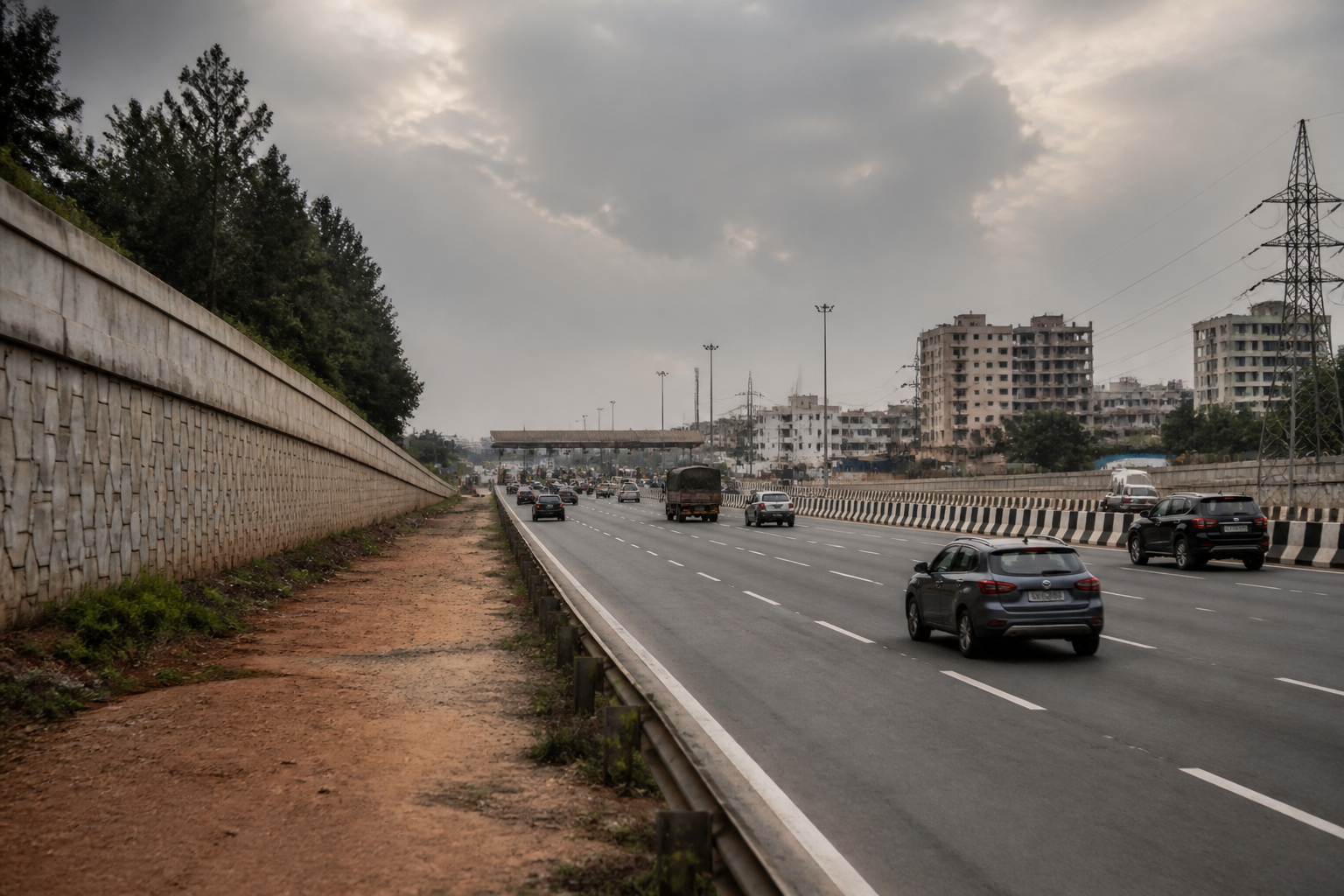
The NICE Road controversy has moved beyond a political exchange between Union minister HD Kumaraswamy and Karnataka Deputy Chief Minister DK Shivakumar. It now sits at the intersection of Bengaluru’s transport infrastructure, land acquisition system, private participation in public projects and a legal process that has remained active for years. Kumaraswamy has questioned how the Bengaluru-Mysuru Infrastructure Corridor evolved from its original framework, while Shivakumar has rejected the allegations as false and politically motivated.
The immediate dispute concerns the Bengaluru-Mysuru Infrastructure Corridor, commonly associated with the NICE Road project. Kumaraswamy has raised questions about alleged changes to the framework agreement, the expansion of land requirements, acquisition of land notified for the project, no-objection certificates and properties near the Hosakerehalli toll plaza. He has also linked those questions to the growth of assets declared by Shivakumar’s family and alleged that changes to the project benefited private interests.
These claims remain allegations. The report does not establish that the alleged transactions or project changes were unlawful, nor does it provide independent verification of Kumaraswamy’s accusations. Shivakumar has said his family’s assets, valued at around Rs 1,400 crore, were acquired legally through business and investments and disclosed to statutory authorities. He has challenged Kumaraswamy to submit evidence to the income tax department. Kumaraswamy has said he will release more documents.
The significance of the controversy lies partly in the fact that the NICE project already has a substantial legal record. The Karnataka high court’s July 29 order dealt with land acquisitions arising from the 1997 framework agreement and subsequent proceedings concerning the BMICP. The Supreme Court’s refusal to stay the high court proceedings has kept the project under judicial scrutiny. That legal background gives the current political dispute a documentary and institutional dimension that goes beyond competing statements by two political figures.
At the centre of the argument is the question of how a major infrastructure project can change after its initial approval. Kumaraswamy has alleged that the 2004 outline development plan altered the original framework substantially, with land earmarked for the tolled road increasing from 6,999 acres to 9,469 acres. The source report does not independently establish the basis for the alleged change or determine whether it was legally authorised. But the difference between the two figures is the precise kind of issue that can be examined through agreements, government decisions, survey records, acquisition notifications and transaction documents.
That distinction matters because infrastructure projects distribute value through land. A road alignment, toll plaza, interchange or associated development can affect access, property prices, acquisition burdens and the future use of surrounding parcels. Where the land requirement changes, the public questions are not limited to the engineering design. They also include who approved the change, which institutions were consulted, whether affected owners received due process and how the revised project was recorded in official documents.
The dispute also shows why land acquisition controversies often outlast the construction phase of a project. The physical road may be visible to the public, but the legal and administrative chain behind it is spread across framework agreements, development plans, notifications, no-objection certificates, acquisition proceedings and court orders. Each document may belong to a different authority or stage of decision-making. This can make public accountability difficult, particularly when political allegations compress a long administrative history into a few headline claims.
The NICE case is therefore not simply a question of whether one politician can answer another. It raises the more important question of whether citizens can reconstruct the history of a major urban infrastructure project from public records. Kumaraswamy has referred to specific agreements, survey numbers, government decisions and transactions as the material needed to support his claims. Political analyst Vishwas Shetty, quoted in the report, said such questions could be answered through official records and that political denial alone may not settle the issue once the documents are placed in the public domain.
That is a useful institutional test. A dispute of this kind can remain trapped in allegation and counter-allegation if the public debate is conducted only through political statements. It becomes more accountable when the underlying records are available for examination and when the responsible authorities explain the sequence of approvals. The source report, however, does not say that all the documents referred to by Kumaraswamy have been released or independently examined. It also does not establish whether the authorities have issued a consolidated response to the specific questions.
The involvement of family-owned or family-linked properties adds another layer of scrutiny. Kumaraswamy has alleged that land notified for the project was later acquired by members of Shivakumar’s family. Shivakumar has denied wrongdoing and said the family’s assets were acquired legally and disclosed to statutory authorities. The report also records a counter-allegation by minister HC Balakrishna that Kumaraswamy holds land in the NICE project area. Kumaraswamy has rejected that charge, saying he bought the land before entering politics, when he was involved in agriculture.
These competing claims illustrate the need to separate three different questions. The first is whether a person or family owned land in or around the project area. The second is whether any acquisition, purchase or transfer complied with applicable law and project records. The third is whether a decision-maker had a conflict of interest or used public authority to benefit a private party. The source material does not resolve those questions. It establishes only that they have become central to the political dispute.
The controversy also has a clear electoral geography. Political strategist MB Maramkal, quoted in the report, said the issue could resonate in Old Mysuru, where both Kumaraswamy and Shivakumar are seeking political space. The report links the dispute to the 2028 assembly elections and says Kumaraswamy’s campaign may challenge Shivakumar’s political narrative. That electoral context helps explain the intensity of the exchange, but it does not determine the truth of the underlying claims.
For Bengaluru, the practical concern is that political contestation should not replace institutional clarity. The NICE Road is part of the city’s wider transport system, and disputes around its land base and contractual history affect public confidence in how infrastructure is planned and delivered. When a project involves a private concession, tolling, land acquisition and multiple levels of government, responsibility can become difficult for citizens to follow. A continuing court process adds another layer, because the legal status of disputed land and project decisions may remain unsettled while political claims continue.
The project’s history, as presented in the report, begins with the 1997 framework agreement and includes later proceedings concerning the BMICP and the 2004 outline development plan. The reported increase in land earmarked for the tolled road, from 6,999 acres to 9,469 acres, is consequently more than a numerical detail. It is a question about how the project’s scope was defined and revised. Establishing the answer would require the original and subsequent agreements, the relevant planning documents, acquisition notifications and the decisions that authorised any changes.
The same principle applies to the allegations concerning the Hosakerehalli toll plaza, no-objection certificates and surrounding properties. These issues cannot be resolved by proximity alone. They require records showing ownership, notification status, the dates of transactions, the authority responsible for approvals and the relationship between those decisions and the project’s implementation. None of those details is independently established in the supplied report.
The court proceedings are therefore important not because they automatically validate one side’s political claims, but because they provide a formal setting in which records and legal arguments can be tested. The Supreme Court’s refusal to stay the high court proceedings means the judicial scrutiny described in the report continues. The eventual relevance of the proceedings to the current political dispute will depend on the documents, findings and orders that emerge from that process.
The NICE Road controversy reveals a recurring weakness in urban infrastructure governance: citizens often receive extensive political argument but limited, consolidated information about how a project changed over time. A project may be publicly justified as a transport solution, yet its most consequential disputes may concern land, contracts, approvals and institutional accountability. In such cases, transparency is not an accessory to infrastructure delivery. It is part of the project’s legitimacy.
At present, the evidence supplied establishes a live political dispute, a continuing legal backdrop and specific questions about the evolution of the BMIC project. It does not establish the allegations against Shivakumar or his family, nor the counter-allegations against Kumaraswamy. The developments that warrant monitoring are the release and examination of the promised documents, formal responses from the relevant authorities, and the Karnataka high court proceedings arising from the 1997 framework agreement and subsequent BMICP decisions.
