


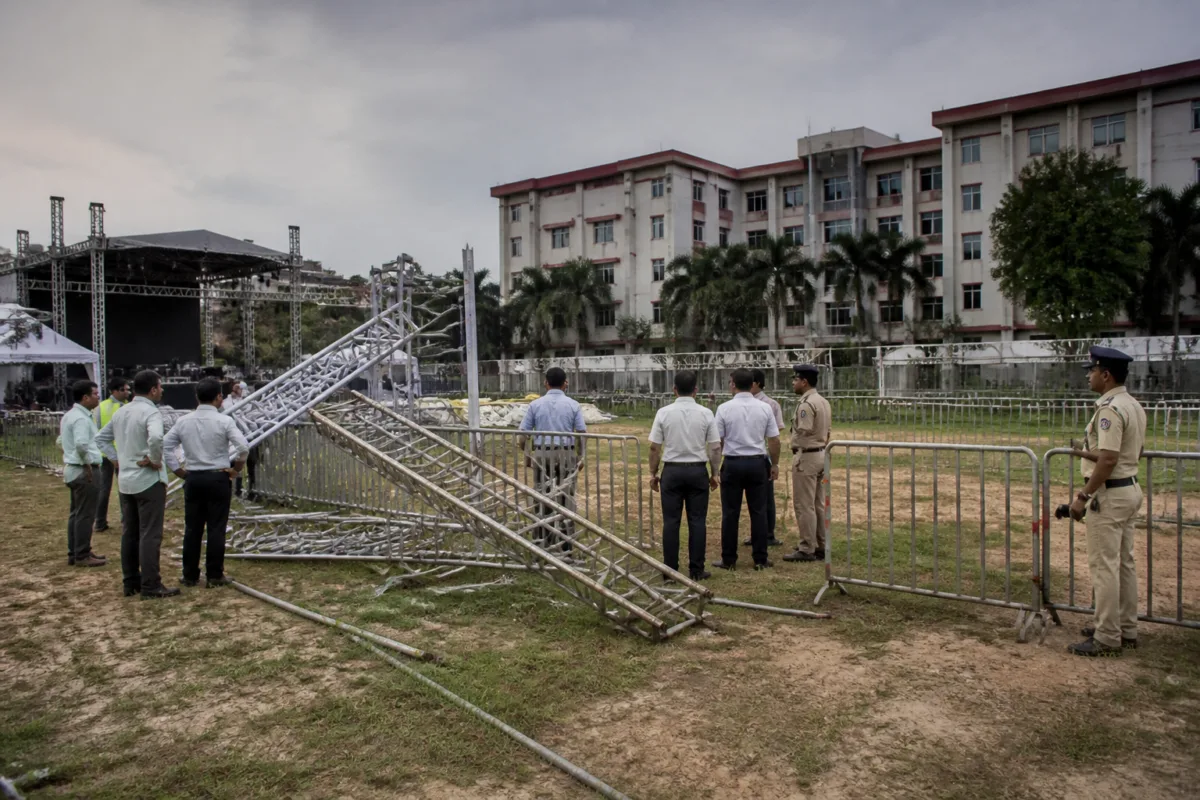
The National Human Rights Commission’s direction for a four-week action taken report on the MVSR Engineering College festival accident has shifted attention from the immediate collapse of a lighting structure to the systems that allow temporary event infrastructure to operate inside educational campuses. The case now involves district and municipal authorities, an alleged failure of structural and event safety, and questions over how responsibility is assigned when a temporary installation causes deaths and injuries.
According to a report by Telangana Today, the NHRC directed the Rangareddy District Magistrate, the Future City Commissioner, and the Commissioner and Director of the Municipal Administration Department, Rangareddy, to take necessary action and submit an Action Taken Report within four weeks. The direction followed a complaint filed by University of Delhi law student Sabavath Kalyan and advocate Karupothula Revanth.
The complaint concerns an incident at the Sangamam 2026 technical and cultural festival at MVSR Engineering College on October 17. It alleges that an overhead metallic lighting truss and its supporting poles collapsed during a Dandiya celebration. The complainants said the incident resulted in the reported deaths of two female students and injuries to around 12–14 other students. The supplied report does not include the NHRC order’s detailed findings, an engineering assessment of the structure, or a final determination of responsibility.
That distinction is important. The NHRC’s direction for an action taken report is not itself a finding that a particular institution, contractor, official or organiser was negligent. It creates a formal requirement for the named authorities to report what action has been taken. The complaint, meanwhile, raises allegations and requests for intervention, investigation, compensation and safety measures. Establishing how the truss was designed, fabricated, installed, inspected and used would require documentary and technical evidence that is not included in the report.
Yet the incident raises a clear urban governance question: who is responsible for safety when a temporary structure is erected for a high-density public event on a private or institutional campus? Temporary trusses, stages, lighting rigs, barricades and crowd-control systems may be used for only a few hours, but their failure can produce consequences comparable to those associated with permanent buildings. Their short operating life does not reduce the need for design checks, load assessment, installation supervision or emergency planning.
The complaint identifies four connected areas of concern: structural safety, event management, crowd control and emergency preparedness at educational institutions. These should not be treated as separate administrative subjects. A structure may be technically sound but become dangerous if crowd movement is unmanaged. Conversely, a well-managed gathering can still be exposed if temporary poles, trusses or lighting equipment have not been properly designed or secured. Safety therefore depends on coordination between the event organiser, the institution, technical personnel, local authorities and emergency responders.
The reported location also matters because educational campuses increasingly function as large public gathering spaces. Festivals and cultural programmes bring together students, staff, guests and service providers. The event environment can include temporary electrical installations, elevated equipment, decorative structures and concentrated pedestrian movement. The report does not state the approved capacity of the venue, the number of people present, whether a structural certificate was issued, or whether emergency access routes and medical arrangements had been checked. These are among the facts that a time-bound investigation would need to establish.
The NHRC’s choice to seek responses from district and municipal authorities illustrates the institutional spread of the issue. The Rangareddy District Magistrate represents the district administration in the action chain. The reference to the Future City Commissioner and the Municipal Administration Department places the matter within a wider local-governance framework. The report does not specify the precise statutory role played by each authority in approving or monitoring the festival, so that division of responsibility remains to be clarified through the action taken report and any related inquiry.
The requests made by the complainants also show that the case is not limited to determining how the structure collapsed. They sought an impartial and time-bound investigation, appropriate compensation for the families of the deceased students, medical assistance for injured students, accountability wherever negligence is established, and comprehensive safety audits of temporary event structures at educational institutions. Together, these demands connect immediate relief with preventive oversight.
Compensation and medical assistance address the consequences experienced by families and injured students. Investigation addresses the chain of decisions before the collapse. Safety audits address the possibility that similar temporary structures may exist at other institutions without consistent inspection. The report does not say whether such audits have already begun, whether a common protocol exists, or whether the NHRC has directed a statewide review. Those matters should not be assumed from the direction alone.
The case also highlights the limitations of treating event safety as a purely internal campus matter. An institution may organise the programme, but public authorities can still become involved where the event affects public safety, involves large crowds or uses temporary structures and electrical systems. The relevant oversight may be distributed across campus administrators, event contractors, municipal officials, district authorities and emergency services. Without a documented chain of approvals and inspections, accountability can become fragmented after an accident.
The available information contains one significant numerical account: the complaint cited two reported deaths and injuries to around 12–14 students. The range itself indicates that the casualty figure in the supplied report is not presented as a final verified medical or administrative count. The number of people at the festival, the dimensions and material specifications of the truss, the cause of the collapse, and the cost or scope of any remediation are not provided. These gaps define what can responsibly be concluded at this stage.
The four-week deadline gives the episode a concrete administrative milestone. A meaningful action taken report would need to establish what authorities have done since the October 17 incident, whether an investigation has been initiated, what assistance has reached the affected families and students, and whether temporary event structures at comparable educational institutions have been reviewed. It would also clarify which agency is responsible for each action and whether any accountability process has been opened.
For cities and rapidly urbanising districts, the larger issue is not limited to one college festival. Public safety is shaped by the everyday interface between institutions, private contractors and local government. Temporary infrastructure often sits outside the public’s view until it fails, while approval and inspection responsibilities can be dispersed across multiple bodies. The MVSR case places that administrative interface under scrutiny without, at this stage, establishing the final cause of the accident.
What the evidence confirms is that the NHRC has sought an action taken report within four weeks from senior Rangareddy and municipal authorities following a complaint about the reported collapse and casualties at MVSR Engineering College. What remains unresolved is the technical cause, the precise responsibility of each actor, the verified casualty record and the extent of any safety review. The next significant development will be the authorities’ response and the findings of any investigation or audit that follows.

