


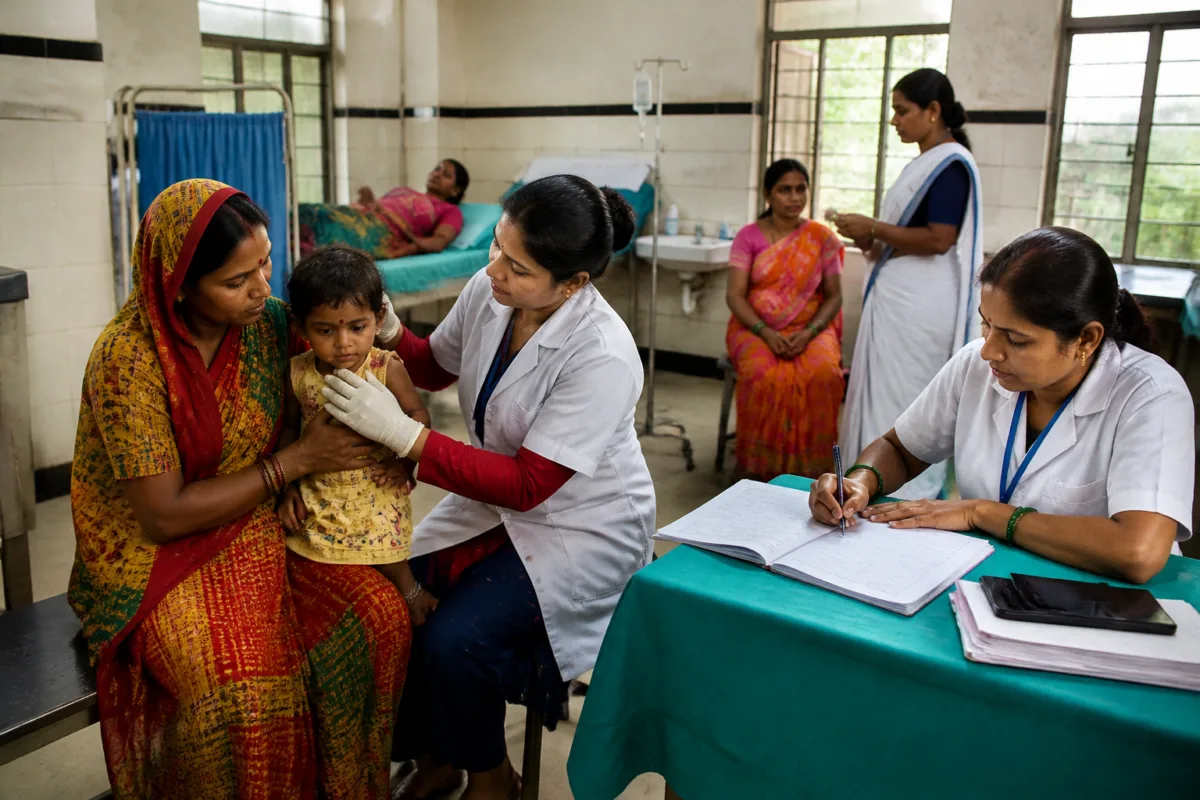
NHM Jharkhand has signed three agreements to strengthen maternal and child healthcare, test new medical technologies and improve public health delivery across the state, with initiatives covering multiple districts and a three-year partnership focused on health systems and care outcomes.
The National Health Mission signed separate memorandums of understanding with the PHIA Foundation, Bharathiya Vikas Trust and Tata Steel Foundation, according to a statement reported by the Times of India. The agreements combine facility-based care, outreach services, health governance, human resources and supply chain management.
The partnerships with PHIA Foundation and Bharathiya Vikas Trust will launch the District Health Sandbox initiative in Sahibganj, West Singhbhum, Khunti, Koderma and Seraikela-Kharsawan. Under the initiative, selected healthcare facilities will be used to test new healthcare technologies and medical devices before any wider adoption.
The sandbox model is intended to allow innovations to be assessed within district health facilities rather than being introduced across the system at once. The material supplied in the report does not specify the technologies or devices that will be tested, the facilities selected, or the criteria that will be used to evaluate them.
The separate three-year agreement with Tata Steel Foundation will focus on strengthening public health systems, improving service delivery and advancing maternal, neonatal, infant and child health indicators. Through its MANSI+ programme, the foundation will continue maternal and newborn health interventions in East Singhbhum, West Singhbhum and Seraikela-Kharsawan.
The foundation will also implement Project SWASTH in 10 districts. The districts named in the report include Ranchi, Dhanbad, Bokaro, Ramgarh and Dumka. The programme’s stated areas of work include public health facilities, outreach services, health governance, staffing, supply chains and public-private partnerships.
The district spread gives the agreements a dual focus: improving services within healthcare facilities and extending interventions through outreach and frontline systems. For residents, the practical effect will depend on how the programmes are integrated with existing district health administration, the availability of trained personnel and the performance of the technologies tested under the sandbox initiative.
NHM mission director Shashi Prakash Jha said the partnerships would support evidence-based planning, strengthen frontline healthcare systems and improve access to quality care across Jharkhand. The statement did not provide a project-wise budget, implementation milestones, baseline health indicators or a schedule for reporting results.
The agreements therefore mark the start of a set of institutional collaborations rather than the completion of a service expansion. The next reported stages are the launch of the District Health Sandbox in the five identified districts, continuation of MANSI+ interventions in three districts and implementation of Project SWASTH across 10 districts.

