


Union home minister Amit Shah has linked the reported decline of Maoist violence in Chhattisgarh to a new phase of infrastructure, tourism and urban development, while announcing plans to plant five lakh peepal trees across Nava Raipur. Speaking at the concluding ceremony of Chhattisgarh Rajyotsav in Nava Raipur, Shah said 90% of people who had left the Maoist movement surrendered and 10% were killed in security operations, without specifying the period or total number covered by the figures.
Shah said the Centre’s policy was to welcome those willing to lay down arms and join the mainstream, while security forces would act against those continuing armed violence. He also criticised sections of the human rights community for, according to him, focusing on armed groups while overlooking the impact of decades of violence on tribal communities.
Describing Bastar’s infrastructure deficit through the legacy of insurgency, Shah said forests, roads and schools had been affected by landmines, attacks and destruction. He said school buildings had been blown up and workers engaged in road construction had been attacked. The government, he added, had provided artificial limbs to people who lost limbs in improvised explosive device blasts.
The minister said the end of armed Maoist dominance had created an opportunity for Chhattisgarh to expand development in areas that had remained difficult to access. He identified Chitrakote and Tirathgarh waterfalls, Kanger Valley National Park, the Maa Bamleshwari and Maa Danteshwari temples, and Bastar Dussehra as assets that could support tourism growth. Shah said Chhattisgarh could become one of India’s top three tourism destinations in the coming years, though he did not provide a target, investment estimate or implementation timeline.
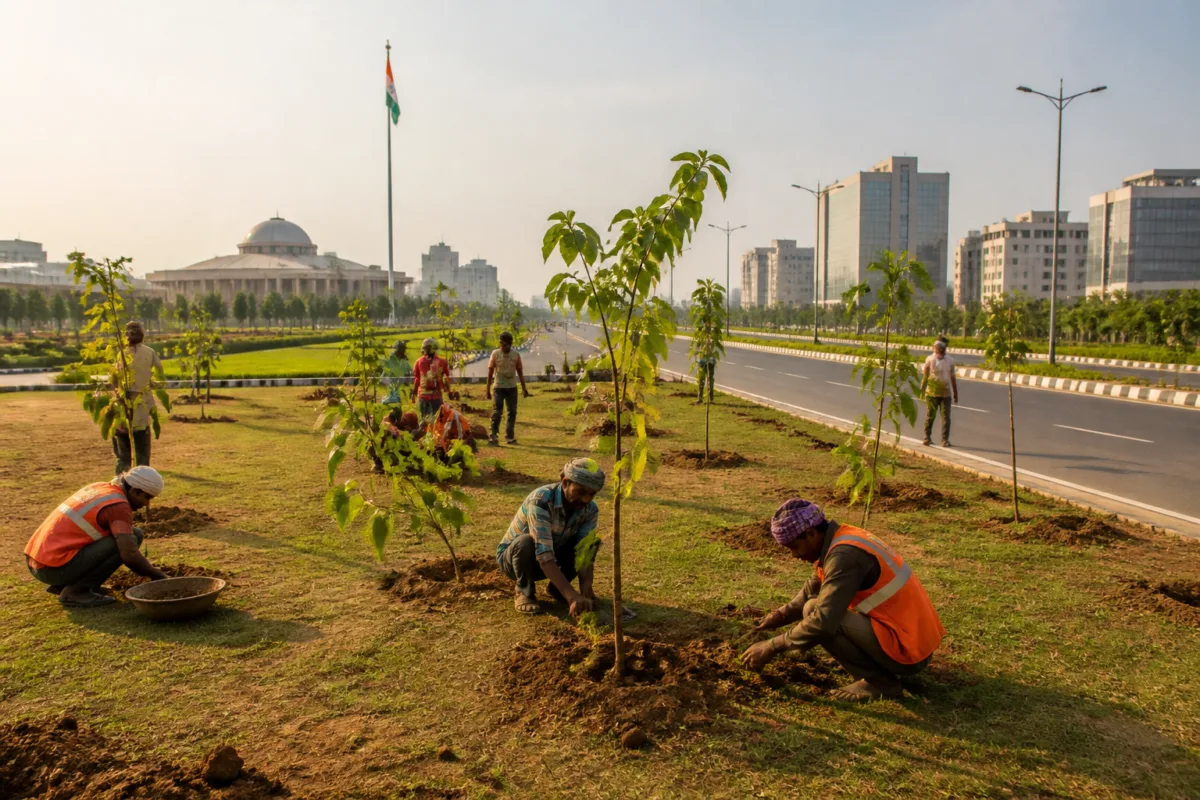
The announcement with the clearest urban and environmental dimension was the proposed plantation of five lakh peepal trees across Nava Raipur. Shah said 2,500 saplings had already been planted at Peepal Van, where he inaugurated the Viksit Bharat Sankalp Park. He said the larger plantation programme would help develop Nava Raipur as a “Peepal City” and establish it as one of the world’s most environmentally friendly urban centres. The speech did not specify the land area, planting schedule, survival targets, maintenance agency or funding arrangements for the initiative.
Shah also cited economic and social indicators to describe the state’s development since its formation in 2000. According to his remarks, Chhattisgarh’s gross state domestic product had increased 25-fold, per capita income had risen 17 times and literacy had improved from 55% to around 80%. He also referred to an approximately 30% increase in the annual budget, without identifying the comparison period or providing supporting documents during the address.
The minister credited former prime minister Atal Bihari Vajpayee with creating Chhattisgarh and Prime Minister Narendra Modi with shaping its future. He praised Chief Minister Vishnu Deo Sai and the state’s two deputy chief ministers, claiming that more than 70% of the BJP government’s election promises had been implemented in a short period. During the ceremony, he released the 33rd instalment of the Mahtari Vandan Yojana, which provides financial assistance to eligible women.
Shah’s address also included attacks on the Congress party and former Union home minister P Chidambaram over earlier approaches to Maoist violence. He challenged Congress leader Rahul Gandhi to debate the Special Intensive Revision of electoral rolls in Parliament and urged the opposition to allow Parliament to function. The immediate administrative milestones for the Nava Raipur plantation plan, including its location-wise rollout and maintenance framework, were not announced in the speech.

