


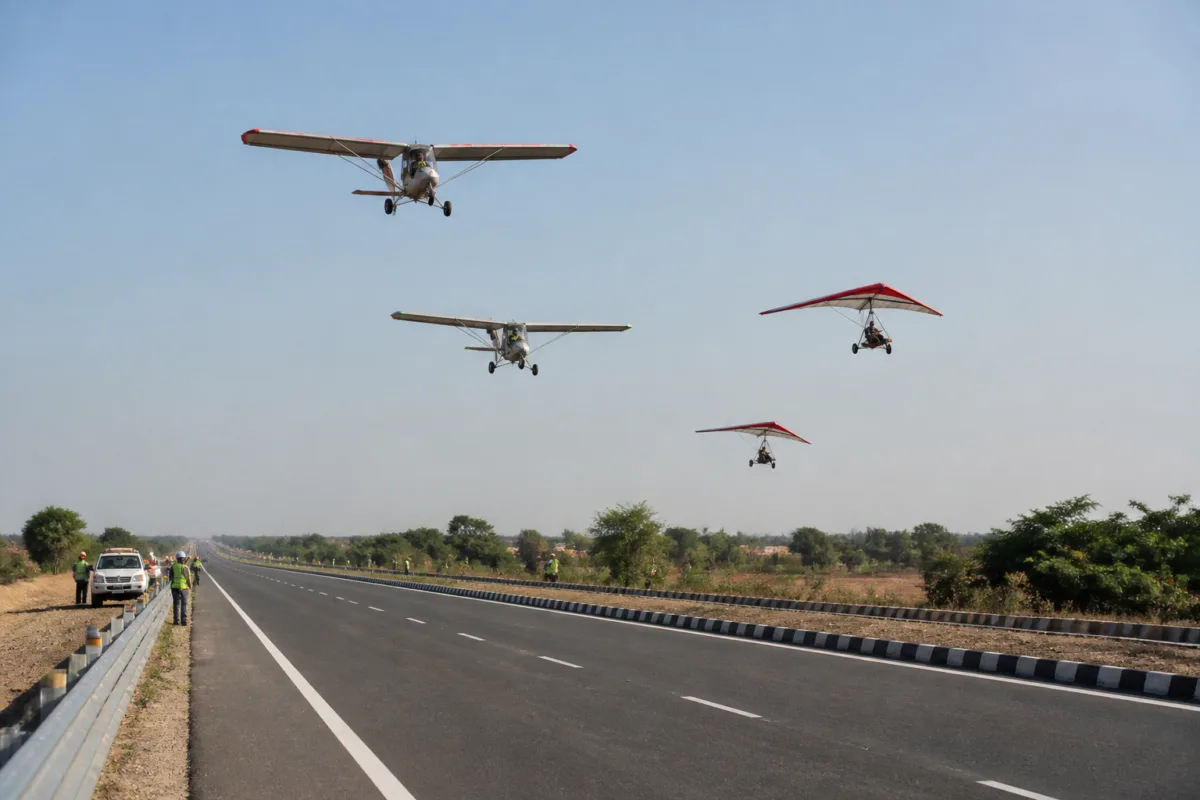
A stretch of the Amritsar-Jamnagar Economic Corridor in Patan, Gujarat, was used for the landing of four Indian Army aircraft on November 24, highlighting how suitably designed national highways may support specialised operational requirements beyond conventional road traffic.
NBM&CW reported that two fixed-wing microlight aircraft and two powered hang gliders belonging to the Indian Army’s Team Mountain Eagles landed on NH-754A. The aircraft had taken off from Kandla Airport as part of the Wings of Valour and Unity Expedition 2026, organised by the Army Adventure Nodal Centre at the Military College of Telecommunication Engineering in Mhow.
The demonstration was attended by agencies involved in the corridor, and Union Minister for Road Transport and Highways Nitin Gadkari congratulated Team Mountain Eagles, the National Highways Authority of India and other authorities involved, according to the report.
The road section’s engineering specifications were central to the exercise. The pavement was designed for a traffic loading of 170 million standard axles, or MSA, and includes a 550 mm pavement crust and a 500 mm subgrade. These specifications indicate the corridor’s design capacity for heavy and sustained traffic loading, although pavement strength alone does not establish that every highway stretch can safely function as an aircraft landing surface.
The landing demonstrated the potential for selected national highway sections to serve specialised emergency or strategic purposes when their geometry, pavement condition, surrounding clearances and operational arrangements are suitable. Such use would require technical assessment, coordination among responsible authorities and the necessary safety clearances, the report said.
For highway planning, the exercise points to a broader question about whether some strategically located corridors should be designed or assessed for occasional dual use. That would involve considerations beyond structural capacity, including access control, traffic management, roadside development, emergency response and the protection of nearby communities during any temporary operational activity.
The reported landing does not establish a wider policy covering national highways. It does, however, provide a demonstration of how infrastructure built primarily for road connectivity can also be evaluated for additional operational roles, subject to engineering and safety requirements.

