


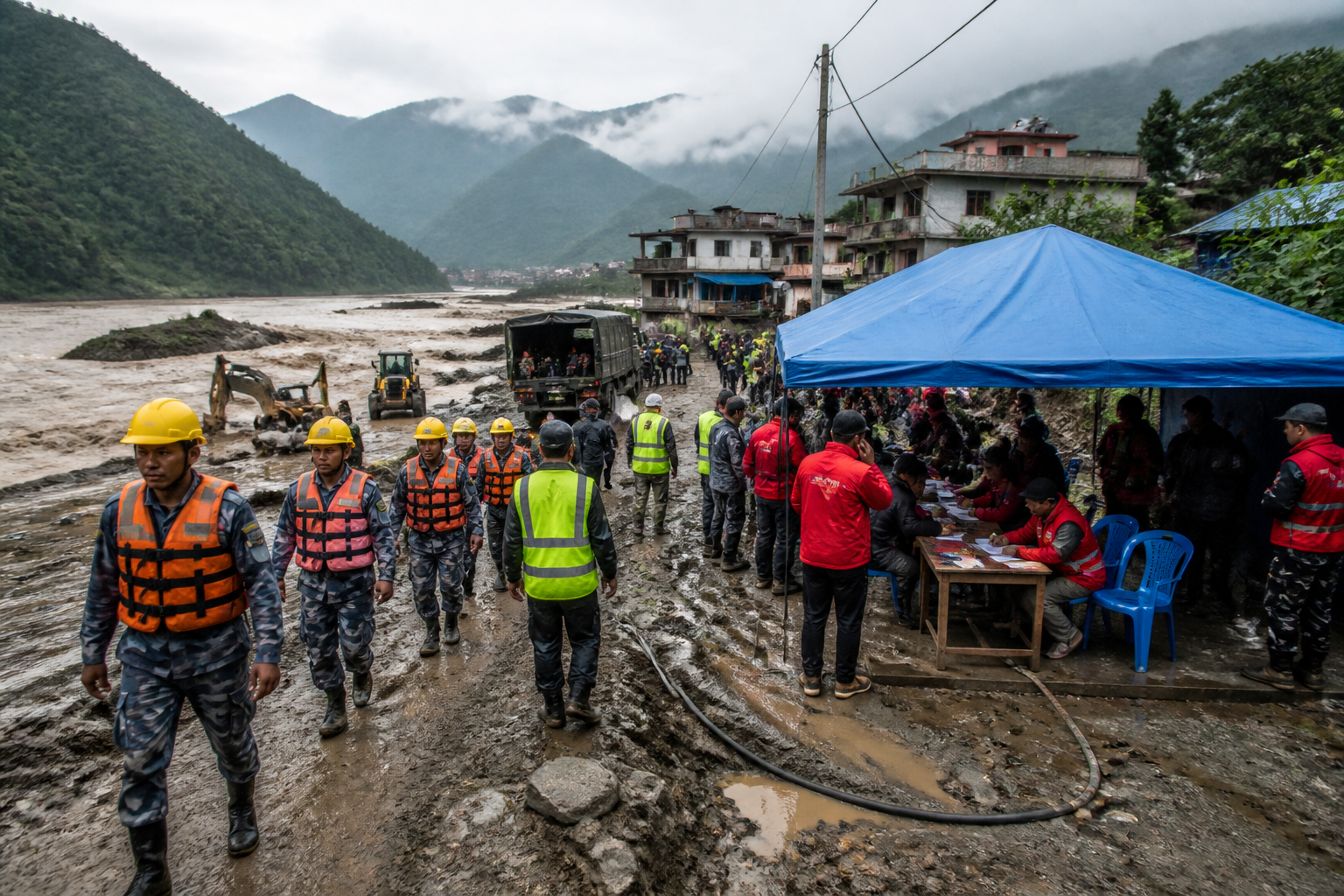
Nepal Flood Missing Tourists Expose Gaps in Disaster Response
Fifteen days after floods struck Nepal, the whereabouts of 67 tourists from Maharashtra remain unknown. The Maharashtra government says it has begun collecting DNA samples from families and sending profiles to the Central Forensic Science Laboratory in New Delhi, while authorities are seeking the last known mobile locations of the missing people. The episode has become a test of how governments manage cross-border disasters when rescue operations give way to identification, information-sharing and family support.
The report by Loksatta – Mumbai says 406 tourists from Maharashtra were caught in the disaster after floods hit Nepal on August 26. Of these, 339 have returned safely to the state, while 67 remain missing. The tourists included people travelling for the Kailash Mansarovar pilgrimage as well as other visitors. The report does not provide a district-wise break-up of the missing people, their last known locations or an official account of the conditions in which they disappeared.
The immediate public issue is therefore not only the search itself, but the transition from emergency evacuation to a formal missing-persons and identification process. When a disaster affects travellers outside the country, state authorities must work through multiple institutional channels: families in India, local authorities in the affected country, central government agencies, telecommunications systems and forensic laboratories. The available account indicates that Maharashtra has activated several of these channels, but it does not establish how quickly each measure was initiated or what results have followed.
According to the report, the state emergency centre coordinated with the forensic laboratory at Kalina and district surgeons to collect DNA samples from relatives of the missing citizens. These samples were used to prepare profiles in a prescribed format and were sent to the Central Forensic Science Laboratory in New Delhi. DNA profiling can support identification when bodies are recovered or when visual identification is not possible, but the supplied report does not say whether any remains have been located, whether samples have been matched or when the first results may be available.
The state has also written to the Department of Telecommunications to obtain the last known locations of the missing citizens’ mobile phones. This step points to the importance of digital records in disaster response. A phone’s last known location may help investigators reconstruct movement before communications stopped, but the report does not state whether location data has been received, how many devices were traceable or whether network coverage and roaming arrangements affected the exercise. Those details will determine how useful the information can be to search teams.
For families, the information system is as significant as the physical search. The Maharashtra government has reportedly created a WhatsApp group with relatives of the missing citizens. The disaster management department told a cabinet meeting that complaints and related requests were being handled at both the state and central government levels. This arrangement can provide a single channel for updates, but the supplied material does not describe the frequency of official communication, the agency responsible for answering families or the process for correcting conflicting information.
The numbers in the report also show the scale of the administrative challenge. Of the 406 Maharashtra tourists affected, 339, or roughly four-fifths, have returned safely. The remaining 67 represent about one-sixth of the affected group. These figures are not merely a count of unresolved cases. They require authorities to maintain individual records, verify identities, coordinate with Nepalese institutions and distinguish between people who are safe but unable to communicate, those who have moved from their last known location and those who may have died in the floods.
That distinction is central to the use of forensic evidence. A DNA sample collected from a family member does not by itself establish what happened to a missing person. It creates a reference profile that can be compared with unidentified remains if those remains are recovered and processed. The report provides no information about the number of unidentified victims in Nepal, the facilities handling them or the legal and logistical arrangements for cross-border identification. These gaps are important because the success of the process depends on coordination beyond Maharashtra’s administrative control.
The episode also illustrates the limits of treating a disaster as a single event with a single response. The floods occurred on August 26, but the families’ crisis continued for at least 15 days after the incident. During the first phase, the priority may be rescue and evacuation. Later, the work shifts to missing-person registration, records management, forensic examination, telecommunications analysis, travel documentation and family assistance. Each phase produces different information, and an unresolved case can move between several agencies without a clear public understanding of who is accountable for the next update.
The report indicates that the Maharashtra emergency centre, the Kalina forensic laboratory, district surgeons, the Department of Telecommunications and central authorities are involved. It also refers to Nepal, where the flooding reportedly affected thousands of tourists and local residents. Yet the source does not identify a single nodal authority responsible for consolidating the cases. Nor does it state whether a common case number has been assigned to each missing citizen or whether families can independently track the status of searches, forensic comparisons and official requests.
This matters because disaster databases are only useful when they are accurate, interoperable and regularly updated. The reported figures—406 affected, 339 returned and 67 missing—provide a broad status picture, but they do not reveal the underlying data structure. It is not known whether the list was prepared from travel records, family reports, emergency registrations or information supplied by Nepalese authorities. It is also not clear whether the list has been reconciled against hospital, shelter, border-crossing or consular records.
The available evidence therefore supports a limited conclusion. Maharashtra has initiated a multi-agency response involving DNA collection, forensic profiling, mobile-location requests and direct communication with families. These steps show that the response has moved beyond immediate rescue into formal identification and information management. However, the supplied report does not establish the outcome of those measures, the status of individual cases or the timeline for resolving them.
The appeal by families to Prime Minister Narendra Modi adds a further institutional dimension. Their request indicates that relatives want intervention at the central level, particularly because the missing citizens are in another country and the search requires coordination across national boundaries. The report does not reproduce the families’ specific demands or record a response from the Prime Minister’s Office. It therefore cannot establish what additional action, if any, followed the appeal.
For authorities, the next milestones are clear even if their timelines are not. They must continue matching missing-person records with information from Nepal, obtain and assess mobile-location data, complete forensic comparisons where possible and keep families informed through an accountable communication channel. The Maharashtra cabinet has been told that these efforts are under way. The next public test will be whether the government can provide case-level updates and verified results rather than only aggregate figures.
The Nepal floods have left Maharashtra with 67 unresolved cases, according to the report. The response now depends on whether emergency coordination can produce reliable identification, transparent communication and a documented account of what happened to each missing traveller. Until those processes yield verified findings, the central fact remains unchanged: 339 people have returned, but the whereabouts of 67 others are still unknown.
