


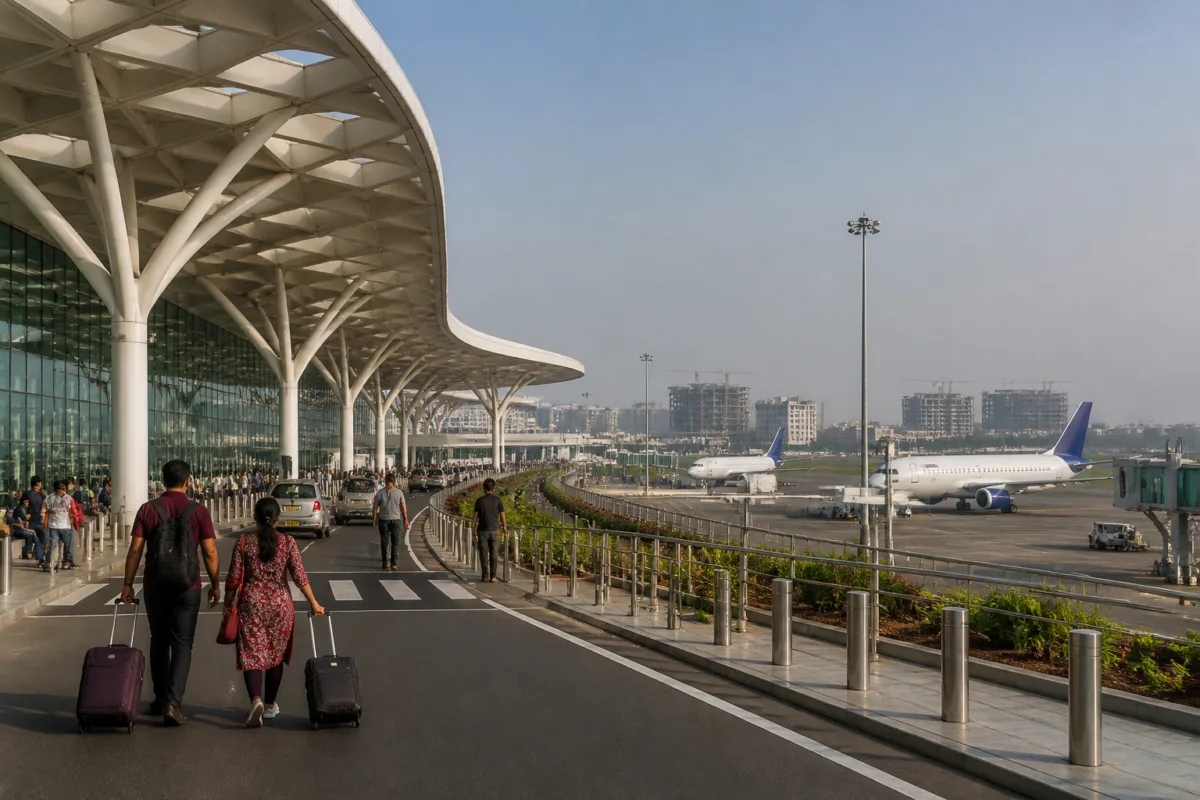
Mumbai’s airport system is preparing for a major redistribution of international traffic. Mumbai International Airport Ltd (MIAL) has proposed shifting flights serving 14 international destinations from Chhatrapati Shivaji Maharaj International Airport to the new Navi Mumbai International Airport, a move intended to create capacity for the demolition and reconstruction of Terminal 1 at the existing airport.
The proposal, reported by The Economic Times from a MIAL letter seen by the publication, is not simply a change in airport location for selected passengers. It is a test of how the Mumbai Metropolitan Region will operate as a two-airport system, how airlines’ existing slots will be handled and whether passengers can be moved between airports without creating confusion or reducing connectivity.
MIAL has asked airlines to voluntarily surrender the relevant slots by November 3. The airport operator has also asked the civil aviation ministry to facilitate the transition if carriers do not submit proposals themselves. If the airlines do not voluntarily offer the slots, MIAL said it plans to temporarily move flights serving the 14 destinations identified in transition plans submitted by Indian carriers.
The affected destinations are Bahrain, Dammam, Dhaka, Doha, Fujairah, Jakarta, Jeddah, Kathmandu, Kuwait City, Madinah, Muscat, Ras Al Khaimah, Riyadh and Sharjah. The list covers important Gulf and Asian connections, meaning the proposal could affect both international passengers and the airlines that rely on established operating slots at Mumbai’s existing airport.
## The capacity problem behind the proposal
According to the report, MIAL wants to shift around five million passengers annually to Navi Mumbai Airport. That is equivalent to about 9% of the existing airport’s traffic capacity, as described in the letter. The stated objective is to free up capacity while Terminal 1 is demolished and reconstructed.
The figure indicates the scale of the transition being contemplated. This is not a limited movement of occasional services. It would involve a substantial volume of passengers and would make Navi Mumbai an operational part of the region’s international aviation network rather than treating it only as an additional airport for future growth.
MIAL has said that flights from the Mumbai region to the identified destinations should be available at one airport instead of being split between two airports. That approach would create a degree of route concentration for passengers travelling to each destination. At the same time, it would require passengers, airlines, travel companies and ground transport providers to adjust to a different airport for services that may previously have been associated with Mumbai’s established airport.
The proposal therefore links two infrastructure decisions that are often treated separately: the redevelopment of an existing airport and the commissioning of a new one. Terminal 1 cannot be rebuilt without affecting airport operations. Navi Mumbai provides a possible location for absorbing some of that traffic, but using it for that purpose requires regulatory coordination and airline participation.
## Why the slot question is central
Airport slots are not merely timetable entries. They determine when airlines can operate from a constrained airport and are closely tied to aircraft deployment, passenger demand and connecting schedules. The Economic Times report says the proposal raises questions about the protection of airlines’ historical slots and the regulatory process for relocating foreign carriers between two separate airports.
That makes the civil aviation ministry’s role significant. MIAL can propose a transition, but the movement of services involving different airlines and international destinations cannot be treated only as an internal airport-management decision. The reported request for ministry facilitation shows that the transition may require action beyond the airport operator and individual carriers.
The distinction between voluntary surrender and a planned transition is also important. MIAL first sought voluntary slot surrender by the November 3 deadline. It then indicated that, if airlines did not submit transition proposals, it intended to temporarily move all flights serving the 14 destinations identified in plans submitted by Indian carriers. The report does not establish how airlines have responded or what final regulatory decision has been taken.
That uncertainty matters because the proposed shift affects the operating rights and schedules of more than one category of carrier. Indian airlines have submitted transition plans for some services, while the proposal also concerns the relocation of foreign carriers between airports serving the same metropolitan region. The final arrangement would therefore depend on decisions involving the airport operator, airlines and the aviation ministry.
## A two-airport region creates a new passenger geography
Mumbai’s existing airport is located within the established urban fabric of the city, while Navi Mumbai Airport will serve a different part of the metropolitan region. A shift in flights changes more than the terminal printed on a ticket. It can change travel time, access routes, transfer arrangements and the choice of airport for passengers living or working in different parts of the region.
The source material does not provide travel-time estimates, ground transport arrangements or passenger-service plans for the proposed move. Those details will be important if services are transferred temporarily and then moved back, or if passengers begin to associate particular international routes permanently with Navi Mumbai. Without clear communication, a two-airport system can make airport choice less intuitive, particularly for passengers who are booking connecting travel or travelling in groups.
MIAL’s argument that all flights to a particular destination should be available at one airport addresses one part of that problem. Route concentration can reduce the risk of passengers confusing two airports for the same destination. However, it also means that passengers who previously used the existing airport may have to reorganise their journeys around Navi Mumbai, depending on where they live and how they reach the airport.
The proposed shift of around five million passengers a year gives the issue a metropolitan scale. The number is large enough to affect road access, airport transfers and the distribution of passenger activity around both airports, although the supplied report does not specify the transport or terminal measures that would support the change.
## Terminal redevelopment versus system expansion
The proposal also reveals the tension between upgrading existing infrastructure and expanding the overall airport system. Rebuilding Terminal 1 could improve the capacity and functionality of Mumbai’s established airport, but the construction process itself would temporarily reduce the space available for operations. A second airport can provide relief, but only if it has the capacity, airline services and passenger access needed to absorb the redirected traffic.
The reported plan describes Navi Mumbai as a temporary destination for flights affected by the redevelopment of Terminal 1. It also suggests that the new airport could become an important part of the region’s long-term aviation structure. The supplied information does not establish whether the proposed international services would return after the redevelopment or whether some would remain at Navi Mumbai.
That distinction will shape how airlines plan their fleets and schedules and how passengers understand the region’s airport network. A temporary transfer requires a credible return or continuation framework. A permanent redistribution requires a stable allocation of routes and slots. The current proposal, as reported, does not resolve that question.
## What remains to be decided
The central decision is whether airlines will voluntarily surrender the relevant slots and submit transition proposals. If they do not, MIAL wants the civil aviation ministry to facilitate the move. The process will also need to clarify how historical slots are protected, how foreign carriers are handled and whether the 14 destinations will be concentrated at Navi Mumbai for a defined period.
The available information confirms the scale and stated purpose of the proposal, but not its final implementation. It does not identify a completed government approval, a confirmed airline-by-airline schedule, passenger communication arrangements or a detailed timeline for Terminal 1’s demolition and reconstruction.
For Mumbai, the issue is larger than the relocation of 14 international routes. It is an early test of whether two airports can function as a coordinated metropolitan system while one of them undergoes major redevelopment. The next important developments will be the airline responses to the slot-surrender request, the civil aviation ministry’s position and the operational timetable for the Terminal 1 project.

