


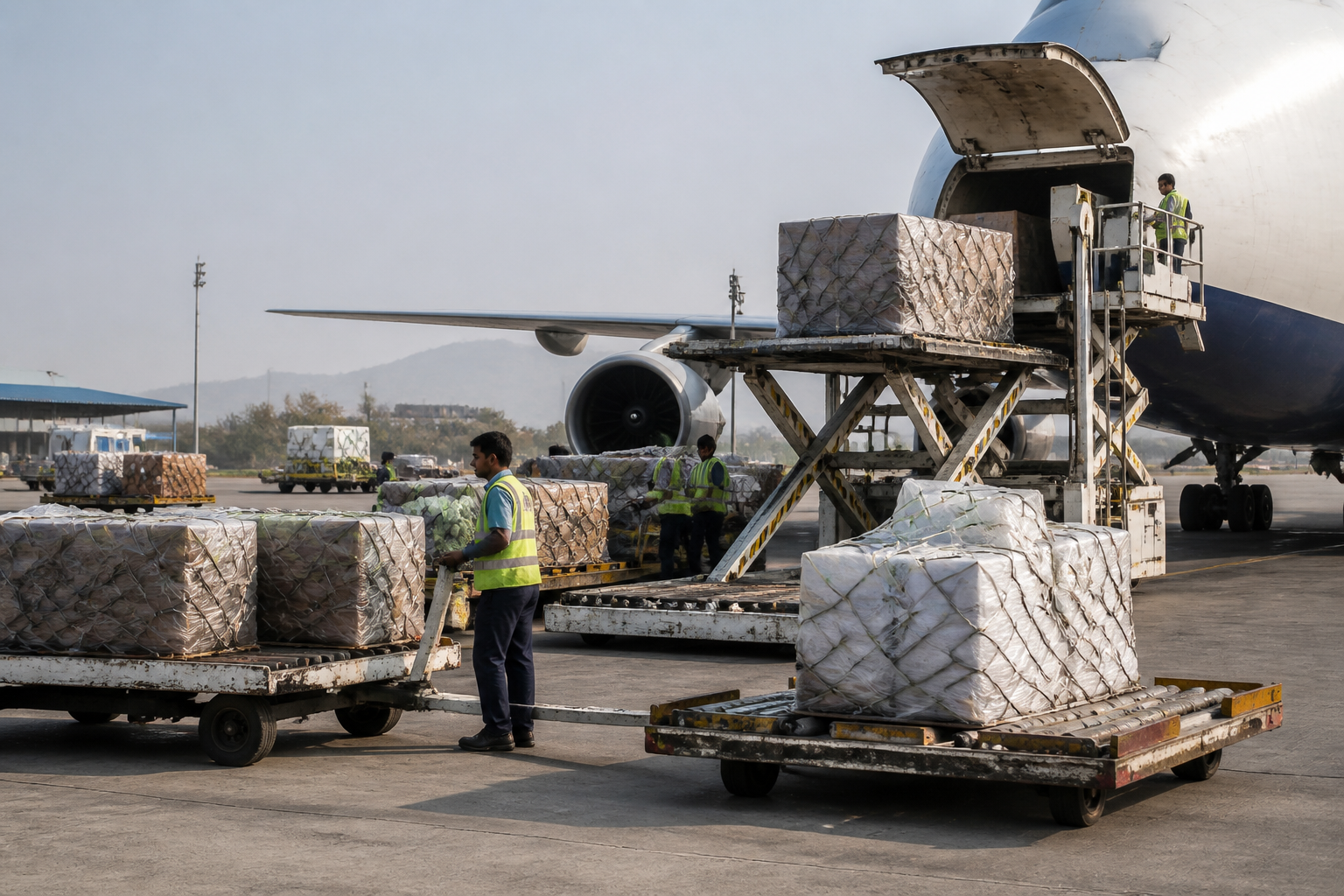
Nashik airport’s international cargo growth is no longer a one-season development. Airport authority data cited in the report shows that the facility handled 4,230 tonnes of international cargo between April and August 2026, an 18% increase over the 3,586 tonnes handled during the corresponding period of 2025-26. The larger story is the speed at which Nashik is being repositioned from an agricultural production centre into a wider export and logistics hub for north Maharashtra.
The cargo figures show a clear change in scale. In 2025-26, Nashik airport handled 9,000 tonnes of international cargo through 500 cargo flights. That was more than double the 4,100 tonnes moved through 250 flights in 2024-25. One year earlier, in 2023-24, the airport handled only 415 tonnes through 25 flights. On the evidence available in the report, cargo volumes have expanded alongside the frequency of cargo operations, rather than through a marginal increase in activity.
That trajectory matters because Nashik’s economic base is spread across sectors that depend on time-sensitive, reliable and cost-conscious logistics. The report identifies grapes, agricultural produce, poultry products, defence consignments, industrial goods and pharmaceuticals among the commodities contributing to the increase. Pharmaceutical exports, introduced over the past year, have added a new category to the airport’s cargo profile and reduced its dependence on a narrower agricultural export base.
The airport’s role is therefore becoming connected to the region’s production geography. Nashik is a major agricultural centre, with grapes, onions and horticultural crops forming part of its established economic identity. At the same time, the city has manufacturing, engineering, food processing, poultry and pharmaceutical activity. International air cargo provides a transport option for goods whose value, perishability or delivery requirements may make speed more important than the lower unit cost associated with slower freight modes.
## Nashik airport cargo and the regional logistics shift
The reported increase also reflects a search for alternatives to larger metropolitan airports. HALCON, the joint venture between Hindustan Aeronautics Ltd and Container Corporation of India that manages cargo operations at Nashik airport, said air cargo handling and related charges at Nashik were significantly lower than those at Mumbai airport. The official attributed the growth to rising exports and said efforts were under way to expand exports to more international destinations and attract additional exporters from the region.
This cost comparison is central to the airport’s emerging proposition. Nashik does not need to replicate Mumbai’s scale to become useful to exporters. Its potential advantage, as described by HALCON, is that regional producers may be able to access international air freight closer to their production base and at lower handling and related charges. For agricultural and industrial businesses, that could change the calculation involved in sending consignments through a larger metropolitan gateway.
However, the figures supplied in the report describe cargo growth, not yet a complete logistics system. They establish that international cargo movement has risen sharply and that more sectors are using the airport. They do not provide a breakdown of cargo by commodity, destination, exporter, aircraft type, revenue or proportion of cargo that is originating in Nashik rather than being consolidated from a wider region. Nor do they establish whether the airport currently has the infrastructure, frequency and destination network required to support the next phase of growth.
Those unanswered questions are important because cargo airports function as networks rather than isolated facilities. Exporters require predictable schedules, customs and handling arrangements, cold-chain capability where necessary, packaging and consolidation services, road access, reliable connections to destinations and clarity on charges. The report points to the airport’s lower costs and growing traffic, but it does not provide details on each of these operational elements. The next stage of Nashik’s cargo story will depend on whether the increase in tonnage can be supported by a broader and more dependable export ecosystem.
## From grapes to pharmaceuticals
The diversification of cargo is one of the most significant details in the report. Grapes and other farm products remain central to Nashik’s export potential, but the addition of poultry, pharmaceuticals, defence consignments and industrial goods changes the nature of demand. Agricultural cargo is often seasonal and sensitive to harvest cycles. Manufacturing and pharmaceutical cargo can create different patterns of movement, subject to production schedules, regulatory requirements and buyer networks.
The report does not quantify the contribution of each category, so it is not possible to determine which sector is driving the largest share of the 18% increase. It does, however, indicate that the airport is serving a broader range of users than it did previously. That matters for the stability of cargo operations: a facility with multiple export sectors may have more opportunities to maintain traffic across different production cycles, although the supplied evidence does not establish how evenly cargo is distributed through the year.
The introduction of pharmaceutical exports over the past year is particularly relevant to the airport’s diversification. Pharmaceuticals generally require tightly managed handling and dependable movement, but the report provides no further information on the products, volumes or specific facilities involved. The fact that pharmaceuticals have entered the airport’s cargo profile is therefore established; the scale and long-term significance of that activity remain unspecified.
Nashik’s industrial associations see this wider base as an indicator of expanding regional export capacity. Ashish Nahar, president of the Nashik Industries and Manufacturers’ Association, said the city had established itself as an agricultural centre while also emerging as a manufacturing and engineering hub. NIMA vice-president Manish Rawal, who heads the association’s aviation committee, said exporters were increasingly looking at alternatives to larger metropolitan airports and that there was scope for further expansion.
These statements show how the airport is being understood by local industry: not only as an aviation facility, but as an instrument for connecting production in the region to overseas markets. That expectation is significant for urban and regional planning because cargo growth affects more than the airport boundary. It can influence warehouse demand, road freight, processing facilities, packaging, customs services and the location of businesses that rely on rapid export access.
## The institutional question behind the growth
The airport’s cargo expansion also raises a question about how regional infrastructure is managed. HALCON’s role links an aviation operator, Hindustan Aeronautics Ltd, with the Container Corporation of India, bringing together airport operations and logistics expertise. The report identifies this joint venture as the manager of cargo operations, while airport authority data provides the basis for the reported volumes.
That institutional arrangement is relevant because cargo growth requires coordination between airport management, exporters, industry bodies and the agencies responsible for customs and related clearances. The report confirms that HALCON is working to attract exporters and expand international destinations. It does not specify which new destinations are being pursued, what additional facilities are planned or whether any capacity expansion has been formally approved.
The available numbers nevertheless show why the airport has become a more consequential regional asset. Cargo increased from 415 tonnes in 2023-24 to 4,100 tonnes in 2024-25 and then to 9,000 tonnes in 2025-26. The movement from 25 cargo flights to 250 and then 500 over the same periods indicates a substantial increase in operating activity. Between April and August 2026 alone, the airport handled 4,230 tonnes, although the report does not provide the corresponding number of flights for those five months.
The trend should therefore be read as evidence of rapid adoption, not as proof that Nashik has already become a fully established national cargo gateway. NIMA’s description of the airport as having the potential to become one of the country’s important cargo gateways is an industry assessment, not a measured ranking. The report supports the conclusion that Nashik’s export role is expanding; it does not establish how the airport compares with other cargo facilities or whether its current growth rate will continue.
For the city and the wider region, the central issue is whether cargo infrastructure can keep pace with production capacity. Nashik’s agricultural, manufacturing, engineering, poultry and pharmaceutical sectors provide a diverse base of potential users. But the report leaves open questions about access, cargo handling capacity, international connectivity and the distribution of benefits across exporters of different sizes.
The evidence confirms a strong turnaround in Nashik’s international air freight activity and a widening range of commodities moving through the airport. It also shows that lower charges and proximity to regional producers are being presented as alternatives to Mumbai’s larger airport ecosystem. What remains uncertain is the composition of the cargo, the destinations being served and the operational investments needed for the next phase. Those are the indicators that will determine whether Nashik’s cargo surge becomes a durable regional logistics system or remains a period of rapid but still limited expansion.
