


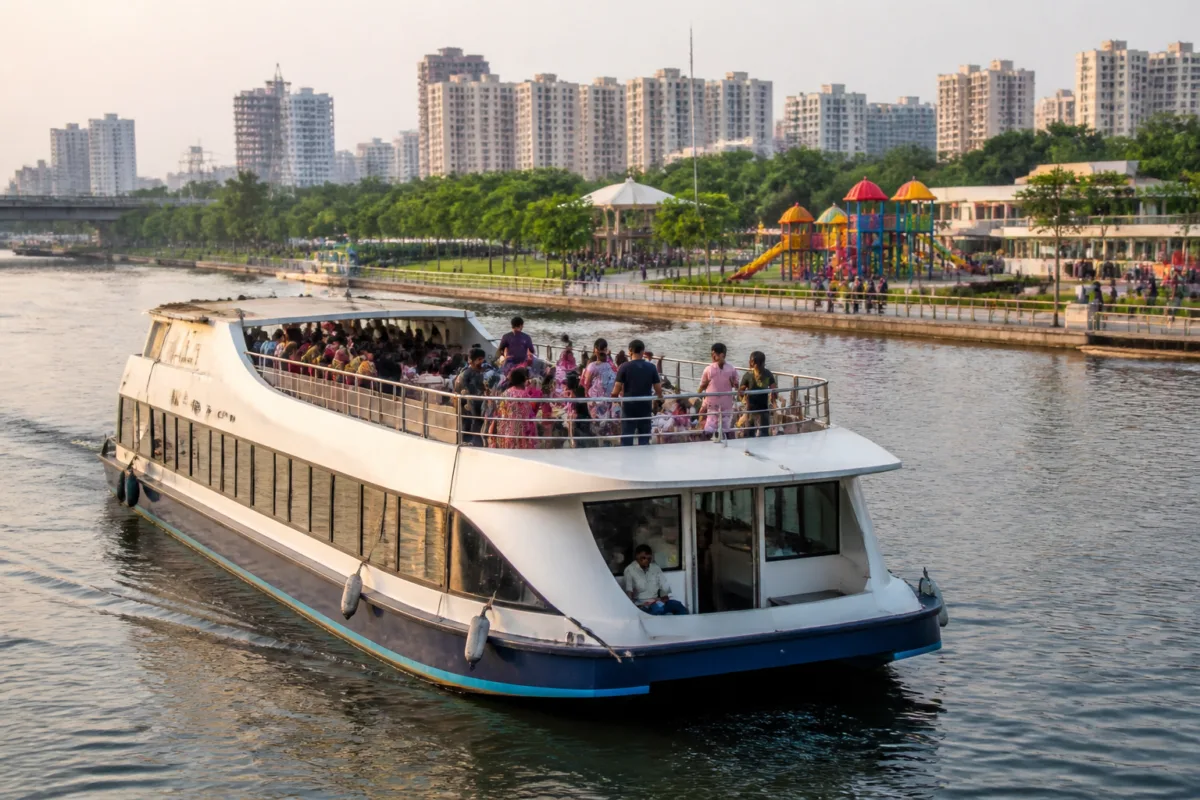
The Namo Yamuna River Cruise has attracted families and other visitors in its opening days, but the early response also reveals a larger problem in Delhi: the city’s supply of accessible, affordable and varied recreational spaces remains limited. On the second day of operations, 236 people took a cruise ride and seven visitors used the jet ski facility, while children’s play equipment, a musical fountain and a food court drew people who were not necessarily interested in boating alone.
That combination is important because it shows that the attraction is functioning less as a single-purpose transport or tourism service and more as a packaged leisure destination. Families arrived for the cruise, but also for swings, a tyre-climbing wall, a trampoline, food and an opportunity to spend time outdoors. The response suggests that the success of such a facility will depend on the quality of the entire public experience rather than the novelty of the river ride itself.
The figures reported from the second day are modest in absolute terms, but they provide an early indication of who is using the space. Families with children formed a significant share of visitors. One family travelled from Mukherjee Nagar, while visitors also came from Mandawali, Ghaziabad, Janakpuri, Rohini, Laxmi Nagar and Sonia Vihar. The spread of locations indicates that the facility is drawing visitors from across the wider Delhi urban region rather than serving only the immediate neighbourhood.
At the same time, the visitor comments show that demand is being shaped by the absence of alternatives. Renu Gupta, who brought her three children from Mandawali before schools reopened, said they had rarely experienced boats or cruises while growing up in Delhi. Tarun Sharma from Laxmi Nagar described the venue as different from a conventional movie or restaurant outing and said Delhi had relatively few comparable facilities. These comments point to a gap in the city’s leisure geography: many families may have access to commercial entertainment, but fewer have access to outdoor experiences that are distinctive, family-oriented and connected to the city’s natural landscape.
This distinction matters for urban planning. Recreation is often treated as an optional addition after housing, roads, transport and utilities have been provided. Yet public spaces and leisure facilities influence how residents experience a city, particularly families with children. A city can have parks and commercial venues while still lacking places where people can spend several hours outdoors, participate in activities and experience a major natural feature such as a river.
The cruise’s initial appeal appears to come from combining several elements in one location. Children can use the play area while parents explore the premises, watch the musical fountain, visit the food court or wait for the electric cruise. This mixed-use format increases the number of reasons to visit and allows different members of a family to use the site in different ways. It also means that visitor satisfaction will depend on basic operational details, including ventilation, crowd management, pricing, seating and the quality of facilities on shore.
Those details emerged clearly in visitor feedback. Devesh Kumar from Rohini said the air-conditioning was not functioning properly and that the lower deck felt cramped. He described the upper deck as more comfortable but called for better ventilation or limits on the number of people accommodated below. He also felt the cruise moved more slowly than expected. These are not merely matters of personal preference. They concern the relationship between capacity, comfort and the experience being sold to the public.
The comments also expose a possible mismatch between the attraction’s branding and visitor expectations. Kunwar Singh, who visited from Janakpuri for his mother’s birthday, said more adventure sports could attract people from different age groups after the initial enthusiasm faded. His observation suggests that a cruise and children’s play area may be sufficient to create an opening burst of interest, but maintaining repeat visits could require a broader programme of activities.
That does not mean the facility must imitate a private amusement park or recreate a coastal tourism experience. Sharma specifically urged visitors not to expect a Goa-like outing. His assessment was more measured: for Delhi, the facility was a useful start, particularly because it offered a family weekend option beyond the usual cinema or restaurant visit. The contrast is significant. The value of the project may lie not in competing with established leisure destinations, but in creating a form of urban recreation suited to Delhi’s own geography and resident demand.
Affordability is another test. The reported entry charge is Rs 50, separate from the cruise fare. Abhay, a resident of Sonia Vihar, said this added Rs 200 to the cost for a family of four before the cruise charge was considered. That structure can influence who is able to use the facility regularly. A price that appears modest for one visitor can become a substantial additional cost for larger families, particularly when transport, food and activity charges are added.
The pricing question is therefore connected to the project’s public character. If the attraction is intended to operate as a commercial leisure venue, users may judge it primarily on the quality and variety of the experience. If it is also being presented as a public urban amenity, the authorities will face greater pressure to ensure that entry and activity charges do not exclude the families most likely to benefit from accessible recreation.
The supplied report does not establish the project’s full operating model, ownership structure, capital cost, capacity, maintenance contract or revenue arrangements. It also does not provide official statements explaining how crowd limits, safety systems, ticket pricing or future activities will be determined. Those details will be important in assessing whether the facility can move from an opening attraction to a reliable public destination.
The use of an electric cruise gives the project an additional urban dimension, although the available report does not provide technical information about the vessel, its operating range or its environmental performance. The river itself is central to the attraction’s identity. One visitor said the Yamuna appeared cleaner than before, but the report does not provide water-quality measurements or an official assessment of the river’s condition. That observation should therefore be treated as a visitor perception, not as evidence of a verified improvement.
This distinction is important because the project places recreation alongside the continuing challenge of restoring and managing the Yamuna. A riverfront attraction can change how residents encounter the river, but a cruise service does not by itself establish ecological recovery. The public experience of cleaner surroundings, better access and leisure facilities will need to be considered separately from measurable improvements in water quality, pollution control and river management.
The second-day response also raises questions about how Delhi plans recreational infrastructure. Visitors travelled from several parts of the metropolitan area, suggesting that such facilities may operate as regional destinations rather than local parks. That creates a need to consider last-mile access, public transport connections, parking, crowd flows and the distribution of similar amenities across the city. The report does not provide information on these matters, but the geographic spread of visitors makes them relevant to the facility’s longer-term functioning.
The early evidence confirms three things. First, there is visible demand for family-oriented outdoor recreation in Delhi. Second, visitors value the combination of activities around the cruise rather than the boat ride alone. Third, basic service quality and pricing can determine whether initial curiosity becomes repeat use. The concerns about cramped space, ventilation, speed, adventure options and entry charges are therefore central to the project’s future public reception.
What remains unclear is how the authorities will respond to these early observations and whether the facility has a defined plan for expansion, pricing, maintenance and visitor safety. The next stage will show whether the Namo Yamuna River Cruise remains primarily an opening-period attraction or develops into a sustained urban amenity. For Delhi, the larger question is not simply how many people board the boat, but whether the city can build more public places where recreation is affordable, comfortable and connected to its own landscape.

