


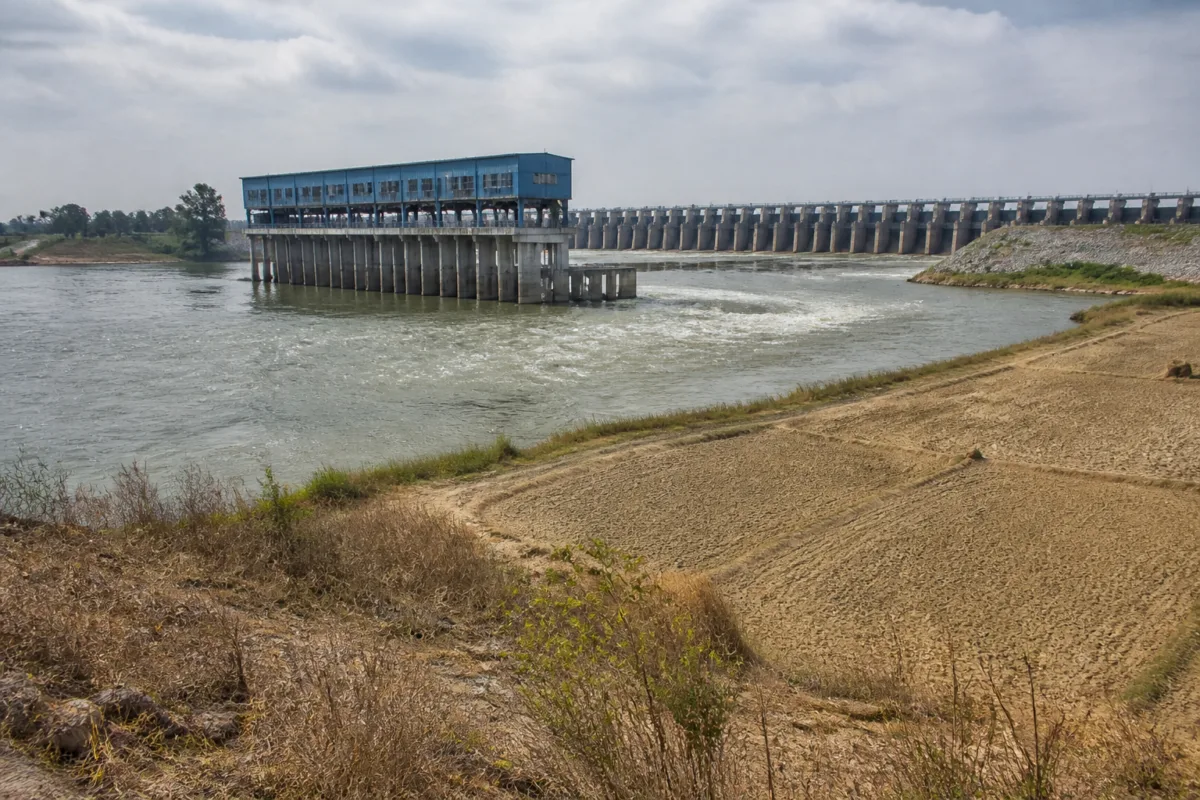
Telangana’s current drought is being presented not only as a consequence of deficient rainfall, but also as a test of how the State manages water when river flows and reservoir inflows diverge. An opinion published by Telangana Today argues that the government allowed substantial Godavari flows to move downstream even as reservoirs, tanks and command areas in Telangana faced shortages. The claim places the focus on an institutional question: whether drought management can depend on rainfall alone when water is available within the State’s river system.
The argument is made by Sridhar Rao Deshpande, a retired Superintending Engineer of the Irrigation and Command Area Development Department. His account says that several parts of Telangana experienced rainfall deficits during the 2026 monsoon, while the lower Godavari continued to carry significant flows. At Medigadda Barrage, he says, flows ranged from 25,000 cusecs to 7 lakh cusecs. At the same time, projects including Sriram Sagar, Singur, Nizamsagar, Kadam, Yellampally, Mid Manair and Lower Manair reportedly received limited inflows.
The distinction between rainfall and usable water is central to the dispute. According to the article, the India Meteorological Department warned as early as July that 20 of Telangana’s 33 districts could face severe rainfall shortages, with similar conditions potentially continuing through August and September. By the end of the rainy season, Telangana had received 615.8 mm of rainfall against a normal 795.7 mm, a deficit of 23 per cent. Andhra Pradesh recorded a 29 per cent shortfall, according to the figures cited in the article.
These numbers describe a difficult monsoon, but they do not by themselves establish how much water Telangana could safely have diverted or stored. That is where the dispute over the Kaleshwaram system becomes important. The article says opposition parties, farmers and engineers urged the government to lift water from the Godavari at the Kannepalli Pump House. The government did not act on the proposal, citing advice from the National Dam Safety Authority and concerns over the barrages.
The article cites Central Water Commission records to claim that approximately 750 TMC of water flowed downstream from Medigadda Barrage into Andhra Pradesh during the season. It further says Andhra Pradesh supplied at least 200 TMC of that water to irrigate crops in the Godavari and Krishna delta command areas, protecting crops across 25 lakh acres. Telangana, by contrast, announced a crop holiday in command areas associated with projects including Sriram Sagar, Nizamsagar and Kaleshwaram. The article also says that nearly 10,000 tanks and check dams in these command areas could not be filled.
Those comparisons are presented by the author as evidence of a management failure, but they also reveal the technical and administrative complexity of inter-state river infrastructure. Water that is physically present in a river is not automatically available for diversion. The decision depends on barrage safety, river levels, pump-house intake conditions, operating protocols, storage capacity, downstream obligations and the state of connected infrastructure. The public disagreement is therefore not simply about whether water existed; it is about whether the available infrastructure could be operated safely and lawfully under drought conditions.
A group of retired engineers proposed using the Link-1 lift system of the Kaleshwaram Project to move water from Kannepalli to Yellampally. The proposal, as described in the article, involved allowing water into the Kannepalli Pump House forebay at a river level of 93.50 metres, while keeping Annaram and Sundilla barrages only up to their minimum drawdown levels. The suggested storage in the two barrages was 8.88 TMC, compared with their combined capacity of 19.70 TMC.
The proposal was intended to limit the volume stored behind the structures rather than restore them to full capacity. The article says the retired engineers believed this could allow water to be lifted while reducing pressure on the barrages. It also alleges that the government dismissed or abused the engineers instead of publicly examining their technical proposal. These allegations are made in the opinion article and are not independently established in the supplied material.
The role of technical evidence changed during the monsoon. The article says the Central Water and Power Research Station in Pune submitted a report in August examining the strength of piers and other structural components of the Kaleshwaram barrages. According to the account, the report found the piers structurally sound in all blocks except Block 7 of Medigadda, where some piers had subsided, and rated the quality of the Annaram and Sundilla piers as excellent.
The article also refers to a written submission by the National Dam Safety Authority before the High Court in response to a public interest litigation. It says the authority informed the court that the decision on lifting water from Kannepalli to Yellampally rested with the State government, after consultation with engineering experts and the oversight committee constituted for the Kaleshwaram barrages. If accurately represented, this places the decision within a framework of State-level responsibility rather than an absolute prohibition imposed by the national safety authority.
The institutional issue is significant. Dam safety advice can identify risks, but governments must still decide how infrastructure is operated during exceptional hydrological conditions. That decision requires a documented risk assessment, clear operating thresholds and a public explanation of the alternatives considered. In the account presented by Deshpande, the State government did not adequately explain why it rejected the proposed lifting operation after receiving technical assessments. The supplied material does not include the government’s detailed response, the full CWPRS report or the complete court record, so the reasons for the final decision cannot be independently evaluated here.
The wider water system adds another layer to the debate. The article cites a commonly used estimate that between 1,500 and 3,000 TMC of Godavari water flows unused into the sea each year. It attributes to 40 years of Central Water Commission gauge records an average annual inflow of 1,651 TMC after the Pranahita joins the Godavari near Kaleshwaram. The monthly averages cited are 50.90 TMC in June, 299.90 TMC in July, 607.10 TMC in August, 423.80 TMC in September and 176.20 TMC in October.
The pattern matters because it shows why seasonal storage and pumping capacity are essential to drought resilience. According to the article, lean flows of about 15,000 to 20,000 cusecs continue from October to February. If these figures are accurate, the State’s vulnerability is not only the amount of annual rainfall but also its capacity to capture, lift and distribute flows during the months when local reservoirs are not receiving normal runoff.
The proposed response has also shifted from operating existing infrastructure to creating a temporary intervention. The article says engineers had suggested a ring bund downstream of the Kannepalli intake to raise the water level above the 93.5-metre requirement for the pump-house forebay. A 2024 proposal reportedly estimated that a 100-metre rubber dam built to a level of 96 or 97 metres would cost about Rs 8 crore. The article says the proposal was not implemented and suggests sandbags as a shorter-term alternative.
Such proposals raise questions about procurement, construction time, safety approval and accountability, none of which are answered in the supplied material. A temporary barrier near a major river intake would require engineering validation and operating safeguards. The article’s central argument is that these options should have been examined in advance, particularly after the IMD forecasts indicated that normal reservoir inflows were unlikely.
The episode also exposes the limits of crop advisories as a drought response. The government is reported to have urged farmers not to cultivate rabi or winter crops and announced crop holidays in certain command areas. Such measures may reduce demand on depleted reservoirs, but they transfer the consequences of water-management decisions to farmers and rural economies. The article does not provide data on affected farmers, crop losses, compensation or electricity demand, leaving the full social and economic impact unquantified.
For Telangana, the larger urban and regional planning question is how drinking-water systems, irrigation commands and river infrastructure should be managed as one connected system. The article names Mission Bhageeratha and the Hyderabad Metropolitan Water Supply and Sewerage Board among the departments that should have considered rainfall forecasts and reservoir conditions. That reference suggests that drought management is not limited to agriculture: reservoir decisions can affect municipal water security, industrial supply and the reliability of connected distribution networks.
The evidence supplied confirms a severe rainfall deficit, substantial reported flows in the lower Godavari, disagreement over the safe operation of Kaleshwaram-linked infrastructure and a sharp difference between available river water and water reaching Telangana’s reservoirs. It does not independently settle whether lifting water during the season was technically safe, legally permissible in every detail or sufficient to prevent the reported shortages. Those questions depend on the full safety reports, operating records, government decisions and court documents.
What the episode makes clear is that drought resilience is measured not only by rainfall received but by the speed and transparency with which institutions respond to forecasts, river flows and infrastructure risks. The next points requiring public scrutiny are the State government’s technical justification for not lifting the water, the complete findings of the safety assessments, the status of repairs at Medigadda and whether the proposed temporary measures receive formal approval.

