


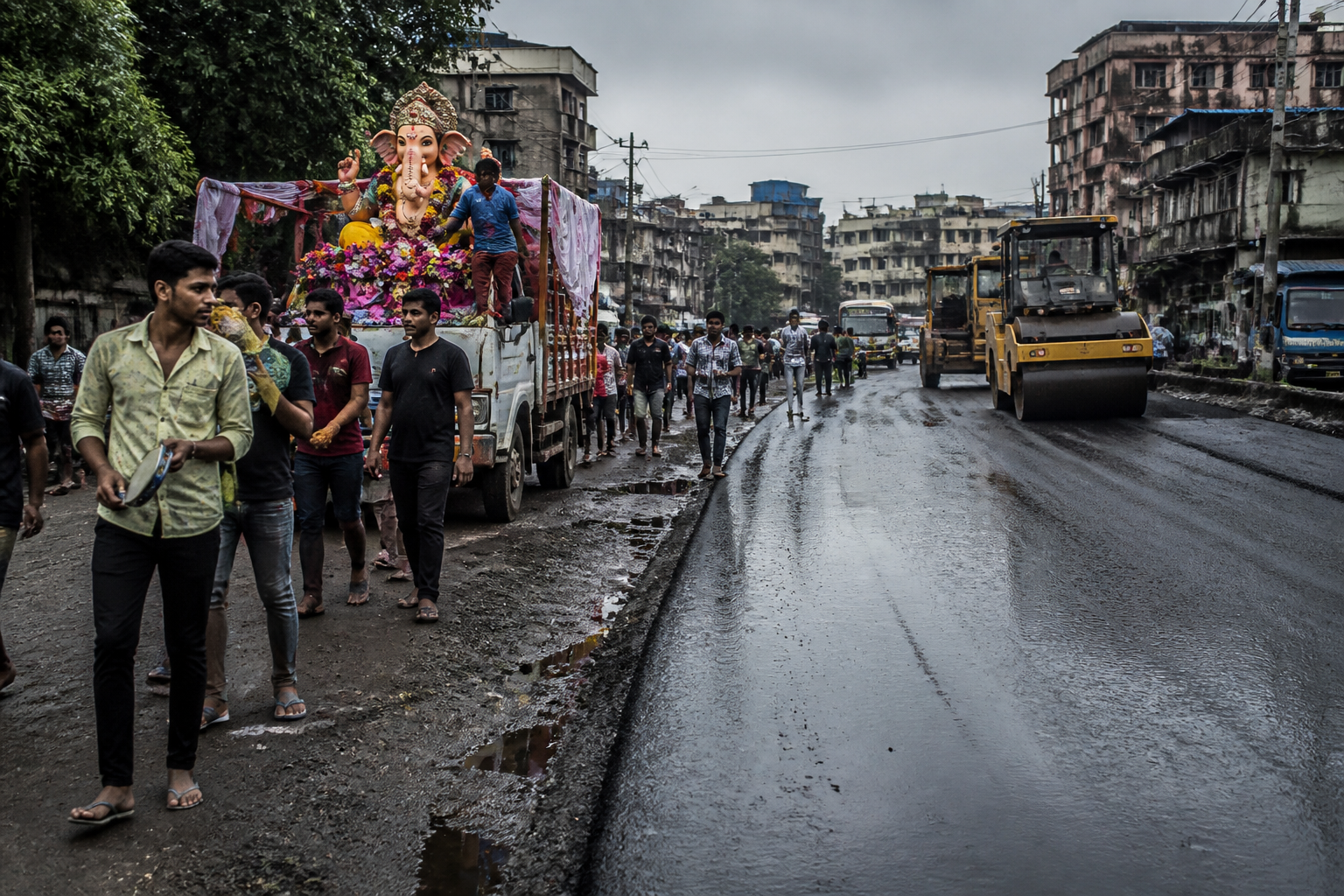
Nalasopara’s road repairs came under criticism after devotees had to take a Ganpati immersion procession over newly laid, still-wet asphalt on Sunday, despite Vasai-Virar Municipal Corporation’s assurance that roads would be repaired before the festival. Citizens have accused the civic administration and the contractor responsible of negligence.
The incident occurred as devotees moved through Nalasopara for Ganpati visarjan. The recently asphalted stretch was reportedly not ready for procession traffic, forcing participants to pass over wet roadwork. The episode has renewed concerns about the condition and timing of road repairs across Vasai-Virar.
According to the report, potholes have spread across a large number of main and internal roads in the city. Heavy-vehicle movement, intense rainfall during July, excavation for different civic development works and the slow pace of repair activity have all contributed to the deterioration of road surfaces. The report also identifies contractor negligence as a factor behind the poor condition of the roads.
Residents had asked the municipal corporation to complete repairs at least before the Ganesh festival. In response, the civic body had assured residents that the roads would be repaired before the celebrations. The reported condition of the Nalasopara road during the immersion procession has led to renewed anger over whether that commitment was met in practice.
The Vasai-Virar Municipal Corporation has claimed that between 70% and 80% of road repairs have been completed. However, the report says the corporation has not succeeded in filling potholes at many locations. The gap between the stated completion figure and the condition observed on several roads has become a key issue in the criticism directed at the civic administration.
The roadwork episode also highlights the operational risks of carrying out asphalt repairs close to large public processions. A road that is technically under repair may remain unsuitable for pedestrians, vehicles and immersion routes until the surface is ready for use. In Nalasopara, the timing of the work meant that devotees encountered a road that had been newly asphalted but had not fully become usable.
The report does not provide details of the contractor involved, the length of the affected stretch, the total repair budget or any municipal action against the contractor. It also does not state whether the corporation has ordered an inspection of the road or announced a revised schedule for completing the remaining repairs. The corporation’s stated progress figure and the condition of roads at several locations remain the immediate points of dispute described in the report.
