


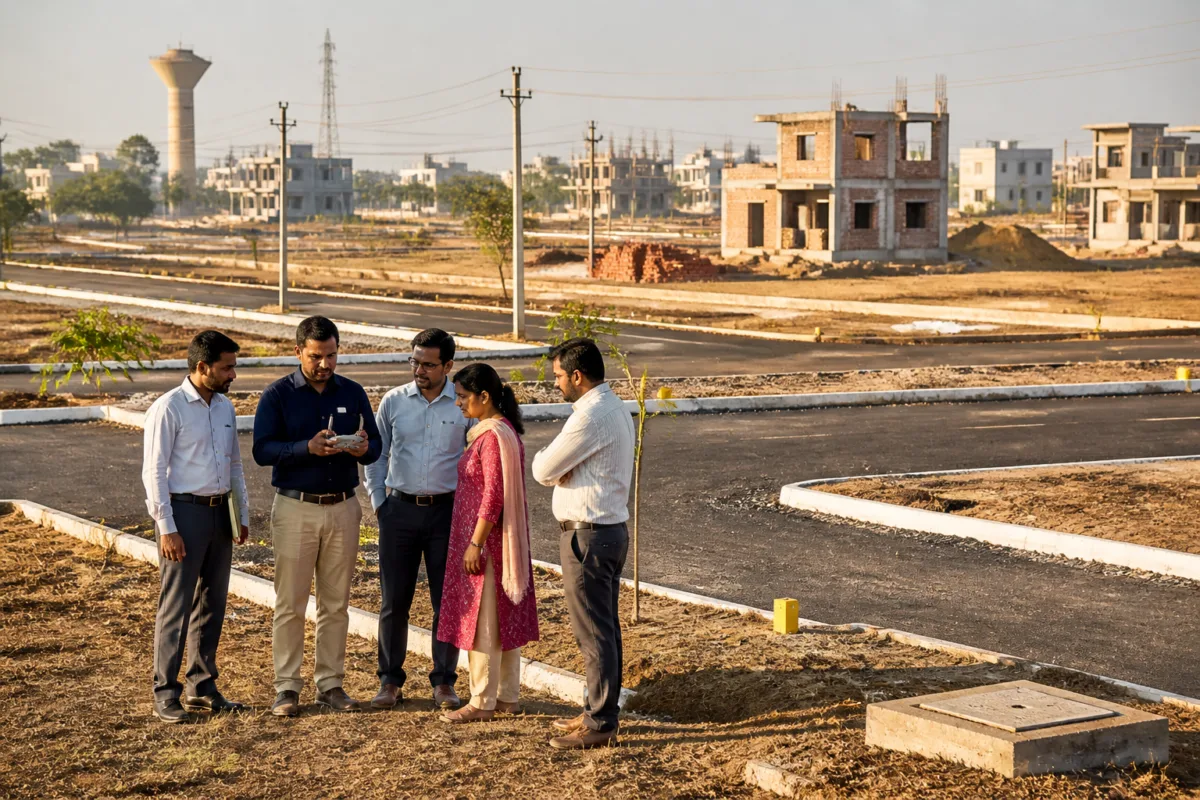
Nagpur’s new layout approval rules place a basic urban question at the centre of land development: can a housing layout be authorised before residents have access to water, roads and electricity? The directions issued by Maharashtra Revenue Minister and Nagpur district guardian minister Chandrashekhar Bawankule to the Nagpur Metropolitan Region Development Authority (NMRDA) seek to make the availability of civic amenities a condition for approving new layouts. They also connect layout scrutiny with action against unauthorised construction, land acquisition and water conservation.
The directions were issued during a review meeting at Niyोजन Bhavan, where Bawankule reviewed development works with the NMRDA and other departments, according to Loksatta. The meeting was attended by Minister of State Ashish Jaiswal, Member of Parliament Shyamkumar Barve, legislators Dr Rajiv Potdar, Charansingh Thakur and Sanjay Meshram, Nagpur district collector Kumar Ashirwad, NMRDA chairman Sanjay Meena and chief executive officer Vinayak Mahamuni, among others.
The immediate concern is the gap between formal approval and actual urban readiness. Loksatta reported that new layouts are being developed in several parts of the city, while essential facilities are not being provided by developers even though approvals are being granted. Bawankule directed the NMRDA not to approve a new layout unless the required civic facilities are confirmed. Where facilities are absent, permission should be denied, the report said.
This shifts the emphasis from approving plotted development to verifying whether the resulting settlement can function as an urban neighbourhood. Water, roads and electricity are identified as basic requirements, but the direction also refers to all facilities prescribed by the government. The supplied report does not specify a revised checklist, service-level standard, approval deadline or penalty structure. That absence matters because the effectiveness of the instruction will depend on how the NMRDA defines, measures and records the presence of these services.
The minister also directed officials to inspect civic amenities in layouts that have already received permission. Where necessary, drone surveys should be conducted, and future approvals should involve strict verification of facilities. If a layout does not meet the rules, permission should be rejected, according to the report. The instruction therefore has two parts: a retrospective review of approved layouts and a tighter screening process for future applications.
The distinction between approval and service delivery is central to the problem. A layout approval can enable land subdivision and construction, but it does not by itself guarantee that households will receive functioning infrastructure. If streets, water connections, electricity or other required facilities arrive late, residents can occupy an area that is legally approved but operationally incomplete. The report does not establish how many layouts face this condition, how long the deficiencies have existed or which agencies are responsible for rectifying them. It does, however, identify the administrative concern: approvals have been issued even where developers have not delivered necessary facilities.
The proposed use of drone surveys indicates an attempt to improve the authority’s visibility over expanding urban areas. Aerial inspection may help officials identify the physical spread of layouts and construction, but the report does not say what data the surveys will collect or how the findings will be linked to approval records. For the measure to become more than a one-time inspection, the NMRDA would need to connect physical evidence with layout boundaries, developer obligations and compliance decisions. Those operational details have not been provided in the source material.
Unauthorised construction formed the second major part of the review. Jaiswal raised the issue of large-scale unauthorised construction in urban areas. Bawankule directed that a committee headed by the town planner be formed to collect information on existing unauthorised buildings and prepare a report on preventing such construction in the future. The minister also directed that responsibility for unauthorised construction be fixed on chief officers.
This creates an enforcement chain that extends beyond individual buildings. The proposed committee is expected to document existing unauthorised construction and examine how future violations can be prevented. Fixing responsibility on chief officers points to the role of local administration in monitoring and enforcement. However, the supplied report does not specify the committee’s membership, jurisdiction, reporting deadline, enforcement powers or the action that will follow its findings. It also does not identify the urban local bodies or areas that will be covered.
The connection between layout approvals and unauthorised construction is significant. Unauthorised buildings can emerge where land is subdivided without adequate scrutiny, where development moves faster than inspection, or where approved layouts are treated as a substitute for full compliance. The report does not attribute a specific cause to Nagpur’s unauthorised construction. The minister’s directions nevertheless bring preventive approval checks and post-construction enforcement into the same administrative conversation.
The review also covered the New Nagpur project, for which land acquisition is under way. Farmers have complained that compensation is being paid at a lower rate, according to the report. Bawankule directed officials to re-examine compensation cases involving 14 farmers. If records show that the farmers had previously cultivated irrigated crops, their compensation cases should be processed accordingly. He also instructed officials to accelerate the remaining land acquisition for the project.
The compensation direction introduces a test of how land-use history is reflected in acquisition decisions. The report does not state the total land area involved, the compensation amounts, the current stage of acquisition or the legal basis for reassessing the 14 cases. It says only that the cases should be reconsidered in light of whether irrigated crops had previously been cultivated. That makes verification of agricultural use a central administrative step in determining whether compensation was assessed correctly.
The proposed third ring road was also discussed. Officials were directed to conduct joint measurement for the road after taking farmers into confidence. Joint measurement can establish the affected land and the boundaries relevant to acquisition, but the report provides no alignment map, length, construction schedule or funding details for the proposed road. The instruction to involve farmers indicates that the measurement process is being treated as a stakeholder issue as well as a technical exercise.
The meeting broadened further into rural access and water management. The report states that murum, a locally available soil and aggregate material, is available in several lakes and streams and could be useful for farm access roads, or pandhan roads. Officials were asked to prepare revenue-circle-level plans for farm road works and for desilting lakes and check dams where such material is available. The stated objective is to build farm roads while also excavating lakes and check dams.
This approach links two forms of public work that are often planned separately: access infrastructure and water storage. The report does not provide the number of lakes or check dams, the quantity of material available, the proposed excavation methods or safeguards. It records the administrative instruction to gather detailed information and prepare plans at the revenue-circle level. The eventual value of the proposal will therefore depend on the quality of the inventory and the coordination between revenue, rural works and water-related authorities.
The NMRDA and forest areas were separately asked to prepare proposals for water conservation. The report says the district is facing drought conditions this year and that lakes and check dams in NMRDA and forest areas need deepening and conservation. Both institutions were directed to collect information on all types of lakes and check dams in their jurisdictions and submit proposals. In forest areas where increasing fodder areas is possible, proposals should also be prepared.
Taken together, the directions describe Nagpur’s urban expansion as an infrastructure and land-governance problem rather than a housing supply issue alone. New layouts require services; existing layouts require inspection; unauthorised construction requires documentation and accountability; land acquisition requires reassessment of compensation; and new roads and development areas require coordination with water and agricultural conditions. The source does not establish that these measures have already changed approval practice or stopped any construction. They remain instructions issued at a review meeting.
The immediate institutional question is how these directions will be converted into routine decisions. The NMRDA is expected to verify services before granting new layout permissions and inspect already approved layouts. A town-planner-led committee is expected to report on unauthorised construction. Officials are expected to reassess 14 compensation cases, accelerate remaining acquisition for New Nagpur, conduct joint measurement for the third ring road and prepare water-conservation proposals. The report does not give deadlines for these steps.
That makes implementation records the next important evidence. For layout approvals, the relevant indicators would include the number of applications inspected, the amenities verified and the permissions rejected or approved subject to compliance. For unauthorised construction, the committee’s inventory and the action taken against identified violations would show whether responsibility has been fixed. For land acquisition, the reassessment of the 14 cases and the progress of the remaining acquisition would indicate whether the review has altered outcomes.
The evidence currently confirms a policy direction, not a completed reform. Nagpur’s authorities have been instructed to place civic amenities ahead of new layout approvals, inspect existing layouts, document unauthorised construction and integrate land and water concerns into ongoing development works. What remains unclear is the enforcement framework, the baseline scale of the problem, the funding for corrective works and the timelines for each action. Those details will determine whether the directions produce more functional neighbourhoods or remain limited to an administrative review.

