


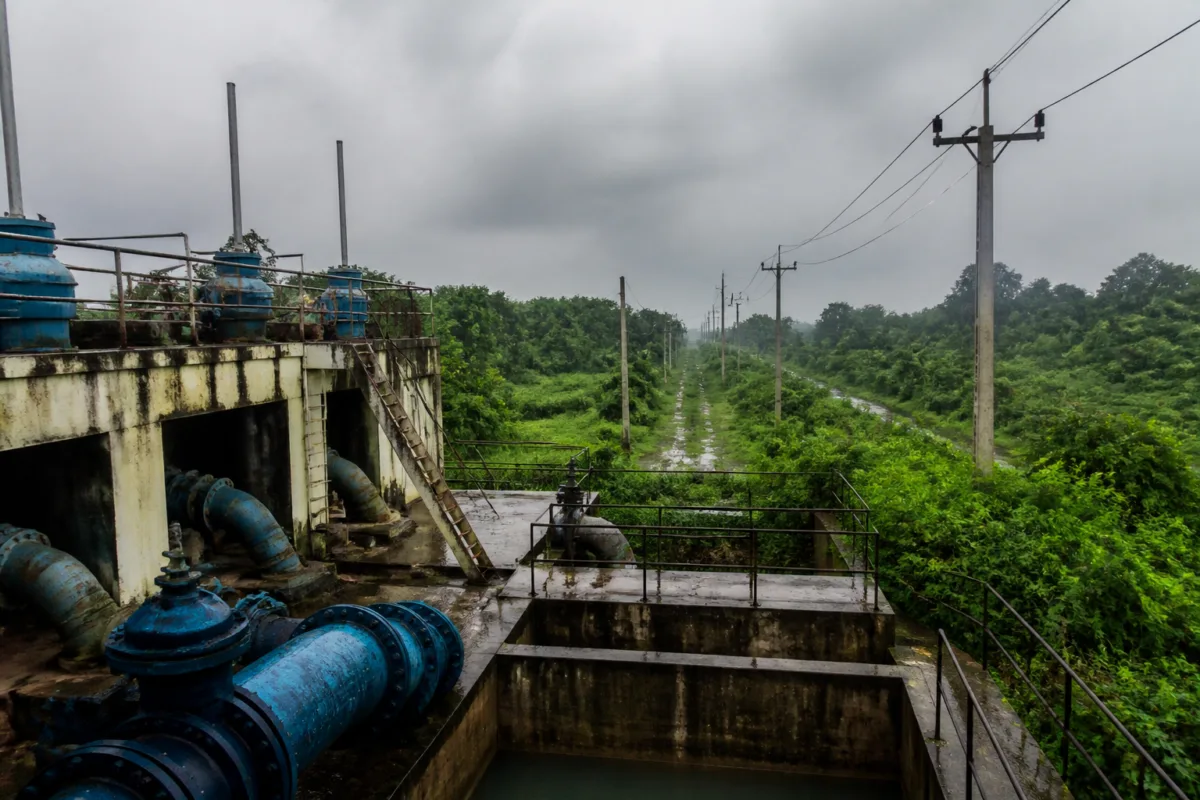
Nagpur’s water supply network is carrying a city-scale risk on a single vulnerable power connection. Nearly 65% of the city’s water supply depends on the Navegaon Khairy raw water pumping station, which receives electricity through a 29-km, 33 kV overhead feeder passing through a forest stretch. Between June and September, power trippings across the listed water installations caused more than 68 hours of shutdowns, according to a written reply by the Nagpur Municipal Corporation (NMC) and power-tripping reports cited by the civic administration.
The immediate concern is not simply the number of interruptions. It is the concentration of dependency. Navegaon Khairy supplies raw water to four treatment plants—three at Gorewada and one at Godhani. Together, these plants serve a substantial part of Nagpur. A failure at the pumping station can therefore affect the movement of water before treatment, placing pressure on the wider supply chain even when treatment plants and distribution assets remain operational.
The arrangement also shows how a water system can become dependent on infrastructure managed by another utility. The feeder originates at the Maharashtra State Electricity Distribution Company Limited’s 132 kV Mansar substation and runs over a long distance before reaching Navegaon Khairy. NMC’s reply linked the frequent disruptions to the distance between the two points, the forest location of the feeder and technical faults in the extra-high-voltage network. Heavy monsoon rain and lightning were also identified as triggers for repeated tripping of the 33 kV NMC feeder.
The figures recorded during the four-month period indicate a recurring operational problem rather than an isolated failure. MSEDCL’s monthly reports recorded 30 power trippings in June, 32 in July, 25 in August and 25 in September across the listed installations. The reported cumulative disruption time was 17.97 hours in June, 23.48 hours in July, 10.92 hours in August and 16 hours in September, adding up to 68.37 hours.
At Navegaon Khairy alone, power interruptions totalled 7.8 hours in June, 1.45 hours in July, 5.75 hours in August and 8.87 hours in September. The longest recorded outage occurred on June 12, when the pumping station remained without power for 366 minutes. Another prolonged interruption on September 19 lasted 250 minutes. These durations matter because pumping is a sequential operation: an interruption at the raw water source can affect treatment throughput and the timing of downstream supply, even if the electricity is restored later.
NMC’s existing alternative is not a fully independent backup. The civic body said supply can be sourced from the Parsheoni substation through back-feeding, subject to availability. However, this arrangement can operate only two pumps at a time. It cannot maintain full-capacity pumping during a failure on the primary feeder. The city therefore has a contingency mechanism, but one that does not replicate the capacity of the infrastructure it is meant to protect.
This distinction is central to understanding the vulnerability. Backup arrangements are often treated as proof that a system has redundancy. In Nagpur’s case, the available information indicates partial redundancy rather than equivalent redundancy. Back-feeding may keep some pumping capacity running, but its limitations mean that the water network remains exposed to reduced output whenever the main supply fails. The resilience of the system consequently depends not only on whether an alternative connection exists, but also on whether that connection can support the required level of operation.
The geography of the feeder adds another layer to the problem. A 29-km overhead line crossing a forest area creates a long exposure corridor for faults, weather-related damage and maintenance difficulties. The NMC reply specifically connects the distance and forest stretch with recurring disruption. The supplied material does not establish the exact cause of every individual outage, but it identifies a combination of technical faults, monsoon conditions and lightning as recurring factors.
The institutional responsibility is similarly divided. NMC operates the water pumping and treatment installations, while MSEDCL is responsible for the power network supplying them. The water utility depends on the electricity utility’s network reliability, but the consequences of a failure are experienced through municipal water services. This creates a coordination challenge: the infrastructure that fails and the public service affected by that failure are not controlled by the same institution.
The proposed response reflects this interdependence. MSEDCL has initiated an examination of a proposal to establish a 132 kV substation at Navegaon Khairy. Discussions are also under way to strengthen the back-feeding arrangement. NMC said further action would follow after approval of the options submitted by the power utility. At the stage described in the supplied material, neither a permanent solution nor an implementation timeline has been confirmed.
The proposal for a 132 kV substation would address the issue at the level of power supply infrastructure, but the available information does not establish whether it has received final approval, what its construction schedule would be, or how it would change operational reliability. Similarly, strengthening back-feeding could improve short-term continuity, but the current capacity limitation shows that the alternative arrangement would need to be assessed against the pumping station’s full operational requirements.
Nagpur’s case illustrates a broader urban infrastructure problem: essential services are frequently planned as separate systems even though their functioning is tightly linked. Water supply depends on electricity; electricity assets are exposed to weather and geography; and both systems require coordinated investment. A treatment plant can have adequate capacity on paper, but that capacity is of limited public value if raw water cannot be pumped consistently into it.
The data supplied by NMC and MSEDCL also shifts the question from emergency response to asset planning. Four months produced 112 recorded trippings across the listed installations and 68.37 hours of cumulative disruption. The records show that the issue was repeated across every month, with the highest number of trippings in July and the longest total disruption in June. The evidence does not show the resulting volume of water loss, the number of affected consumers or the duration of any distribution-level shortages, so the precise citizen impact cannot be quantified from the available material. It does, however, establish a persistent vulnerability in a critical upstream facility.
The bigger urban question is whether Nagpur’s water network has enough electrical redundancy to withstand predictable stresses such as monsoon rain, lightning and faults along a long overhead feeder. The current arrangement suggests that the city’s water security is tied to a single major supply route, supported by a backup that cannot operate all pumps. Until the proposed substation and strengthened back-feeding plan move beyond examination and discussion, the system remains exposed to interruptions at the point where water enters the treatment chain.

