


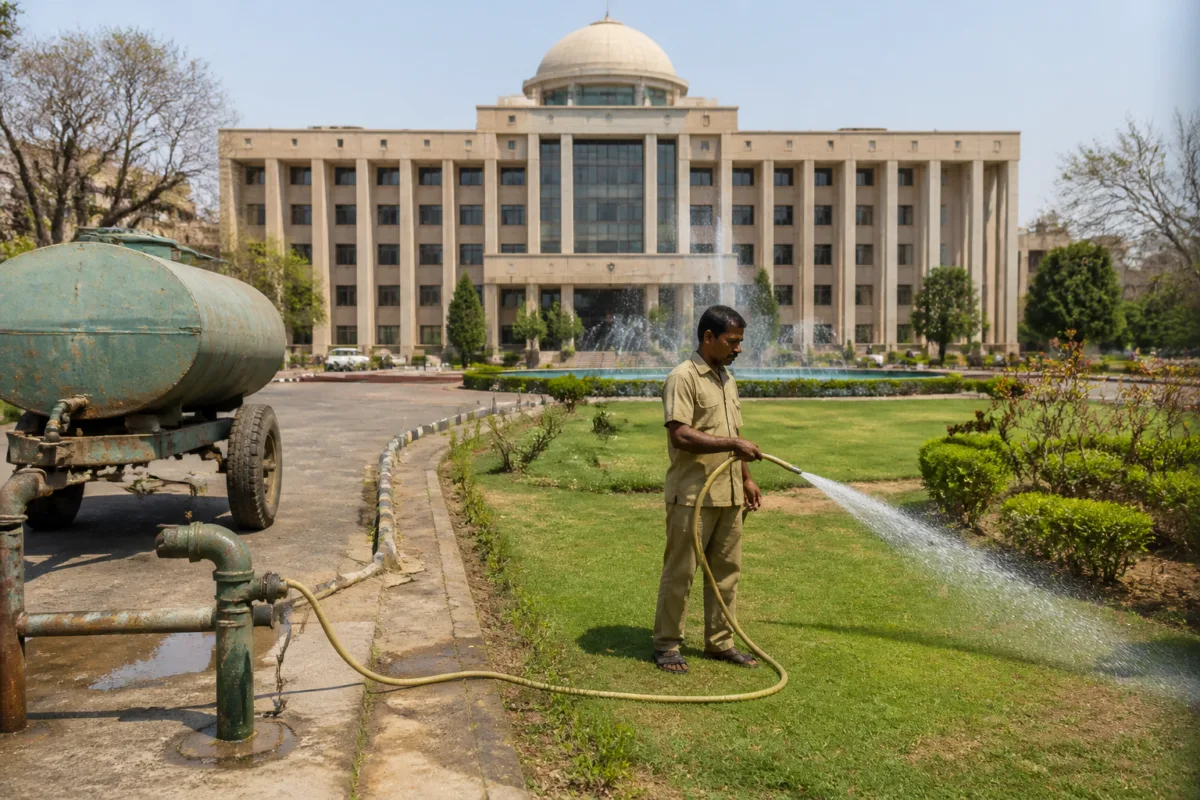
Nagpur’s water conservation programme is facing a credibility test at the headquarters of the agency enforcing it. Lawns at the Nagpur Municipal Corporation (NMC) headquarters are reportedly being watered with treated water from the municipal network, while two fountains outside the offices of the mayor and deputy mayor are also operating on the same supply.
The reported practice comes as Nagpur faces deficient rainfall, falling reservoir storage and restrictions on the use of treated drinking water for non-domestic purposes. The NMC has prohibited the use of treated water for watering gardens, washing vehicles, cleaning roads and construction activities.
A caretaker responsible for the headquarters gardens told the Times of India that the premises had no borewell or well for gardening and other uses. According to the report, water is instead drawn from a tank filled through a treated-water connection. A senior official from the NMC’s garden department also acknowledged that the headquarters had no alternative arrangement beyond a sump connected to the municipal supply.
The caretaker said he was unaware of restrictions on using treated water for gardening. The report does not indicate whether the NMC has issued a specific exemption for its headquarters or whether an alternative supply system is being planned.
The issue is significant because the civic body’s seven-point water conservation programme is intended to reduce the misuse of treated drinking water across the city. Municipal commissioner Vipin Itankar has said that people found using treated tap water for purposes other than drinking and household consumption would face a fine of Rs 5,000. The NMC has also directed officials to intensify inspections of commercial establishments and identify violations.
Those inspections have already found non-compliance among car-washing centres. During checks on October 26 and 27, the civic body found that 20 of 174 centres were using water from the municipal supply network. The report said penalty orders were still awaited despite the findings.
The conservation drive follows a sharp decline in storage at Totladoh reservoir, a major source of Nagpur’s water supply. The reservoir had 221.16 million cubic metres of live storage on November 19, equivalent to 21.75% of its designed capacity, compared with 86.65% on the corresponding date the previous year, according to the report.
The NMC’s action plan targets savings of 27.7 million litres per day. Its largest proposed measure is the reuse of treated sewage water from 10 sewage treatment plants, which is expected to save 20 million litres per day. Other measures include repairing leaking pipelines, increasing the use of wells, acting against wastage and shifting commercial users to alternative water sources.
The headquarters episode highlights an implementation gap within the conservation programme: restrictions imposed on residents and businesses have limited credibility if the municipal administration cannot demonstrate the same standards on its own premises. It also points to the practical infrastructure challenge behind water reuse. Without dedicated non-potable supply systems, storage or groundwater arrangements, public institutions may continue relying on treated municipal water for landscaping and other uses that the city is trying to curb.

