


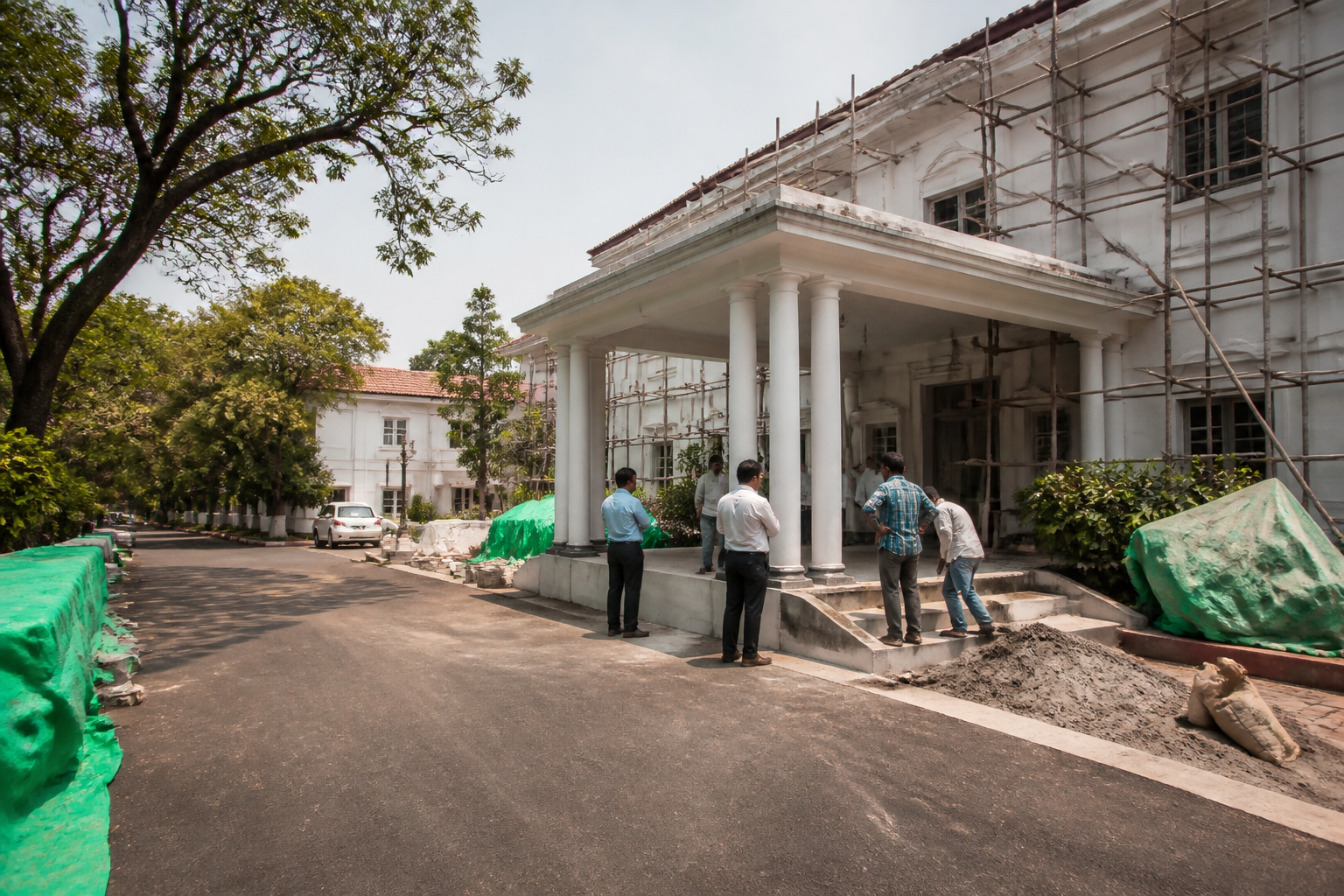
Fresh Public Works Department tenders worth Rs10.11 crore for 57 works in Nagpur have brought an ordinary but consequential function of urban governance into view: the cost of keeping government buildings ready for a major political event. The tenders, floated ahead of Maharashtra’s winter legislative session, include Rs41.09 lakh for renovating a dining area and general toilet at a government bungalow in Civil Lines. The figure has drawn attention because it sits alongside the state PWD’s reported pending dues of about Rs17,000 crore and Nagpur’s unresolved need for large-scale water infrastructure.
The issue is not simply whether a toilet, dining area or meeting hall requires repair. It is how public works departments define urgency, group projects, calculate estimates and allocate scarce funds when routine maintenance competes with major civic needs. In Nagpur, the tender documents described in the report show a concentrated burst of works across premises used during the winter session, with every work carrying a one-month completion period.
That deadline is central to understanding the spending. The tenders were issued barely a day after questions were raised over an earlier Rs10.38 crore package for 94 pre-winter session repair works. The new tenders divide 57 works into three packages: 26 works worth Rs4.77 crore, 24 works worth Rs3.5 crore and seven works worth Rs1.84 crore. The one-month completion period indicates that the department is working backwards from the session schedule in December rather than following a routine, open-ended maintenance cycle.
This approach can be administratively understandable. Buildings hosting the legislature, ministers, officials and support staff have to be functional before the session begins. But compressed timelines also change the public-interest question. Once a deadline becomes the organising principle, the key test is whether each proposed work is necessary, properly estimated and independently monitored, rather than merely whether it can be completed on time.
The largest individual point of public attention is Bungalow 27/1 in Civil Lines. The PWD has proposed Rs41.6 lakh for strengthening the meeting hall and other repairs, and another Rs41.09 lakh for renovating the dining area and general toilet. Together, the two works amount to Rs82.69 lakh. The report compares the second estimate with prevailing residential property prices, noting that the amount could buy a 580-square-foot flat in Friends Colony. That comparison is not a technical assessment of the work, but it illustrates why a seemingly routine maintenance item can become a public accountability issue.
The tender list shows that the expenditure is distributed across several types of government premises. At Ramgiri Bungalow, Rs42.02 lakh is proposed for strengthening a roadside passage with stamped concrete. At Ravi Bhavan, Rs42.02 lakh is earmarked for roof replacement and renovation of Ministerial Cottage No.13. At Vidhan Bhavan, two works total Rs82.78 lakh: Rs41.6 lakh for the Chief Minister’s chamber, ante-chamber, dining room and washroom, and Rs41.18 lakh for the Chief Minister’s office and toilet at the Old Annexe building.
Other works cover painting and repairs. At Hyderabad House, four works include Rs21.1 lakh for internal and external painting of the new building. At the MLA Hostel, external and oil painting of Wing 2 has an estimate of Rs38.66 lakh, while Wings 3 and 4 have an estimate of Rs23.53 lakh. At Deogiri, the tender package includes repairs to ministerial cottages and personal-assistant quarters. Several estimates also appear in recurring slabs, including two works at Rs16.88 lakh each and two at Rs12.66 lakh each in Notice 49. Other individual estimates cited in the report include Rs21.1 lakh, Rs15.61 lakh, Rs15.19 lakh and Rs9.16 lakh.
The recurring amounts raise an institutional question about how maintenance estimates are generated. A senior PWD official told the Times of India that repeated estimates result from the department’s standard maintenance-estimation process. For works below Rs10 lakh, detailed estimates are prepared after accounting for GST and other overheads, and the amount is then reflected in the technical sanction. This explanation provides a procedural account of the figures, but it does not by itself establish whether the underlying works are necessary, whether their scope is proportionate or whether the completed work will match the estimate.
That distinction matters because a technical sanction is an administrative approval of an estimate, not a public audit of outcomes. The documents can state what is proposed and how much it is expected to cost. They do not, on the evidence available in the report, establish the condition of every building, the alternatives considered, the contractor-selection outcome, or the quality of work after completion. Those stages determine whether a tender represents prudent maintenance or deadline-driven expenditure.
The timing also places the works within a wider fiscal context. The reported Rs17,000 crore in pending PWD dues suggests a department operating under significant financial pressure. The report does not establish how the new tenders will affect that liability or whether the works are funded from a specific budget provision. It does, however, show the tension between accumulated obligations and new commitments. A department with large unpaid bills must distinguish between essential safety and functional repairs, presentational improvements and works that can be deferred without affecting public operations.
The comparison with Nagpur’s proposed Rs952 crore barrage on the Kanhan river makes that tension more visible, though the two expenditures belong to different scales and purposes. The barrage proposal is intended to augment the city’s water-storage capacity and is awaiting administrative approval. The maintenance tenders concern existing government buildings and are linked to the winter session. They cannot be treated as interchangeable budget lines. Yet their simultaneous presence in the city’s public spending landscape shows how immediate institutional requirements can sit alongside long-term urban infrastructure needs.
The governance structure is equally important. The PWD is responsible for maintaining state government buildings, while the legislative session creates a fixed operational deadline. The model code of conduct for the Nagpur Division Graduates’ Constituency election, according to the senior official cited by the report, does not bar maintenance and repair works in existing government buildings. That clarification addresses whether the works can proceed during the election period; it does not settle the separate question of value for money.
Citizen Anil Wadpalliwar has called for an independent third-party audit and inspection to establish whether the works are genuinely necessary and justified. His intervention identifies the missing accountability link: a public explanation of the condition survey, the scope of each work, the basis for the estimate and the verification of completion. Such information would allow citizens to assess the tenders on evidence rather than on the optics of a high-value toilet, dining-area or painting estimate.
The episode also illustrates how cities become venues for periodic institutional activity. Nagpur’s winter session brings a temporary concentration of elected representatives, officials, media and security personnel into buildings that may remain lightly used outside the session cycle. The resulting maintenance model has to serve both everyday building management and peak seasonal demand. The report does not establish how frequently these premises are occupied or whether lifecycle maintenance plans exist, but the one-month deadlines show that at least some preparation is being organised around the annual event.
The broader urban question is therefore not whether government premises should be maintained. They must be. The question is whether maintenance is planned as a transparent asset-management function or treated as a recurring pre-event exercise. The distinction affects costs, procurement pressure and the ability of public agencies to prioritise repairs based on safety, use, condition and service continuity.
The tender documents confirm a new Rs10.11 crore round of works across 57 government-premises projects, with several individual estimates above Rs20 lakh and a one-month completion target before the winter session. The supplied evidence does not confirm whether the works have been awarded, whether the estimates will change, or whether an independent inspection has been ordered. Those are the next points that will determine whether the spending becomes a case of justified urgent maintenance or another example of opaque public-works prioritisation.
