


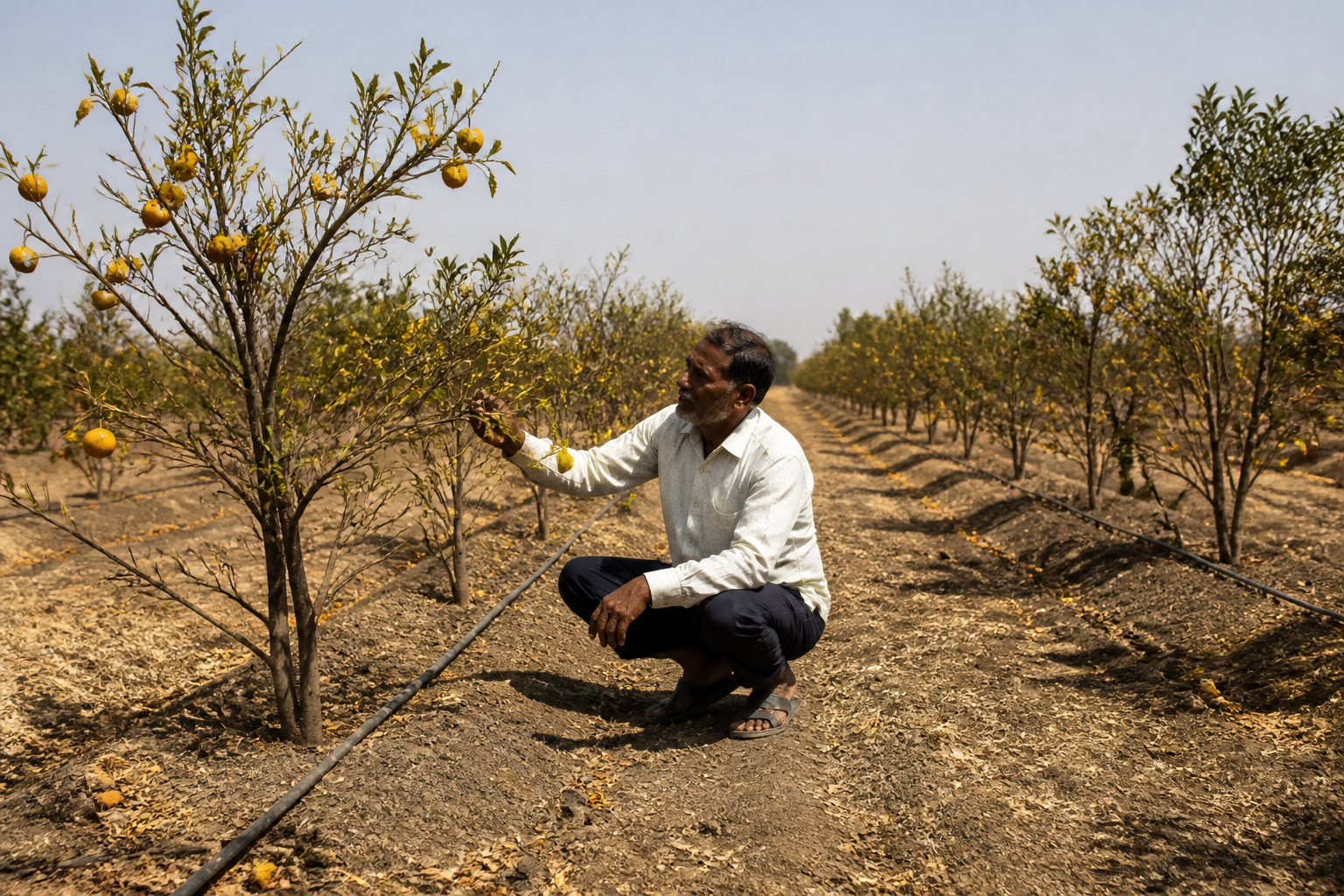
The crisis facing Nagpur mandarin orchards is no longer limited to a weak harvest or a single dry season. In Amravati district, farmers have reportedly removed orange trees from around 5,000 hectares as drought, water shortages, October heat and rising cultivation costs make it increasingly difficult to keep orchards productive. The development places the future of a major regional horticulture belt under pressure while exposing how water, electricity, insurance and market risks are converging on farm livelihoods.
The affected belt, spread across Chandur Bazar and adjoining areas, covers about 35,000 hectares of orange orchards. It is known for its relatively small-sized, tangy Nagpur mandarins. According to the report, the immediate stress has been intensified by Amravati receiving 43% less monsoon rain this year. With temperatures rising during October, growers say that securing enough water throughout the season has become both more difficult and more expensive.
The timing of water stress is critical for orange cultivation. Farmers told the Times of India that inadequate soil moisture is affecting tree growth, flowering, fruit development and fruit size. Prolonged dry conditions can weaken trees, increase fruit drop and reduce productivity, while high temperatures are also being associated by growers with a higher incidence of disease.
“Because there’s no moisture in the soil, fruit drop has risen. The high temperatures are also increasing the incidence of disease in orange trees and other crops,” farmer Sopan Mohod of Madhan was quoted as saying. His account describes a chain reaction in which the absence of rainfall affects not only irrigation planning but also the biological stages that determine whether an orchard can produce a viable crop.
For an orchard farmer, replacing trees is not simply a short-term response to a poor monsoon. Orange orchards represent an ongoing commitment to water, labour, electricity, fertilisers, pesticides, drip irrigation and management. The report indicates that growers are now weighing that commitment against uncertain returns and considering crops that may consume less water.
Pushpak Khapre, an orange grower and member of the Amravati district fruit crop insurance committee, said farmers were increasingly removing trees because the economics of maintaining orchards had become difficult. “Farmers are now shifting to alternative crops which may consume less water. There is no profit in growing oranges now,” he said.
That assessment suggests that the reported loss of orchard area is not being driven by water scarcity alone. Khapre attributed the distress to several years of low and uncertain market prices, rising costs of fertilisers, pesticides, labour, electricity, drip irrigation and orchard management, as well as pest and disease attacks and weather fluctuations. The current water crisis has become the immediate concern, but the broader problem is the accumulation of risks that leave farmers with fewer financial reasons to continue.
This distinction matters for understanding the future of the Nagpur mandarin belt. A single rainfall deficit may be addressed through emergency irrigation or other short-term measures. A decline in orchard viability caused by several interacting pressures is harder to reverse. Once trees are removed and farmers shift to other crops, the change reflects not only a seasonal production decision but also a reassessment of whether the existing orchard model can absorb rising costs and uncertain income.
The reported 5,000-hectare reduction also brings the question of irrigation capacity into focus. Growers with inadequate rainfall and limited irrigation sources are struggling to plan how water will be supplied to orchards. Shekhar Vighe, a farmer from Dapori in Morshi taluka, said the absence of rainfall had made irrigation planning difficult and that unreliable transformer power was adding to the problem.
“Because of the lack of rainfall this year, orange growers are unable to plan how to irrigate their orchards. Even power supply from transformers is unreliable. There is a strong possibility the next season may also be lost,” Vighe was quoted as saying. His statement links two infrastructure dependencies: water availability and the electricity needed to operate irrigation systems. The orchard economy therefore relies not only on rainfall or farm-level investment, but also on the reliability of local power infrastructure.
The evidence supplied in the report does not establish the precise share of orchard area that has been removed by each cause, nor does it provide an official assessment of total production losses or farm incomes. It does, however, identify a clear pattern in the accounts of growers: the immediate water shortage is occurring within an already weakened economic system. The result is a decision by some farmers to remove trees rather than continue paying for an orchard whose output and prices are uncertain.
Crop insurance is another institutional pressure point. Growers are concerned that delays in assessment and compensation are adding to financial uncertainty. When an orchard is affected by drought, heat, disease or crop loss, delays in compensation can leave farmers carrying input and maintenance costs without timely support. The report does not specify the number of pending claims or the time taken for settlements, but the concern places insurance administration alongside irrigation and electricity as part of the sector’s resilience.
Khapre has also argued that crop insurance should cover damage caused by wild animals. He warned that water scarcity in forests could increase human-wildlife conflict as animals move towards farms in search of water and sought a 100% government subsidy for iron fencing around farms. This introduces a further land-use dimension to the crisis: declining water availability can affect not only crops directly, but also the interaction between cultivated areas and nearby forest ecosystems.
The request for subsidised fencing reflects the expanding cost of protecting an orchard. Farmers are already dealing with water procurement, power reliability, input prices, pests, diseases and market uncertainty. If wildlife damage becomes more frequent as water sources decline, physical protection could become another cost that individual growers are expected to bear. The report records the demand for support but does not establish whether such a subsidy has been approved or implemented.
The policy challenge is therefore spread across multiple departments and administrative systems. Irrigation and water management affect whether orchards can survive dry periods. Electricity distribution affects whether wells and drip systems can operate. Agriculture departments and insurance institutions influence compensation and risk protection. Market conditions determine whether the crop can cover cultivation costs. Measures relating to wildlife and fencing involve another set of authorities. The fragmented nature of these responsibilities can make a farm-level crisis difficult to address through a single intervention.
The numbers available in the report show the scale of the pressure but also the limits of the current evidence. The orchard belt covers about 35,000 hectares, while trees have reportedly been removed from around 5,000 hectares. Amravati’s monsoon rainfall is reported to be 43% below normal this year. These figures establish a substantial shock to water availability and a sizeable change in land under orchards, but they do not by themselves reveal how much production, employment or income has been lost.
That missing information is important for policy. The condition of an orchard cannot be measured only by the area under trees. Tree age, access to irrigation, fruiting performance, disease incidence, market prices and the time required to establish replacement crops all affect the economic consequences. The supplied report does not provide those details, so the full scale of the regional impact remains to be quantified.
What it does show is that climate and infrastructure risks are being experienced together. Lower rainfall increases the need for irrigation precisely when water sources are under stress. Higher temperatures raise concerns about fruit drop and disease. Unreliable electricity makes irrigation planning more difficult. Rising input costs reduce the ability of farmers to absorb these shocks, while delayed insurance payments increase exposure after losses occur.
The larger urban question is how cities and regions depend on rural production systems that are often treated as separate from urban infrastructure. Nagpur mandarins move through markets and supply chains that connect orchards with towns and cities, but the sustainability of that system depends on water governance, power networks, farm economics and environmental management in the surrounding region. When those systems weaken, the effects are visible first in orchards but can extend through livelihoods, food supply and regional economies.
The reported removal of orange trees does not prove that the entire Nagpur mandarin belt is in irreversible decline. It does show that some growers no longer consider continued orchard maintenance economically viable under present conditions. The developments that now require attention are the extent of further tree removal, the reliability of water and electricity supplies, the assessment and settlement of crop insurance claims, and whether support for protection from wildlife damage is provided. Together, these factors will determine whether this season’s distress remains a severe shock or becomes a longer-term restructuring of Amravati’s orchard landscape.
