


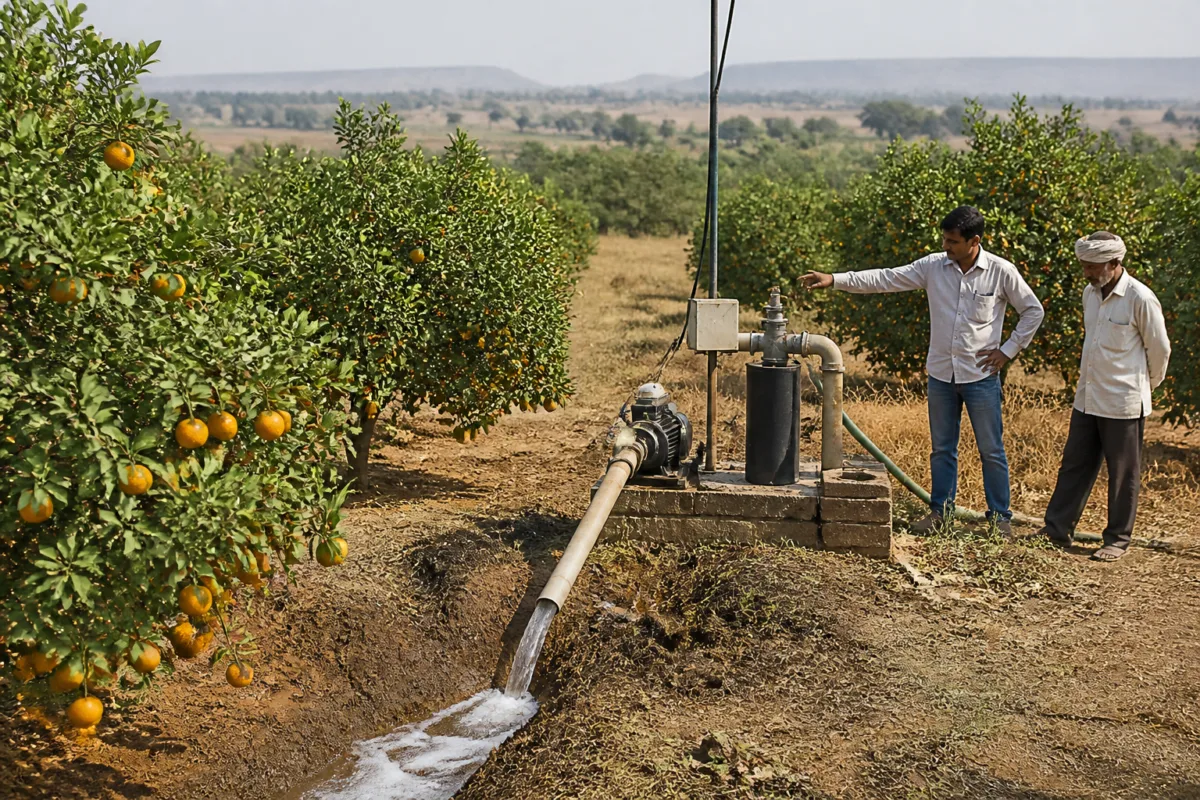
Nagpur district has lifted restrictions on digging borewells in areas where groundwater is required to protect fruit-bearing orchards, particularly orange and sweet lime plantations, as drought conditions threaten crops. Guardian minister Chandrashekhar Bawankule said the decision was intended to prevent trees from drying up while ensuring that the district’s drinking-water reserves are protected.
The district collector is expected to issue detailed guidelines after the Diwali vacation. The administration will regulate the process and take measures intended to improve groundwater levels, according to the minister. A similar step is expected to be taken in Amravati district, where orchard cultivation is also significant.
Bawankule said the state government had taken the decision after assessing the need to maintain adequate water availability for fruit trees. The relaxation does not amount to an unrestricted opening of groundwater extraction, as the district administration is expected to specify how and where borewells can be dug.
The announcement comes amid concern over Nagpur’s drinking-water reserves. Bawankule said water stored in the Totladoh reservoir would last for the next eight months and ruled out releasing water from the reservoir for rabi crops. He said drinking-water supplies would not be diverted for irrigation.
Totladoh held 257.61 million cubic metres of live water on November 11, equivalent to 25.33% of its designed live storage capacity of 1,016.93 million cubic metres. On the same date last year, the reservoir held 89.5% of its live storage capacity. Kamthi Khairi reservoir was in a stronger position, with 113.72 million cubic metres against a designed capacity of 141.98 million cubic metres, or 80.10%. Its storage stood at 85.49% on the corresponding date last year.
The administration has also reduced the water reservation for the Koradi and Khaparkheda thermal power stations. The two stations are now being operated with treated sewage water, according to Bawankule. The change is intended to reduce pressure on water reserved for other uses, including the city’s drinking-water supply.
Nagpur’s lakes and other water bodies were another focus of the minister’s remarks. He said two meetings had been held to discuss their conservation and urged residents not to discharge sewage or drain water into public water bodies. He also called for desilting and deepening lakes to increase their storage capacity.
The condition of the city’s lake network has already raised administrative concerns. Earlier reporting by The Times of India said Nagpur once had 13 lakes, while records of the Nagpur Municipal Corporation now recognise 11 surviving lakes within city limits. The listed water bodies include Ambazari, Futala, Sonegaon, Pandharabodi, Police Line Takli, Binaki Mangalwari, Naik, Gorewada, Sakkardara, Lendi Talao and Gandhi Sagar lakes. Sanjay Gandhi Lake and Dobi Lake have effectively disappeared from the civic body’s official inventory.
The immediate next step is the district collector’s detailed guidance on borewell digging for orchard irrigation. The administration’s stated priorities are to protect fruit trees, regulate groundwater extraction, conserve surface water and preserve Totladoh for Nagpur’s drinking-water needs.

