


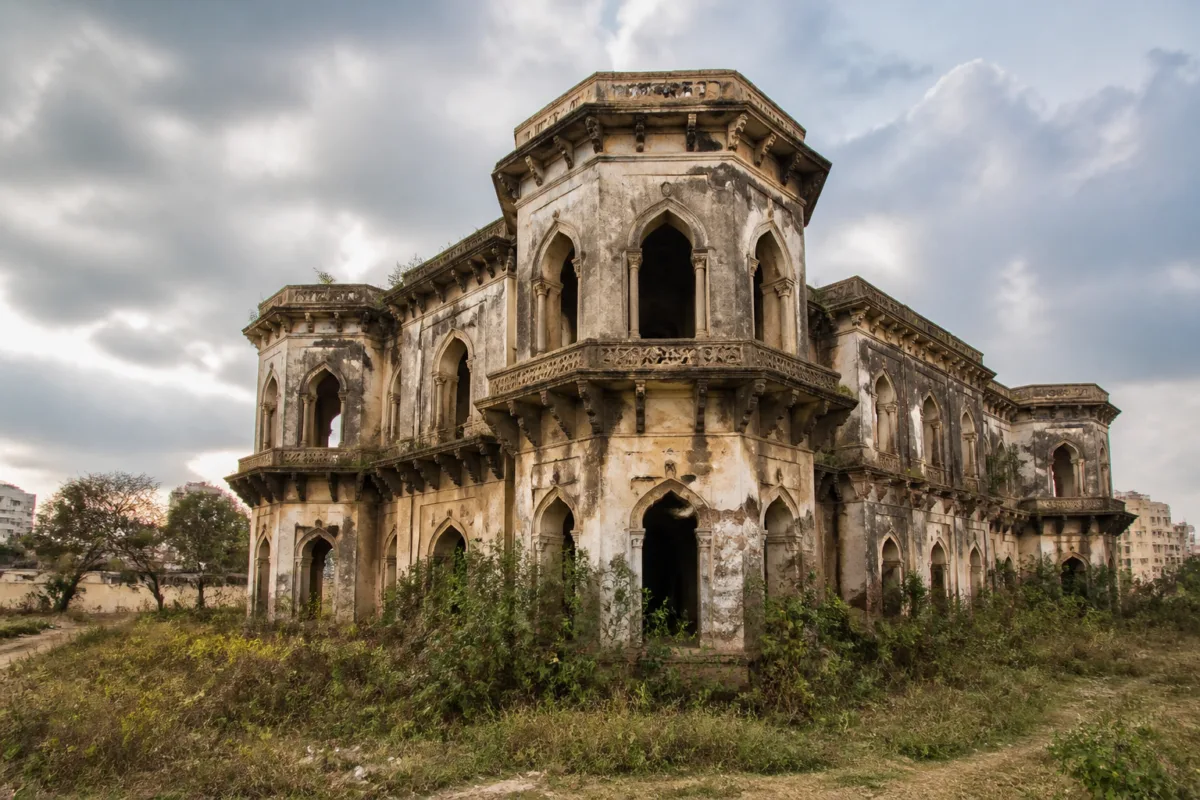
Mushk Mahal’s deteriorating walls, encroaching vegetation and reported land pressure reveal a wider problem in Hyderabad: historic buildings can remain culturally important while lacking sustained protection, maintenance and institutional accountability. The two-storeyed palace at Attapur, associated with the Qutb Shahi period, is now described as being in a dilapidated condition after years of neglect.
The palace was constructed in 1678 by Miyan Malik Mishk, a commander of the Carnatic forces of Abul Hassan Tana Shah, the last ruler of the Qutb Shahi dynasty. It stood on a six-acre site south of the Musi river. The structure’s history is therefore tied not only to a building but also to the political geography and urban imagination of early Hyderabad.
According to the report by Deccan Chronicle, Mushk Mahal was once associated with the trade in musk and later housed a madrasa at Attapur. Its present condition contrasts with descriptions of a building that was once maintained and actively used. Local resident Abdul Hafeez said the structure had been in good condition about four decades ago but now had vegetation growing around it and cracks appearing in its walls.
That account points to an important distinction in heritage management. A historic structure does not necessarily decline because of age alone. Its condition can also reflect whether it remains occupied, maintained, monitored and connected to a responsible institution. In Mushk Mahal’s case, the reported transition from an active madrasa to an apparently neglected site appears to have weakened the everyday systems that may once have helped preserve the building, although the supplied report does not identify the precise agency currently responsible for its upkeep.
The report also identifies a land-encroachment threat. That makes the issue broader than architectural conservation. When the boundaries, ownership arrangements or protected status of a heritage property are unclear or weakly enforced, physical deterioration can be accompanied by pressure on the surrounding land. The result is a combined governance problem involving conservation, land administration, site security and public access.
Mushk Mahal’s significance lies partly in its architectural features. The palace included iconic octagonal balconies, a design element also found in other Qutb Shahi-era structures, including Gosha Mahal Baradari, Dad Mahal in Golconda and Ibrahim’s Palace in Kondapalli. These similarities place Mushk Mahal within a wider architectural tradition rather than treating it as an isolated historic residence.
The original site was also described as more extensive than the surviving palace. A grand three-storeyed garden pavilion, waterways and gardens reportedly occupied a 10-acre area. From the site, it was possible to see the Golconda Fort, the Musi river and the Charminar. These references suggest that the palace formed part of a larger landscape system in which buildings, gardens, water and prominent urban landmarks were connected.
That landscape dimension is important because heritage is often reduced to the condition of the main structure. A palace can be technically preserved while losing the spatial relationships that gave it meaning. Gardens may disappear, waterways may be altered, sightlines may be blocked and surrounding land may be absorbed into unrelated development. The supplied report does not establish how much of Mushk Mahal’s historic landscape survives, but its description of the original gardens and present encroachment risk highlights the gap between monument conservation and conservation of an entire urban setting.
The palace’s association with musk also carries an architectural and cultural meaning. Historian Fatima Husna said the name and character of Mushk Mahal reflected the Qutb Shahi idea of Hyderabad as a city designed with gardens, fragrance and beauty. She linked this to the instructions attributed to Mohammed Quli Qutb Shah when he founded Hyderabad in 1591 and to the role of Mir Momin, the city’s architect and prime minister.
In that interpretation, the building was not simply a fortified or residential structure. Its identity was connected to an urban vision in which gardens, scents, water and architecture formed part of the experience of the city. The loss of vegetation, gardens and waterways therefore represents more than visual decline. It may also mean the disappearance of the environmental and spatial elements through which the building was historically understood.
The report attributes further historical context to history enthusiast Dheeraj Vanarasa, who said Miyan Mishk was a military officer and administrator during the Qutb Shahi period and held Attapur and surrounding areas as his jagir. Vanarasa also described Mishk as a military slave from Ethiopia who later became governor of Rayalaseema, south Karnataka and parts of northeastern Tamil Nadu. These details place Mushk Mahal within the movement of officials, administrators and military figures that shaped the Deccan’s political and urban history.
Yet historical importance alone has not protected the building. Heritage activists and historians have reportedly made repeated appeals to officials to restore and protect the palace, without receiving a response. This is the central institutional question raised by the case: what happens after a site is recognised as historically valuable but before a funded, documented and enforceable conservation plan is put in place?
The supplied report does not identify the relevant heritage authority, disclose an ownership record, provide a conservation estimate or state whether a formal restoration proposal has been approved. It also does not establish the legal status of the alleged encroachments, the extent of damage through a structural assessment or the date of the last official inspection. Those gaps matter because restoration cannot be responsibly planned without knowing who controls the property, what protections apply and which parts of the structure remain structurally sound.
This absence of institutional information is itself significant. Public discussion about endangered heritage often focuses on visible decay: cracked walls, weeds, damaged roofs and neglected entrances. But the less visible questions determine whether intervention is possible. A conservation programme needs a clear custodian, a defined site boundary, technical documentation, funds, permissions and a mechanism for monitoring work. If any of these are missing, even a building with considerable public and historical value can remain trapped between announcement and action.
Mushk Mahal also illustrates how urban heritage competes with changing land values and expanding settlements. The site is located at Attapur, an established part of Hyderabad’s urban area, rather than in a remote rural setting. As surrounding land becomes integrated into the city, an unmaintained historic property can be treated as vacant or underused land despite its cultural value. The report does not quantify development pressure around the palace, but its reference to an encroachment threat makes the relationship between heritage protection and land governance unavoidable.
The city’s historic structures are also part of a wider network. The palace’s architectural links to other Qutb Shahi buildings show that conservation decisions should not be made building by building alone. If related structures are maintained unevenly, the historical pattern becomes harder to read. A city may retain individual monuments while losing the connections between them—the routes, landscapes, water systems and civic settings that explain how its urban culture developed.
That networked view also changes the role of public authorities. Protection is not limited to repairing masonry. It includes recording the building, securing the site, preventing unauthorised occupation, managing vegetation, controlling water damage and deciding whether the public can safely access the property. The report confirms the visible deterioration but does not provide enough information to determine which of these functions are currently being performed.
The history of Mushk Mahal’s use offers another lesson. It reportedly functioned as a madrasa in a later period, and local residents said the building was in good condition when it was in use. Adaptive use can sometimes provide regular occupation and maintenance, but it can also create conservation pressures if alterations are not documented or supervised. In this case, the report does not specify what changes occurred during the madrasa period or when the building ceased to function in that capacity. That history deserves formal documentation before restoration decisions are taken.
The immediate evidence is therefore clear on some points and incomplete on others. The structure is reported to have crumbling walls, overgrown vegetation and visible cracks. It is associated with the Qutb Shahi period, has distinctive architectural features and once formed part of a larger garden and water landscape. Residents, historians and heritage activists have raised concerns. An encroachment threat has also been reported. What remains unclear is the responsible authority, the legal protection available to the site, the scale of structural risk and the status of any restoration or protection proposal.
Those unanswered questions should form the basis of the next stage of public scrutiny. Any credible response would need to establish the property’s ownership and heritage status, inspect the structure, map the original and current boundaries, assess the remaining landscape and publish a time-bound conservation plan. The supplied report does not say that such steps have begun.
Mushk Mahal’s decline is consequently not only a story about a damaged palace. It is evidence of the distance between Hyderabad’s historic identity and the administrative systems required to protect it. The building’s future will depend less on its historical description than on whether its custodian, legal status, boundaries, structural condition and funding arrangements are clearly established and acted upon.

