


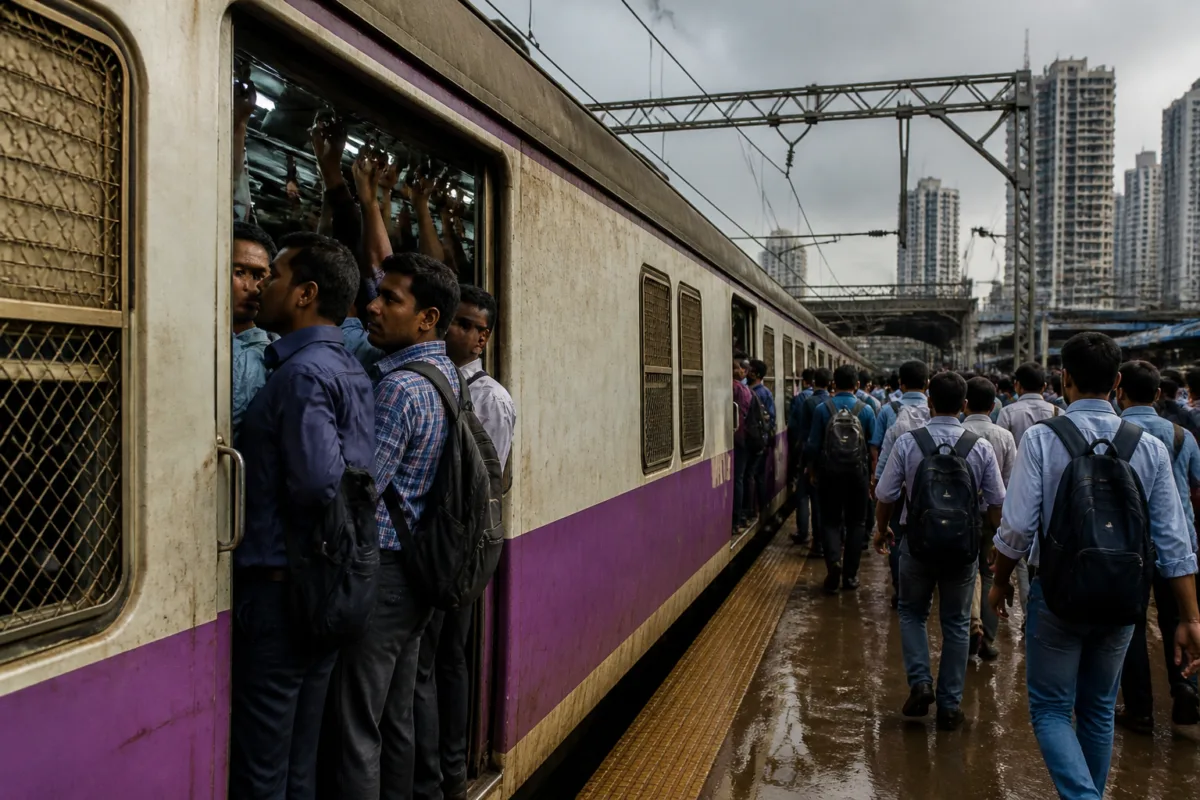
Mumbai’s suburban railway is facing a safety crisis that extends beyond isolated acts of violence. Recent incidents involving a knife attack, a fatal stabbing and a woman being pushed from a train after resisting molestation show how overcrowded coaches and weak passenger-security systems can turn ordinary journeys into situations of severe danger.
The latest reported incident took place on November 15 on a Virar–Churchgate fast local, where a 53-year-old commuter was injured in the chest after a knife thrown during a fight between two men missed its intended target. The man who allegedly threw the knife was arrested, according to the report. The incident is significant not only because of the weapon involved, but because the injured passenger was reportedly a bystander caught in a confrontation between others.
That incident followed a series of episodes in which conflict inside or around suburban trains produced serious consequences. Eleven days earlier, a 20-year-old woman suffered severe injuries after being pushed from a local train at Naigaon railway station when she resisted molestation by a co-passenger. Her left arm had to be amputated below the elbow. On June 23, 22-year-old Mayank Lohar was stabbed to death on a Nalasopara-bound local from Andheri after an argument allegedly began over keeping a compartment door open during heavy rain.
Taken together, these cases reveal the vulnerability created when large numbers of passengers are concentrated in confined spaces, often while trains are moving, doors remain open and personal disputes unfold without immediate intervention. The incidents differ in their immediate triggers, but the supplied evidence points to a common setting: a transport system in which density, stress and limited control can rapidly magnify risk.
Psychiatrist Harish Shetty described the wider social condition as an “angst-driven society”, arguing that anger can spread quickly and become difficult to control. He attributed the escalation of confrontations partly to the psychological effects of overcrowded public transport. In his assessment, when passengers are forced into extremely tight spaces, stress affects how people respond to minor physical contact and verbal disputes.
Shetty’s comments offer a behavioural explanation, but they do not remove the institutional question. Passenger aggression may be influenced by difficult living conditions, price pressures and daily stress, yet the railway environment determines how easily a confrontation can become a serious crime. In a crowded coach, a push may be difficult to distinguish from deliberate aggression, a victim may have little room to move away, and other passengers may be unable to intervene safely. The same density that allows the suburban railway to carry large volumes of people also reduces the physical space available for de-escalation.
Rail safety activist Samir Zaveri placed accountability at the centre of the issue. He said that the incidents reported in recent months represented only a fraction of the conflicts occurring on trains and that several cases go unreported. That claim is presented in the source as an activist assessment; the supplied report does not provide an independent dataset establishing the scale of unreported incidents. It nevertheless raises a key measurement problem: a safety system cannot respond effectively to risks that are not systematically recorded.
Zaveri also linked overcrowding to the rapid escalation of disputes. He said that even a small push in a packed train can trigger an argument, while passengers already under pressure from difficult living conditions and rising prices may be more prone to outbursts. This does not establish overcrowding as the sole cause of violence. The reported molestation case, the knife attack and the fatal stabbing involved different forms of conduct and different alleged triggers. But overcrowding can create the conditions in which personal conflict becomes harder to avoid and more difficult to contain.
The administrative response therefore cannot be limited to arresting individuals after an incident. Police action remains necessary when crimes occur, but the recurring urban question is whether the railway environment provides enough capacity, surveillance, trained personnel and reporting mechanisms to prevent ordinary disputes from becoming lethal. The supplied material does not specify the number of security personnel deployed on the affected services, the response times to emergencies, the availability of panic systems or the extent of surveillance coverage. Those gaps make it difficult to assess how much of the risk arises from capacity constraints and how much from deficiencies in enforcement and emergency response.
Zaveri said he had written in June to Union Railway Minister Ashwini Vaishnaw and Maharashtra Chief Minister Devendra Fadnavis seeking urgent reforms. His demands included the introduction of 18-coach local trains, based on technical approval for 18-coach electric multiple unit trains by the Railway Design and Standards Organisation in 2008-09. The proposal connects passenger safety with the long-running capacity question: if trains remain heavily crowded, extending their length could increase the amount of space available per service, subject to platform, signalling, depot and operational requirements that are not detailed in the report.
The reference to RDSO approval also points to the difference between technical feasibility and implementation. A technical approval does not by itself establish that longer trains can be introduced across the network. Such a change would require alignment between rolling-stock availability, platform infrastructure, station operations, maintenance facilities and the scheduling of services. The supplied material does not say whether these requirements have been met or whether a current implementation plan exists.
Mumbai’s suburban railway is often described as the city’s lifeline because it connects residential areas with employment centres across the metropolitan region. That dependence makes safety failures more consequential than incidents on an ordinary private service. When passengers have few practical alternatives, they continue using the system even when trains are crowded or when reports of violence create fear. The railway’s role is therefore not only to move people but also to provide a controlled public environment used daily by a large and socially diverse population.
The cases cited in the report also show that passenger safety has multiple dimensions. The fatal stabbing reflects the danger posed by interpersonal disputes and weapons. The Naigaon case highlights sexual violence, the vulnerability of women passengers and the potentially catastrophic consequences of resisting an offender near an open train or station edge. The knife injury to the 53-year-old commuter demonstrates how bystanders can become victims even when they are not involved in the original confrontation. A single overcrowding solution cannot address all these risks, but capacity, security and emergency response are interconnected parts of the same transport-safety system.
What the available evidence confirms is that violence on Mumbai local trains is not confined to one type of incident or one part of the network. It also confirms that overcrowding is being identified by both a mental-health expert and a rail-safety activist as an important factor in the escalation of conflict. What remains unestablished in the supplied material is the precise scale of the problem, the proportion of incidents that go unreported, and the current status of proposed 18-coach services. Those are the facts that authorities would need to publish if passenger safety is to be addressed through measurable reforms rather than only post-incident arrests.
The next institutional test is whether the railway and state authorities respond with information and action on capacity, security and reporting. Until then, the recent incidents remain warnings that the city’s most essential transport system can also become a high-risk public space when crowding and weak safeguards converge.

