


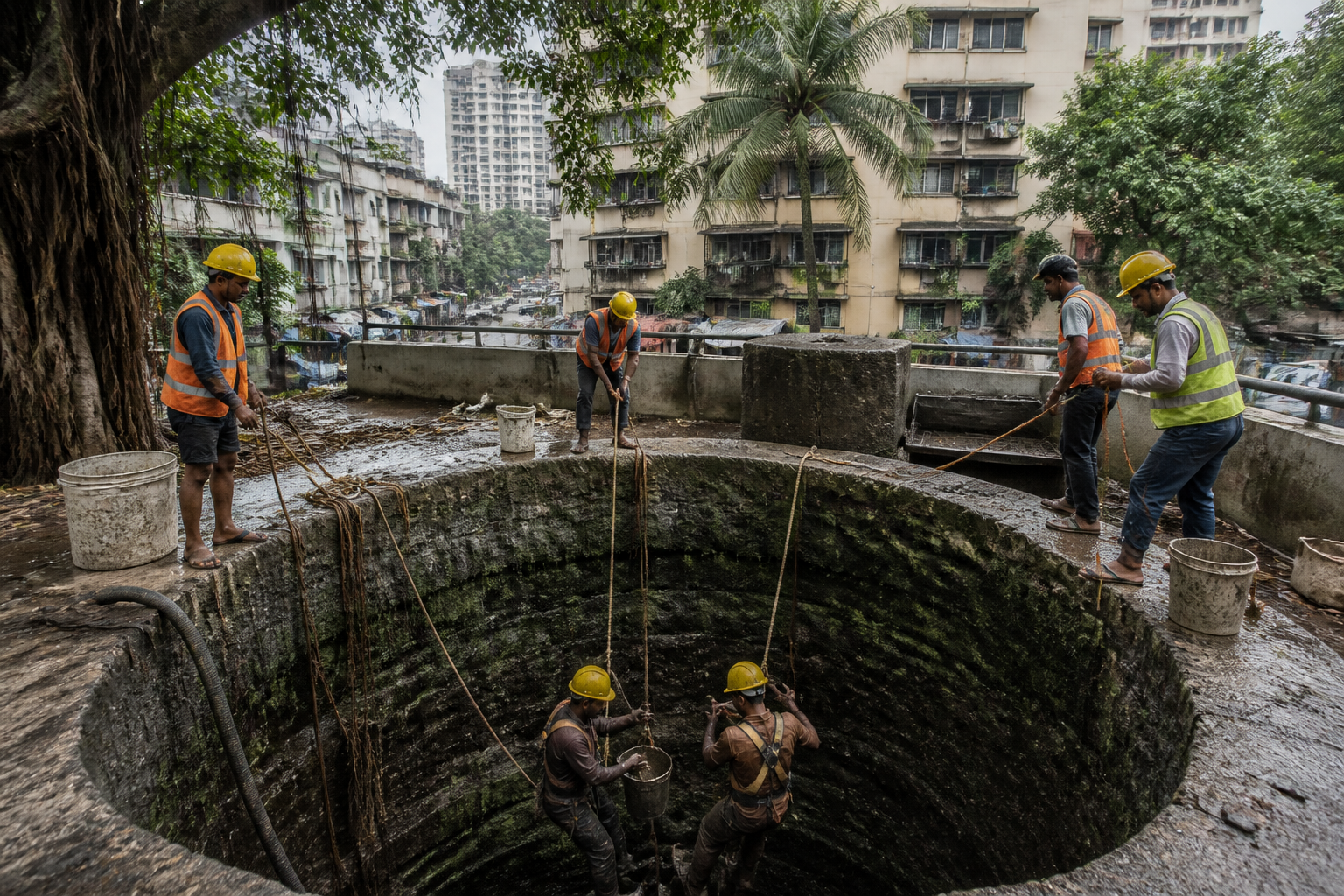
Mumbai’s decision to revive 3,000 wells and build approximately 10,000 recharge structures is more than a short-term response to a possible water shortage. It marks a renewed attempt by the city’s civic administration to restore a water source that became secondary after the development of large reservoirs and municipal water schemes, but has since been weakened by neglect, pollution and seawater intrusion.
The Brihanmumbai Municipal Corporation’s move comes as Maharashtra faces a wider water-security concern. The state government has declared drought in 265 of its 358 tehsils, according to the report by The Indian Express. The declaration covers about three-fourths of the state and provides the immediate backdrop to Mumbai’s effort to identify supplementary sources before the next monsoon cycle.
Mumbai’s water system has long been built around rainfall and storage. The city draws its potable and industrial supply from seven lakes, which are replenished during the southwest monsoon. Those lakes currently provide about 3,850 million litres per day, while the city’s stated requirement is 4,200 million litres per day. That gap exists even when lake levels are high, making groundwater revival an attempt to address a structural shortfall rather than merely a seasonal emergency.
The intervention also exposes how the city’s water infrastructure has evolved. Before the development of water schemes and dams from the late 1860s, Mumbai relied on a network of borewells and dug wells. As reservoir-based systems expanded, wells became a secondary source and many fell out of use. The result was not simply a decline in dependence on groundwater, but the deterioration of an urban resource that remained potentially useful during periods of stress.
According to civic officials quoted by The Indian Express, the current programme is being implemented at ward level through the BMC’s hydraulic department. Funds are being released on the basis of pre-approved rates. This administrative design places the work within the existing municipal machinery rather than treating groundwater as a separate, city-wide infrastructure project managed by a new institution.
The first component is the desilting of wells. Officials said that stagnant water in several wells has accumulated silt, reducing their carrying capacity. Natural underground streams that once allowed water to flow into the wells have also closed up after years of disuse. The stated objective of desilting is therefore not only to clean the visible structure, but also to restore its connection with the underground water bed.
The BMC has identified 3,000 wells across Mumbai’s island city and suburban areas for restoration. The geographic spread matters because the city’s water risks are not confined to one municipal zone. The programme is designed to operate across older, densely developed parts of the island city as well as suburban pockets, where groundwater conditions and the pressures on local water systems may differ.
The second component involves new recharge structures. A senior civic official told the newspaper that the BMC is seeking to build approximately 10,000 such structures so groundwater can be replenished and later extracted for potable and industrial consumption. The source material does not specify the design, location or construction schedule for these structures, but their inclusion indicates that the civic body is pursuing both sides of the groundwater problem: improving existing wells and increasing the capacity of the underground resource to receive water.
This is important because groundwater cannot be treated as an unlimited reserve. A well may be desilted and made functional, but its usefulness depends on the quantity and quality of water entering the aquifer. Recharge structures are intended to support that replenishment process. At the same time, the BMC’s own assessment has identified a second threat: salinisation caused by the intrusion of seawater into groundwater resources.
Mumbai’s coastal geography makes that concern particularly significant. Surrounded by the sea on three sides, the city has groundwater resources that are vulnerable to saline intrusion. The BMC has appointed the All India Institute of Local Self Government to study salinisation levels by collecting water samples from wells across the city. The agency is expected to analyse the samples and submit a roadmap for addressing the problem.
The study has been commissioned after an internal audit highlighted the salinisation of groundwater resources. According to the official account reported by The Indian Express, the assessment is expected to determine the extent of seawater intrusion, as well as the likely costs and scope of measures needed to regulate salinity levels. Until that exercise is completed, the city does not have a publicly established picture of which wells can safely support human use and which may require treatment or exclusion.
That distinction is central to the difference between restoring infrastructure and restoring a water source. A revived well is not automatically a source of potable water. Its suitability depends on contamination, salinity and the conditions of the surrounding aquifer. The BMC’s decision to pair physical revival with water sampling acknowledges that groundwater management requires both engineering work and quality monitoring.
The timing of the programme is linked to concerns over rainfall and temperature. The report says that El Niño conditions have raised concerns about below-average rainfall and above-normal temperatures. It also notes the possibility of warmer weather through February and faster depletion of lake levels. These conditions create pressure on a system that is already supplying less water than the city’s stated daily requirement.
The BMC has retained a 10 per cent water cut even though the seven lakes were reported to be at 97 per cent of their total stock. That decision illustrates the difference between storage levels at one point in time and reliable annual supply. Full or near-full reservoirs do not remove the need to plan for the period before the next substantial monsoon. The civic administration is attempting to ensure that current lake reserves last through the year while developing supplementary sources that could be used during shortages.
The proposed groundwater work therefore sits between emergency management and long-term urban planning. In the immediate term, the BMC wants additional sources available ahead of the summer season. In the longer term, it is attempting to create a system in which wells, recharge structures and reservoirs operate as parts of a broader water-supply network. The evidence supplied in the report does not establish how much water the revived wells will ultimately contribute, or whether they can materially close the city’s 350 million-litre-per-day gap. Those outcomes will depend on the quality of the wells, the extent of recharge and the findings of the salinisation study.
The institutional structure also reveals a recurring challenge in municipal water management: responsibility is distributed across departments, wards, consultants and state-level decisions. The BMC hydraulic department is implementing the well revival work at ward level. The civic chief directed an audit of groundwater resources in June. The All India Institute of Local Self Government is studying salinity. The state government’s drought declaration provides the wider policy context. Each institution has a distinct role, but the effectiveness of the programme will depend on whether these activities are connected through a common groundwater plan.
The current programme also raises questions about how the city will classify and use its wells. The BMC has referred to potable and industrial consumption, but the supplied material does not specify which restored wells will serve which purpose. That distinction will affect treatment requirements, monitoring standards and the infrastructure needed to move water from individual sites to users. It will also determine whether the wells function as local emergency sources or become integrated into formal municipal distribution.
Mumbai’s water history shows why the present intervention matters. The city’s reservoir network reduced dependence on wells, but did not eliminate the value of groundwater. Decades later, the civic body is returning to those older sources because the reservoir-based system faces a persistent demand gap and increasing uncertainty around rainfall and heat. The revival effort is consequently not a rejection of large water infrastructure; it is an attempt to add resilience to a system that remains heavily dependent on monsoon replenishment.
The central issue is whether Mumbai can manage groundwater as infrastructure rather than as leftover space beneath the city. Wells, recharge structures and aquifers are easy to overlook because they are dispersed and mostly hidden from public view. Yet their condition affects the city’s ability to respond when reservoirs, rainfall patterns or demand levels create pressure. The BMC’s programme brings that buried layer of urban infrastructure back into the water-supply conversation.
What is established so far is the scale and direction of the intervention: 3,000 wells have been identified for revival, approximately 10,000 recharge structures are being considered, and a city-wide salinisation study is under way. What remains uncertain is how much usable water the programme will generate, how quickly the work will be completed, and whether saline or polluted groundwater can be made safe and economically viable for consumption. The next important milestones are the completion of the water-sampling exercise, the consultant’s roadmap on salinity, and the implementation of the recharge and well-revival works before the next period of heightened water stress.
