


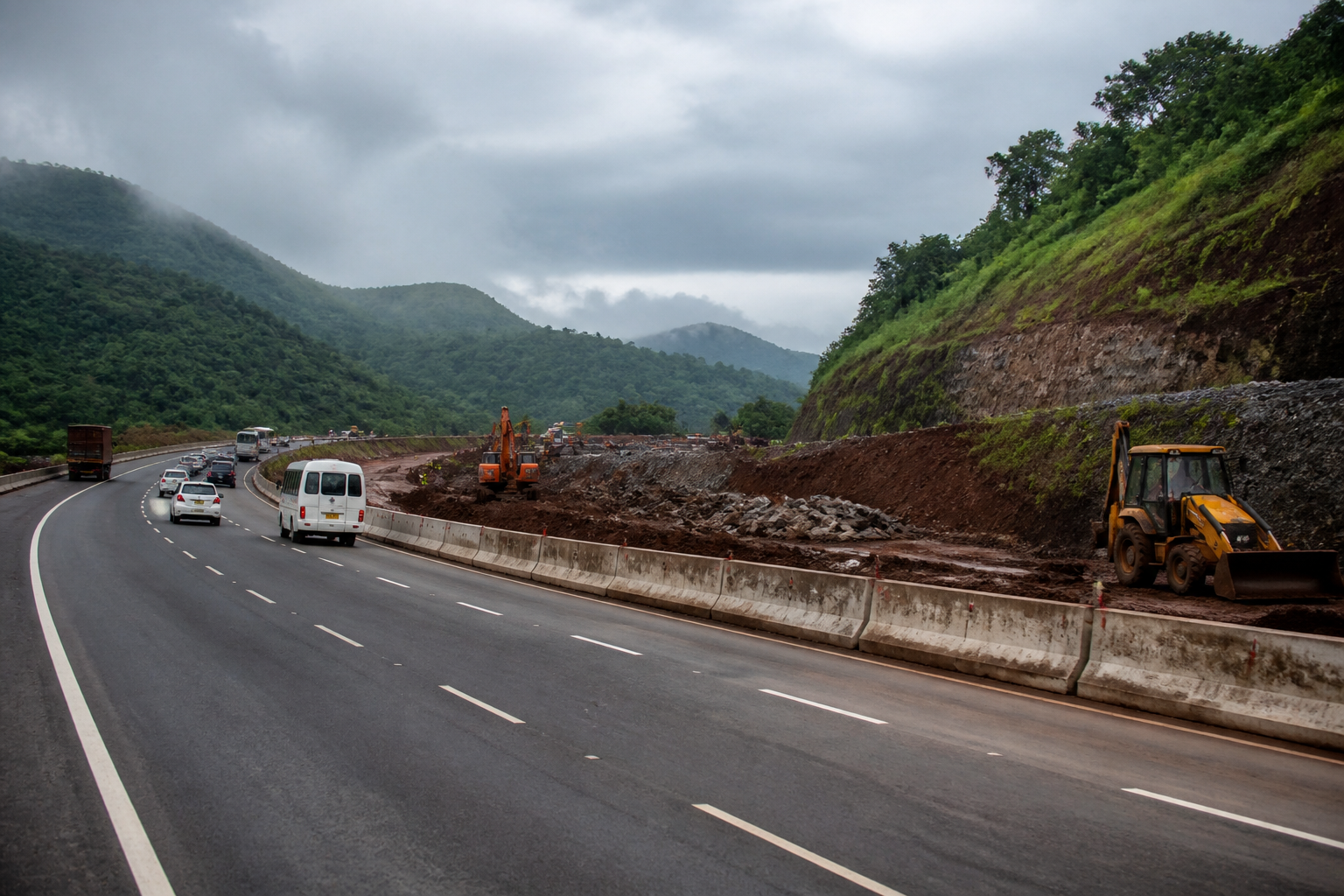
The Mumbai-Goa Highway has become a long-running test of whether India’s infrastructure system can deliver a large regional road project within a credible time and cost framework. Seventeen years after the Centre approved the widening of National Highway 66, the 355-kilometre Maharashtra section remains incomplete, while the approved cost of its 10 packages has risen by about 48%, according to information obtained under the Right to Information Act.
The figures, reported by Loksatta – Mumbai, show the approved cost rising from Rs 11,409.14 crore to Rs 16,909.22 crore. The increase is approximately Rs 5,500 crore. The same response from the Ministry of Road Transport and Highways states that Rs 11,577 crore has already been spent on the highway works—more than the project’s original approved budget—although the work is still unfinished.
The central issue is therefore not only that the Mumbai-Goa Highway has been delayed. It is that expenditure has crossed the original project envelope without producing a completed corridor. For residents and travellers in the Konkan region, the consequence is a road that continues to combine the promise of a modern national highway with the operational realities of incomplete construction.
## What the Mumbai-Goa Highway figures reveal
The project’s basic numbers point to three separate failures that are often merged into the single phrase “delay”. The first is schedule performance: the widening has remained incomplete for 17 years. The second is financial performance: the approved cost of the 10 packages has risen by 48%. The third is delivery performance: even after expenditure of Rs 11,577 crore, the entire project is not ready for use as a completed four-lane corridor.
These are connected but not identical problems. A project can face a delay without a comparable cost escalation, or record higher costs while still opening completed sections on schedule. In this case, the RTI-based figures show that time and cost pressures have occurred together. The available information does not provide a package-by-package explanation for every increase, but it identifies a particularly sharp escalation in the Parshuram Ghat-Aaravali package in the Chiplun-Ratnagiri area.
That package’s approved cost increased from Rs 983 crore to Rs 2,226 crore, a rise of 126%. It is the highest increase among the packages cited in the report. The difference is important because project-wide averages can conceal the locations where delivery has become most financially and administratively difficult. A 48% increase across the Maharashtra section is significant, but a 126% increase in one package indicates that cost pressure is not distributed evenly along the corridor.
The available report does not establish whether the increase in the Parshuram Ghat-Aaravali package arose from land acquisition, design changes, geological conditions, contractor-related issues, extensions of time or other causes. It does, however, show why package-level disclosure matters. Without that detail, the public can see the scale of escalation but not the institutional chain that produced it.
## A corridor that remains incomplete for users
National Highway 66 connects Mumbai and Goa through the Konkan region. Its widening has significance beyond the movement of vehicles between two major destinations. The corridor is used by people travelling to and through the coastal districts, including the large number of passengers who travel towards Konkan each year. According to the report, incomplete stretches continue to cause substantial difficulty for these travellers and repeatedly become dangerous.
An unfinished highway does not function like a single project under construction on an isolated site. It affects the continuity of a journey. Users move between completed and incomplete sections, construction zones and existing road segments. The report does not provide accident figures or travel-time data, so the precise safety and mobility impact cannot be quantified from the supplied material. It does establish, however, that the incomplete portions remain a continuing problem for users.
This is a key distinction in evaluating transport infrastructure. The public value of a highway is not created simply by spending money on individual packages. It emerges when the route operates as a dependable network. If major sections remain incomplete, the benefits of completed work can be limited by bottlenecks elsewhere. For travellers, the experience is determined by the weakest or most disrupted parts of the corridor rather than by the total length already built.
The project’s regional importance also raises a governance question: how should progress be measured when an infrastructure scheme is divided into multiple packages? Reporting the amount spent or the number of contracts awarded may show administrative activity, but neither measure confirms that the corridor is delivering the intended service to users. Completion, continuity and safe operation are different milestones from financial utilisation.
## Why package-level accountability matters
The highway’s 10-package structure is central to understanding the delay. A corridor divided into packages can allow work to proceed in parallel, but it can also create multiple points at which approvals, land availability, contracts, design decisions and construction progress must remain aligned. The supplied information does not identify which of these factors caused the delay. It does show that the overall project outcome is the product of several package-level outcomes, including the sharp escalation recorded in the Parshuram Ghat-Aaravali section.
This makes the RTI response valuable not merely as a cost figure but as a window into how public infrastructure is monitored. The information was sought by RTI activist Jitendra Ghadge, and the Ministry’s response provides the approved and revised costs for the 10 packages. Such disclosure allows the public to compare the original sanction with the current financial position and identify where the largest deviations have occurred.
Yet the figures also show the limits of aggregate reporting. The revised total of Rs 16,909.22 crore indicates the scale of the project’s financial expansion, but it does not by itself explain responsibility or causation. To understand the delay fully, each package would need to be read alongside its original completion schedule, revised completion date, expenditure, physical progress and current status. Those details are not contained in the supplied report.
That absence should not dilute the significance of the available evidence. Public accountability begins with a clear comparison between the original commitment and the present position. In this case, the comparison is stark: 17 years since approval, Rs 11,577 crore spent, a revised cost of Rs 16,909.22 crore and an incomplete highway.
## The policy problem behind the cost increase
Large transport projects are approved on the assumption that financial estimates and implementation timelines provide a workable basis for public expenditure. When a project remains incomplete for nearly two decades and its cost rises by almost half, the issue extends beyond construction speed. It concerns the reliability of the planning and monitoring framework used to approve, package and supervise the work.
The Ministry of Road Transport and Highways is the authority identified in the report as providing the figures. That establishes the ministry’s role in the financial record cited here. The source material does not specify the roles of individual contractors, state agencies or other institutions in the delays, and no such responsibility can be assigned on the basis of the available information.
The institutional lesson is that approval is only the beginning of infrastructure delivery. A project’s public value depends on how effectively the approving authority and implementing agencies manage changes after approval. When costs rise, the public needs to know what changed, when it changed and how the revised decision affected the completion schedule. When a package becomes significantly more expensive than originally sanctioned, the explanation must be available at the same level of detail as the original estimate.
The Mumbai-Goa Highway case also shows why the language of “development” can obscure delivery outcomes. A project may remain politically and administratively active for years, with contracts, expenditure and revised estimates continuing to accumulate. For users, however, the relevant question is simpler: can the route be used as the promised road, across its full intended length, with predictable safety and travel conditions?
## What remains established—and what is not
The evidence supplied in the report establishes that the widening of 355 kilometres of National Highway 66 in Maharashtra was divided into 10 packages; that the approved cost increased from Rs 11,409.14 crore to Rs 16,909.22 crore; that the increase was about 48% or approximately Rs 5,500 crore; that Rs 11,577 crore had been spent; and that the work remained incomplete.
It also establishes that the Parshuram Ghat-Aaravali package recorded the largest cited increase, from Rs 983 crore to Rs 2,226 crore, or 126%. The report identifies incomplete portions as a continuing source of difficulty for travellers heading towards Konkan and describes those stretches as repeatedly dangerous.
The supplied material does not establish the final completion date, the current physical progress of each package, the reasons for every cost revision, the number of accidents, or the precise responsibility of particular agencies or contractors. Those are the next questions required for a fuller institutional account of the project.
For now, the evidence confirms a prolonged infrastructure delivery problem with a substantial financial consequence. The Mumbai-Goa Highway is not simply a delayed road. It is a case in which the original budget has been exceeded, the largest package has more than doubled in cost, and users continue to experience an incomplete corridor 17 years after approval.

