


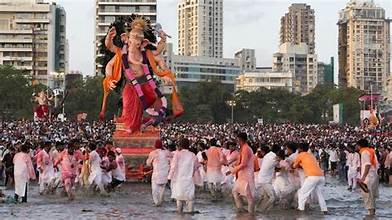
Mumbai Ganesh Visarjan processions continued for more than 24 hours after Anant Chaturdashi, with loud percussion, DJs and other prohibited sound and lighting equipment reportedly used despite Bombay High Court directions, according to a report by Loksatta. The report also said police largely remained spectators while the restrictions were being breached.
Public Ganesh mandals across Mumbai bid farewell to their idols on Friday after 12 days of worship. Processions moved towards immersion points including Girgaum, Dadar and Juhu beaches, as well as other locations across the city. Celebrations included gulal, fireworks and drum performances, with processions continuing through the night and into the following day.
The report said the processions continued for over 24 hours in several parts of Mumbai. It described the use of banned “dhol” and other percussion instruments at volumes that caused significant noise, while DJs were also used at some locations. These activities took place despite existing restrictions linked to noise and air pollution during festival processions.
Mumbai has around 12,000 public Ganesh mandals, according to the report. A large number of these mandals traditionally organise immersion processions on Anant Chaturdashi, accompanied by fireworks, gulal and drumbeats. The scale of the event places substantial demands on roads, public spaces, police deployment and immersion-site management across the city.
The Bombay High Court had issued directions aimed at preventing noise and air pollution during Ganeshotsav and processions associated with all communities, Loksatta reported. The directions included restrictions on fireworks, DJs, laser lights and beams in public places and on roads. The restrictions were intended to apply during festival activities and processions, including those linked to idol arrivals and immersions.
The question of enforcement had assumed importance before Anant Chaturdashi, with attention focused on the role the Mumbai Police would take during the immersion processions. However, the report said that police did not effectively intervene when the court-directed restrictions were allegedly violated. It did not provide details of the number of cases registered, equipment seized, fines imposed or arrests made.
The extended duration of the processions also highlights the operational challenge of managing one of Mumbai’s largest annual public events. Immersion routes and sites remain active for long periods, while residents, commuters, emergency services and local businesses must share roads and public spaces with the processions. The report, however, did not provide citywide figures on traffic disruption, noise levels, air-quality readings or the number of idols immersed.
The immediate issue raised by the coverage is therefore not only the duration of the immersion activity but also the enforcement of restrictions already laid down by the court. Further clarity would be required from the police and civic authorities on the action taken against reported violations and on the implementation of the court’s directions during the festival.
