


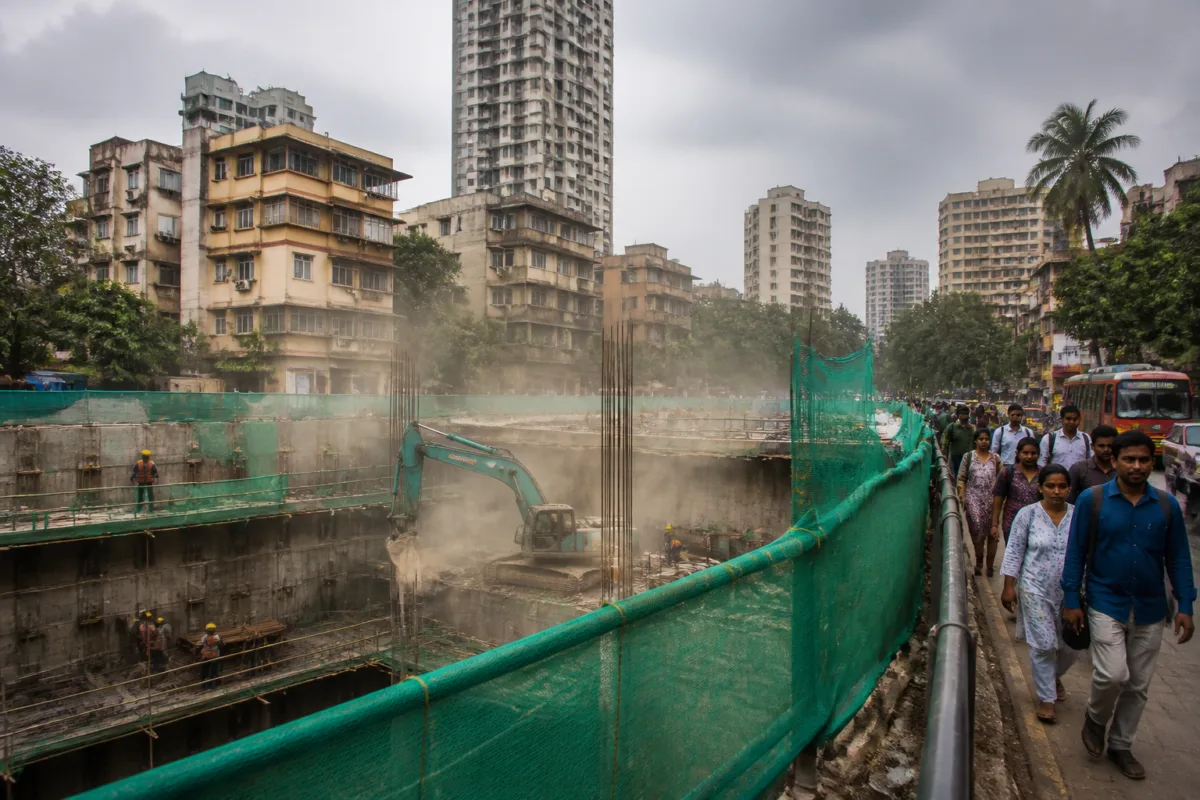
Mumbai construction dust is being generated at far more stages than the demolition of old buildings, according to construction industry stakeholders cited in a Times of India report. It is produced when structures are dismantled, when deep basements are excavated, when walls are grooved for electrical and plumbing lines, and when materials are processed on active sites. The pattern points to a gap in how the city approaches dust control: construction is regulated as a series of projects, while dust is experienced by residents as a continuous neighbourhood-level burden.
The issue has become more significant as redevelopment gathers pace. Mumbai’s construction cycle is not limited to the replacement of one building with another. It can involve the demolition of an existing structure, excavation for several basement levels, construction of a high-rise, and later internal work involving concrete blocks and wall channels. Each stage creates a different dust source, requiring different controls. The experts cited in the report argue that existing practices have not adapted sufficiently to this more intensive sequence of work.
Demolition is identified as the most significant point of concern. Manoj Daisaria, senior architect and former president of the Practicing Engineers, Architects, and Town Planners Association, said demolition methods should shift away from simply using heavy equipment to smash structures. He called for staged dismantling and greater use of cutters. His comparison was with older buildings in areas such as Fort and other parts of south Mumbai, where tiled roofs, bricks and other elements were removed individually by hand.
That earlier method was slower and more labour-intensive, but Daisaria said it significantly reduced pollution. His suggestion does not amount to a simple return to traditional construction practice. It raises a more difficult institutional question: whether demolition is being treated primarily as a speed and cost exercise, rather than as an activity with consequences for the surrounding public realm. A staged method could take longer and require more manpower, but the source report records the view that its pollution benefits should be considered alongside project costs.
Excavation creates a second and increasingly important dust problem. Daisaria said the foundations of new skyscrapers can extend five or six floors underground, generating substantial dust before the visible structure rises above ground level. In a city where redevelopment projects are increasingly designed with multiple basement levels, this phase can affect neighbouring buildings, roads and pedestrians for an extended period.
The proposed response is comparatively specific: mandatory netting during excavation and regular fogging at construction sites. Daisaria said nets are not currently mandated during excavation, while also arguing that the additional cost would not be excessive. The significance of this proposal lies in its timing. Dust controls are often associated with the exposed façade or the movement of construction vehicles, but excavation begins before the building takes its final form and can generate large volumes of loose material below street level.
Structural consultant R C Tipnis also identified the demolition of older buildings as a major source of dust. He called for curbs or restrictions on demolition, a standardised model and greater self-discipline among those involved. These suggestions point to three different routes of control: limiting when demolition takes place, creating a common operating method, and improving compliance by project participants. The report does not establish how such a standardised model would be designed or enforced, but it shows that stakeholders see inconsistent practice as part of the problem.
Dust does not end when demolition and excavation are complete. Former contractor Mihir Setia highlighted jari, or grooving, in which workers cut channels into walls for electrical conduits and internal plumbing. He described this as one of the dustiest stages of construction, especially when concrete blocks are cut and fly ash is released. This is a ground-level detail that is often absent from policy discussions focused on large equipment, site boundaries and road washing. It shows how pollution can continue inside and around a project even after its main structural frame has taken shape.
The challenge with grooving is practical as much as regulatory. The work is carried out repeatedly across rooms and floors, often through small-scale operations that are difficult to monitor in the same way as excavation or demolition. The source report does not identify a single established control for this activity. That absence is important because a dust-control framework that focuses only on major machinery may miss the cumulative effect of smaller, repeated tasks carried out across hundreds of construction sites.
Developer Rajesh Jain said greater use of precast construction materials could reduce pollution at construction sites. Precast components can shift some work away from the site, reducing the amount of cutting and processing required on location. Jain said builders have the capacity to adapt and that the resulting cost increase would be manageable over the long term. The report, however, does not provide comparative figures on the cost of precast materials or quantify the reduction in dust that would result from their use.
Jain also criticised the current framing of the issue. He said the BMC’s dust mitigation guidelines were suited to developed cities such as New York and London, while Mumbai has large areas that still require development. His argument is that dust cannot be separated from the city’s redevelopment needs, particularly the reconstruction of ageing buildings and the development of slum areas. This position treats construction pollution as a consequence of a larger urban transition rather than as an isolated failure at individual sites.
The most consequential part of Jain’s argument concerns the incentives behind construction activity. He said the government is prioritising revenue generation through the sale of additional floor space index, or FSI, and that this is driving the construction boom. He argued instead for greater focus on ageing buildings built before 1940 and slum development, alongside an end to the sale of additional FSI. Jain described the existing approach as a revenue-based development plan rather than a density-based model.
That claim is presented in the report as a developer’s view, not as an independently established finding. It nevertheless identifies the institutional question behind the dust debate: whether the city has a clear connection between additional development rights, construction intensity and the capacity to manage their environmental effects. If more buildings are demolished, excavated and rebuilt, the controls governing each stage become as important as the permissions that allow the construction to proceed.
The competing priorities are visible in the different remedies proposed by the stakeholders. Daisaria focuses on demolition techniques, excavation netting and fogging. Tipnis emphasises restrictions, standardisation and self-discipline. Setia points to the dust created by internal finishing work. Jain supports precast materials and questions the policy incentives that generate construction activity. These are not interchangeable solutions. They operate at different points in the project cycle and involve different responsibilities for builders, contractors, workers, municipal authorities and policymakers.
This distinction matters for enforcement. A rule that controls demolition cannot by itself address dust from basement excavation. Netting around an excavation cannot control particles created when workers cut wall channels. Precast materials may reduce some on-site activity but do not resolve dust from the demolition of the existing structure. The evidence in the report therefore supports a broader conclusion: dust mitigation has to follow the full construction chain, from the first dismantling activity to the final internal works.
Mumbai’s redevelopment model also makes the issue difficult to treat as a purely private-site matter. Construction takes place beside occupied buildings, public roads and neighbourhood services. Dust travels beyond the project boundary, while the decisions about demolition technique, excavation depth, material choice and work sequencing are made within the project. This creates a mismatch between who controls the source and who experiences the impact.
The report does not establish the number of active construction sites in Mumbai, the volume of dust generated by each activity, or the extent to which existing BMC guidelines are being enforced. It also does not provide air-quality measurements that would isolate construction dust from other sources of pollution. Those gaps limit the conclusions that can be drawn about the scale of the problem. What the supplied evidence does establish is that industry participants identify multiple recurring sources and believe current practices require change.
The larger urban question is whether Mumbai can pursue redevelopment at speed without treating pollution control as a secondary cost. The answer will depend not only on more guidelines but on whether the city can translate them into activity-specific standards, consistent site supervision and clear responsibility across the construction process. For now, the evidence points to a city where the building boom has outgrown a dust-control approach focused on only the most visible stage of construction.

