


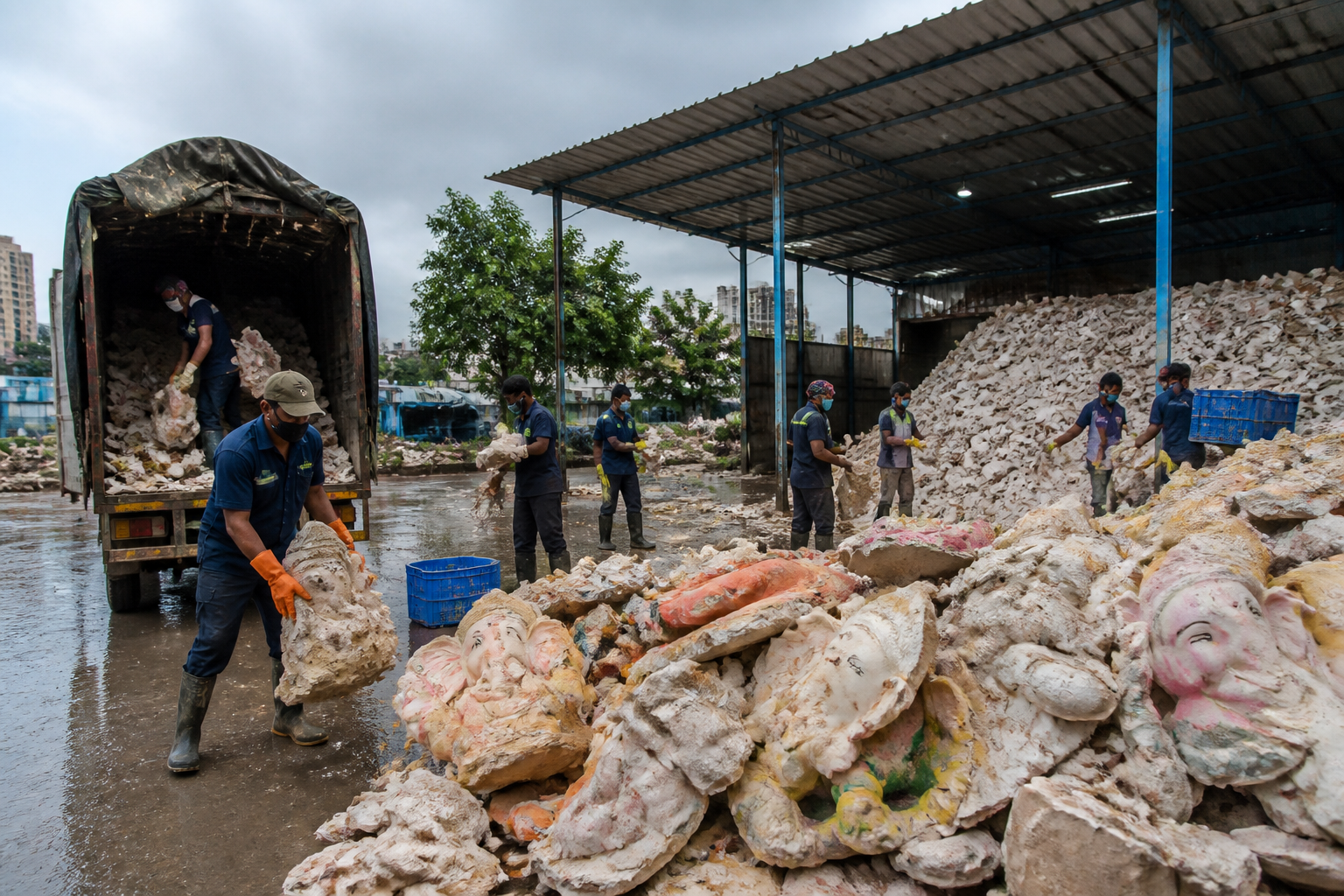
The Brihanmumbai Municipal Corporation has invited agencies to reuse or upcycle Plaster of Paris collected after Ganeshotsav and Navaratri idol immersions, as Mumbai seeks a more structured system for handling festival waste. The civic body collected nearly 2,400 metric tonnes of PoP after last year’s Ganeshotsav immersions and about 315 tonnes after Navaratri.
The BMC has issued an Expression of Interest for agencies that can process the collected material using scientific and environmentally compliant methods. The processed PoP could be used for making idols, plasterboards, ceramics, medical plaster and bricks, among other applications.
“Last year was our first attempt at collecting all the used PoP after festivities for responsible disposal. This time we intend to combine the PoP collected over the two years and work with agencies that can process this material,” Kiran Dighavkar, deputy municipal commissioner, Solid Waste Management, was quoted as saying.
The proposed reuse programme will combine PoP collected during the previous two years. The move follows the BMC’s effort to collect used idol material after immersions instead of leaving it to enter the wider waste stream or accumulate at temporary immersion sites. The civic body has not disclosed in the announcement the number of agencies expected to be selected or the deadline for processing the material.
The BMC has also introduced zone-level standard operating procedures for idol immersions. Under the SOPs, all idols are to be retrieved from temporary tanks within 24 hours and stored at an interim facility. The concerned ward will maintain collection records, while closed-body vehicles will be used to transport the material.
Separately, the BMC’s Solid Waste Management department and the Lalbaugcha Raja Sarvajanik Ganeshotsav Mandal have started the “Prasad to Power” project to divert organic waste from festival food distribution facilities to municipal biomethanation plants. The waste is expected to come from “prasad kaksh” and “annachhatra” operations over the 10 to 11 days of the festival.
The project estimates that around 80 metric tonnes of organic waste will be collected, segregated and transported to biomethanation plants at Nair Hospital, Kasturba Hospital, GTB Hospital and Sion Hospital. The generated electricity is intended for lighting patient wards and common areas at these hospitals.
Each of the plants has a stated processing capacity of two metric tonnes per day. The BMC estimates that the project could generate 7,744 units of renewable electricity, depending on the quantity and quality of the waste received and plant operations. The civic body’s next steps are the selection of agencies for PoP processing and implementation of the immersion and organic-waste collection procedures during the upcoming festival season.
