


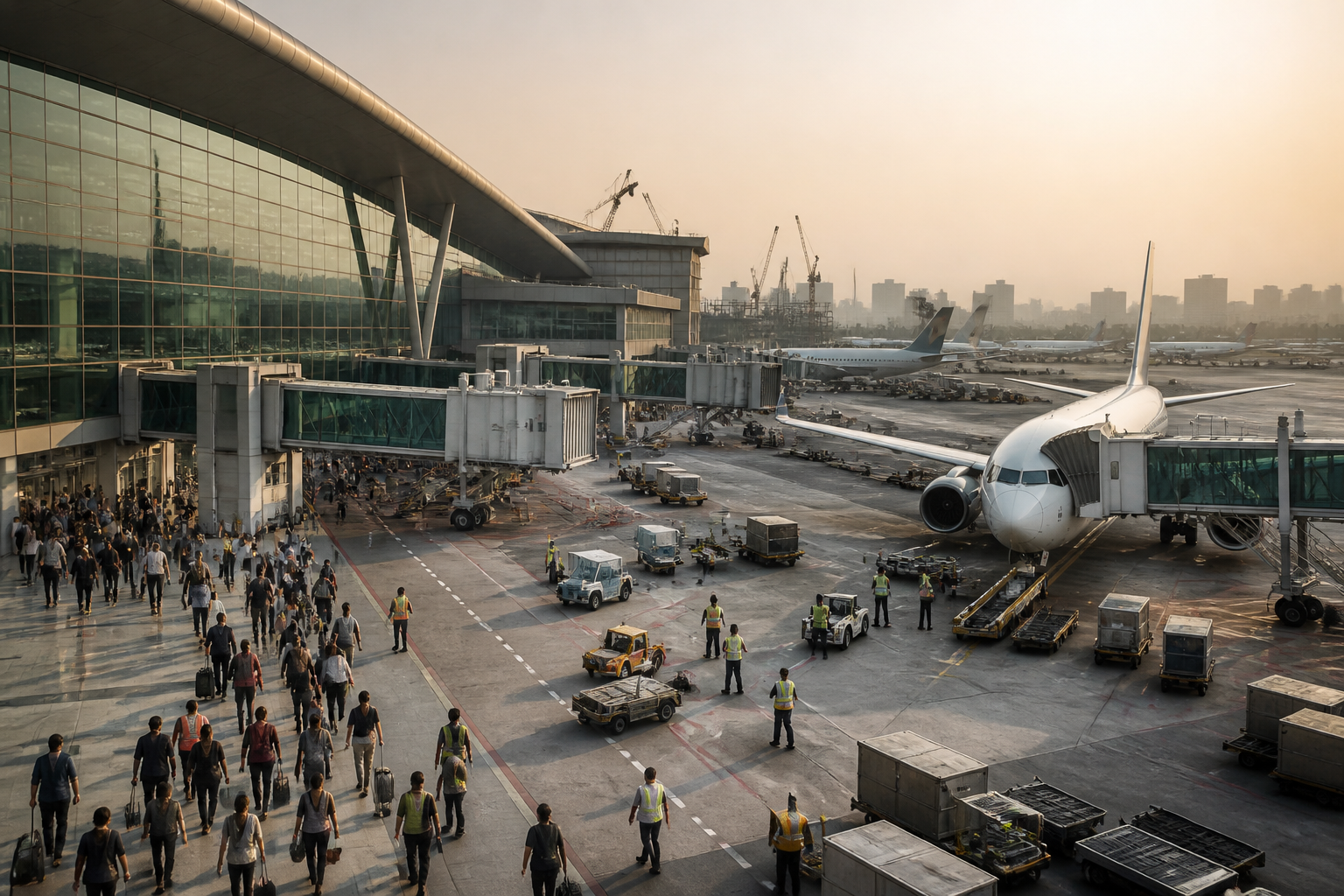
Mumbai airport’s decision to temporarily remove 265 of 770 weekly international departure slots from Terminal 2 has turned a terminal redevelopment project into a wider test of airport capacity, airline coordination and passenger protection. The cuts are scheduled to begin on October 25, just as the winter flying season starts, and could affect fares, connections and the distribution of international traffic across Mumbai’s two airports.
The immediate operational reason is the planned redevelopment of Terminal 1, which handles only domestic flights. Mumbai International Airport Ltd (MIAL) has told airlines that the slots and ground infrastructure released at T2 will be used to accommodate domestic operations displaced by the phased demolition of T1. The first phase of that redevelopment is scheduled to begin on January 15, 2027.
The scale of the adjustment is significant. MIAL’s plan affects 46 Indian and foreign airlines and removes about 38 international departures a day from T2. IndiGo is set to lose 74 of its 224 weekly international departure slots, while Air India would lose 33 of its 100. Air India Express would lose seven of 21, Akasa Air 11 of 32 and SpiceJet five of 14. Among international carriers, Etihad and Emirates would each lose 10 of 28 weekly slots, while British Airways would lose seven of 21. Several airlines operating daily services are expected to lose three weekly slots.
These figures show that the issue is not simply a temporary schedule adjustment. Mumbai’s airport system is being asked to absorb a major reallocation before the city’s second airport has fully become an operational substitute for the first. The immediate question is where the affected flights will go. Some may shift to Navi Mumbai Airport, while others could be cancelled or redeployed to airports such as Hyderabad and Bengaluru. Each option changes the journey for passengers and the economics for airlines.
If flights move to Navi Mumbai, passengers from the wider Mumbai region may face longer surface journeys and higher taxi costs, depending on where they live and how they connect to the airport. If flights are cancelled or shifted to other cities, Mumbai-origin travellers would have fewer direct choices during the winter period, when holiday and wedding travel increases demand. The supplied report does not establish the final destination of each affected service, but it makes clear that airlines have not yet accepted a single operational solution.
The dispute also exposes the difference between airport capacity as a physical asset and capacity as a coordinated public service. A slot is not only a take-off or landing opportunity. It is linked to aircraft deployment, crew planning, terminal counters, baggage systems, passenger bookings, airport transfers and onward connections. Airlines told the Times of India that the winter schedule had already been approved in June, with aircraft deployment and advance sales planned around it. One airline official said 35% to 40% of seats on many November and December Mumbai flights had already been booked.
That timing has created a governance problem. MIAL’s October 1 letter asked airlines to identify the slots they would surrender by 4 pm on October 6. If they did not, MIAL said it would select the slots. Airlines have rejected the reduction and sought the intervention of the Ministry of Civil Aviation. Their objections include the timing of the decision, the alleged lack of meaningful consultation and the difficulty of splitting services between Mumbai and Navi Mumbai without affecting operating margins.
The disagreement is particularly consequential for international carriers because a disrupted flight creates obligations beyond the airport operator’s scheduling decision. An airline official cited in the report said European carriers could face legal exposure under EU261, including refund and rerouting requirements. The same official argued that supporting T1 redevelopment should not be treated as consent to cancel T2 slots. These claims are attributed to airline representatives and do not establish how regulators or courts would assess individual cases, but they indicate the legal and financial risks embedded in a capacity transition.
AAHL, which operates the airport system, has presented the redevelopment as a safety-led and temporary intervention. On Saturday, its chief executive, Arun Bansal, said only the north section of Terminal 1B would be demolished in Phase 1. That section accounts for around one-third of T1’s capacity, according to AAHL, and the company said the limited first phase was intended to minimise passenger inconvenience and operational disruption.
AAHL also said T1 had long been identified as a safety-related concern, with temporary mitigation measures used over the years because there had been no viable alternative. The company said consultations with airlines on T1’s future had been ongoing since 2020. Bansal said the transition to Navi Mumbai Airport was temporary and did not represent a permanent shift of Mumbai airport traffic. He also said passenger safety had to remain paramount and that further delay could affect the safety and convenience of millions of travellers.
This creates the central institutional tension in the project. The airport operator is framing the redevelopment as necessary to address a long-standing safety concern and is trying to sequence the work in a way that limits disruption. Airlines are viewing the immediate slot cuts through the lens of already approved schedules, sold tickets and contractual obligations. Passengers experience the issue differently again: as a possible change in departure airport, a more expensive journey to the terminal, a cancelled flight or a higher fare.
The proposed use of Navi Mumbai Airport is therefore more than a question of adding another airport to Mumbai’s map. It is a test of whether the metropolitan region can function as a coordinated multi-airport system. AAHL said Navi Mumbai Airport would offer a 100% waiver on landing fees for new international flights and planned cash vouchers for international flyers to offset the user development fee gap between the two airports. Those measures may improve the attractiveness of Navi Mumbai for airlines and passengers, but the supplied material does not establish how many affected services will move there or how quickly the new airport can absorb them.
The transition also has a clear capacity logic. MIAL plans to begin allocating vacated T2 assets—including check-in counters, baggage belts, boarding gates and operational office space—to scheduled domestic operators from October 26. The aim is to facilitate the movement of about five million domestic passengers per annum from T1 to T2. This means the international slot reduction is being used to create room inside an existing terminal for domestic passengers displaced by the redevelopment.
That arrangement illustrates the limits of Mumbai’s airport footprint. The airport is not merely short of runway capacity or terminal buildings in isolation. Its usable capacity depends on how counters, gates, baggage systems, offices and aircraft movements are matched across terminals. A domestic terminal redevelopment can consequently affect international schedules, even when the international flights themselves are not being reconstructed or expanded.
The numbers also clarify why the transition is likely to remain contested. Removing 265 international departures from a weekly schedule is a substantial reduction, while accommodating five million additional domestic passengers a year requires more than an announcement about shared terminal space. It requires airlines to redesign schedules, passengers to adapt their travel plans and airport operators to maintain service levels during construction. The source material does not provide a detailed passenger-transfer plan, a final list of affected flights or a confirmed allocation of replacement slots, leaving those as important implementation gaps.
For the city, the deeper issue is how redevelopment is governed when critical infrastructure cannot be taken offline. Mumbai’s airports serve a region in which a terminal’s location, access cost and airline network all shape the practical value of a flight. Moving an operation from one airport to another may preserve the aircraft movement on paper while changing the burden for passengers. A capacity plan that works operationally for an airport may therefore impose additional time and cost on travellers.
The immediate process will determine whether the transition is managed as a coordinated metropolitan adjustment or as a series of separate commercial decisions. MIAL controls the allocation of airport infrastructure and slots at T2; AAHL is presenting the wider redevelopment and Navi Mumbai transition; airlines control aircraft deployment and schedules; and the Ministry of Civil Aviation has been asked to intervene. Passengers remain dependent on the final decisions made across these institutions.
What is established is that T1 redevelopment will require domestic capacity to move to T2, and that MIAL plans to create room for it by reducing international departures from T2 from October 25. What remains unsettled is how many flights will relocate to Navi Mumbai, how many will be cancelled or shifted elsewhere, how passengers with existing bookings will be handled and whether the ministry will alter the proposed process. The next milestones are the airline slot responses requested by October 6, the planned allocation of T2 assets from October 26 and the start of phased T1 redevelopment on January 15, 2027.
