


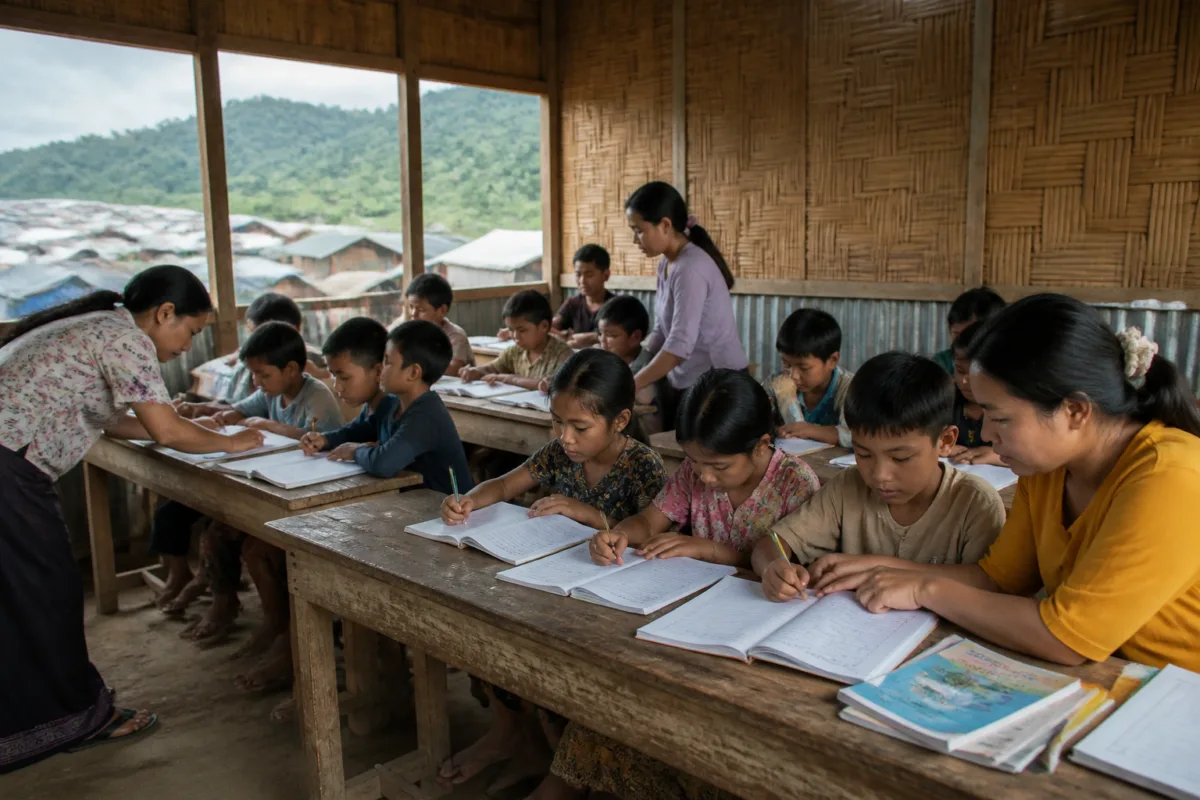
The education crisis facing Manipur’s displaced children is no longer limited to whether they have been admitted to a school. For thousands of children uprooted by the violence that began in May 2023, the harder questions concern how much learning has been lost, whether temporary shelters can support regular study, and whether schools have the capacity to respond to trauma, malnutrition and prolonged instability.
The experience of children at the Kuki Students’ Organisation Community School in Churachandpur illustrates the scale of the challenge. Around 370 children study there, nearly 80% of them displaced. The school provides free education, with teachers’ salaries supported by public donations. Its students are attempting to rebuild routines after months or years of interrupted schooling, displacement and exposure to violence.
Savina, now in Class VII, was in Class IV when her father was killed during the violence and her family fled Imphal. She missed months of school before the KSO located her in a relief camp and helped her return to class. Her ambition to join the Army is shaped partly by stories of soldiers protecting her village and providing first aid. But her immediate educational challenge is more basic: recovering continuity after displacement.
Headmaster Zamboi Gangte told The Times of India that more than 100 students who passed Class VIII last year have moved on to higher education. The school has recorded no dropouts, and teachers have observed improvements in concentration and parental involvement. One student who once scored between 20% and 30% became a topper. These outcomes show what sustained support can achieve, but they do not erase the structural limitations under which the school operates.
Teachers report that some children struggle to concentrate after witnessing burnt homes, protests and gunfire. Others lack uniforms, books and notebooks. Malnutrition and illness add to the difficulty of keeping up with lessons. English teacher Kimruth described the children as requiring different forms of engagement, while science teacher Melody said they need more time and individual attention. These are not simply classroom management problems. They indicate that displacement has changed the conditions under which education is being delivered.
The school has responded with counselling sessions involving church pastors and child psychologists. Teachers and parents also help children cope with the effects of violence. Yet the support remains dependent on local institutions, individual educators and public donations. The report does not establish that a uniform, state-wide system of trauma-informed education is in place across all schools receiving displaced children.
The risks extend beyond missed lessons. Gangte recalled that a Class III girl, around 10 years old, died by suicide in December 2025. He also expressed concern that older boys were being drawn towards violence. Some male students volunteered for village defence in 2024 and 2025 after seeing their neighbourhoods burnt. The school is attempting to redirect them towards education, but the episode shows how prolonged conflict can reshape children’s ideas of safety, responsibility and adulthood.
The disruption is not confined to one community or one educational network. In Imphal, displaced Meitei families continue to live in makeshift shelters. Some children attend nearby government schools, while others grow up in temporary spaces divided by dupattas. The report also refers to displaced Kuki and Naga children. Their circumstances differ, but the common problem is that formal school access does not necessarily provide a stable place to study, regular nutrition, emotional security or the family support needed to learn.
The available official figures reveal the gap between admission and recovery. In August 2023, the Union education ministry told the Rajya Sabha that 14,763 school-going children had been displaced. It said 93.5% had been admitted to nearby schools free of cost. That figure demonstrates an important administrative response, but it cannot show how often children attend classes, whether they have adequate study space, how far behind they are academically, or whether they can process what they are taught after experiencing violence.
The Manipur Education Department has facilitated admissions to nearby government schools and provided textbooks and uniforms, according to Sucheta Khumukcham, Zonal Education Officer, Imphal East. Some private schools have offered exemptions to displaced students, although the terms vary between institutions. In Imphal East, the department has also arranged exercise books and stationery through crowdfunding.
Khumukcham acknowledged that some children in relief camps still do not have enough space to study as they would at home. She also said children who directly witnessed violence may take much longer to recover emotionally. The department’s stated priority is to keep children in safe and supportive educational environments and gradually restore a sense of normalcy.
That response points to a policy problem: the state’s education intervention is being asked to compensate for weaknesses in housing, relief-camp conditions, health and child protection. A school can provide a classroom, but it cannot independently resolve overcrowding in shelters, inadequate food, illness, family separation or continuing insecurity. The quality of educational recovery therefore depends on coordination across departments and institutions rather than on admission alone.
The state’s rehabilitation measures have begun to extend beyond schoolchildren. By May 2026, the government had provided one-time assistance of ₹10,000 each to 754 displaced college students under the Chief Minister’s College Students Rehabilitation Scheme. The scheme was launched in July 2023 to help students continue higher education during prolonged disruption. This is an acknowledgement that displacement can interrupt education across age groups, but the available information does not show whether similar comprehensive support exists for learning recovery, counselling and material needs among schoolchildren.
The Manipur Commission for Protection of Child Rights has sought a broader policy framework. Citing nearly 30,000 displaced Kuki, Meitei and Naga children, the commission has urged the government to notify the Manipur State Policy for Children, 2026, by November 14, National Children’s Day. Its chairperson, Keisam Pradipkumar, described displaced children as “the innocent victims” of the conflict.
The proposed policy includes prevention, intervention and rehabilitation measures. These include family tracing and reunification, education, trauma counselling, psychosocial support and community child protection committees. Its significance lies in treating children’s displacement as a child-protection and recovery issue, not only as an administrative exercise in school placement.
The institutional question is also about continuity. In January 2026, the then chief secretary said the government’s objective was a “holistic transition out of relief camps” focused on livelihoods, education and well-being. For children, that transition cannot be measured only by whether a family leaves a camp or a child enters a nearby school. A move without stable housing, income, food, safety and a functioning support network may simply shift the location of educational disruption.
The figures in the report also show why a single success indicator is inadequate. The 93.5% admission rate captures the reach of the school system. The 370 children at the KSO Community School show the continuing demand for alternative or supplementary educational arrangements. The 754 college students receiving assistance indicate that displacement has affected higher education as well. The reference to nearly 30,000 displaced children suggests a much larger child-protection challenge than the number of students visible in any one school.
What remains missing is a consolidated account of learning loss and psychosocial need. The supplied evidence does not provide standardised assessments of children’s academic levels, attendance after admission, teacher shortages, counselling coverage or the number of children who have dropped out across the state. Nor does it establish how the proposed State Policy for Children, 2026, will be funded, implemented or monitored. Those gaps matter because recovery requires more than a one-time distribution of supplies or a place in a classroom.
The experience in Churachandpur nevertheless offers evidence of what continuity can achieve. A school that combines free education, parental involvement, counselling and sustained teacher attention has helped students progress to higher education and avoid dropouts, according to its headmaster. But the model is supported by public donations and local organisational effort. Its success cannot automatically be treated as proof that the wider system has solved the problem.
For Manipur’s displaced children, the larger urban and administrative issue is the relationship between temporary shelter and public services. Relief camps and makeshift homes have become places where children are expected to study, recover and plan their futures. Schools are absorbing the consequences of conflict, while teachers and community organisations are performing roles that extend into mental-health care, child protection and social rehabilitation.
The evidence confirms that school admission was an essential first response, but not a complete recovery strategy. The next points to monitor are the notification and implementation of the proposed State Policy for Children, the reach of trauma and psychosocial support, the conditions in which displaced children study, and whether rehabilitation measures provide continuity across school and higher education. Until those elements are addressed together, returning children to classrooms will remain only the beginning of restoring the years they lost.

